Conquering Cascadian Weather with a Ductless Heat Pump
Discover ductless heating and cooling for Pacific Northwest homes: efficient, zoned comfort for Cascadian climate. Save 50% on bills!
Is Ductless Heating and Cooling Right for Pacific Northwest Homes?
Ductless heating and cooling for Pacific Northwest homes is one of the most effective HVAC upgrades available to homeowners in the region today. Here's a quick look at why:
- Energy efficient - Mini-splits can cut monthly heating and cooling bills by up to 50%
- No ductwork needed - Ideal for older homes, additions, and spaces with baseboard or radiant heat
- Works in cold weather - Cold-climate models maintain 80-85% heating capacity even at 5°F
- Zoned control - Each room gets its own temperature setting, so you only heat or cool what you use
- Quiet operation - Indoor units run as quietly as a library
- Improved air quality - Built-in filtration captures dust, pollen, and allergens
The Pacific Northwest has a climate unlike most of North America. Winters are mild but damp. Summers are increasingly hot. And wildfire smoke has become a real concern in recent years. Standard forced-air systems were never really designed with this combination in mind — and the numbers back that up. Traditional ducted systems can lose more than 30% of their energy through leaky or poorly insulated ductwork before conditioned air even reaches a room.
That's a significant problem in a region where energy efficiency matters both for your wallet and the environment.
Ductless mini-splits solve this in a direct, elegant way. They move heat instead of generating it, deliver air right where it's needed, and skip the ductwork entirely. For a Northwest home — whether it's a 1920s Craftsman in Portland, a new ADU in Olympia, or a converted garage workshop in Bellingham — that combination is hard to beat.
The technology has also come a long way. As of April 2026, top models from brands like Daikin, Mitsubishi, and Panasonic achieve SEER2 ratings as high as 35, far outpacing most traditional ducted heat pumps.
How does ductless heating and cooling for Pacific Northwest homes actually work?
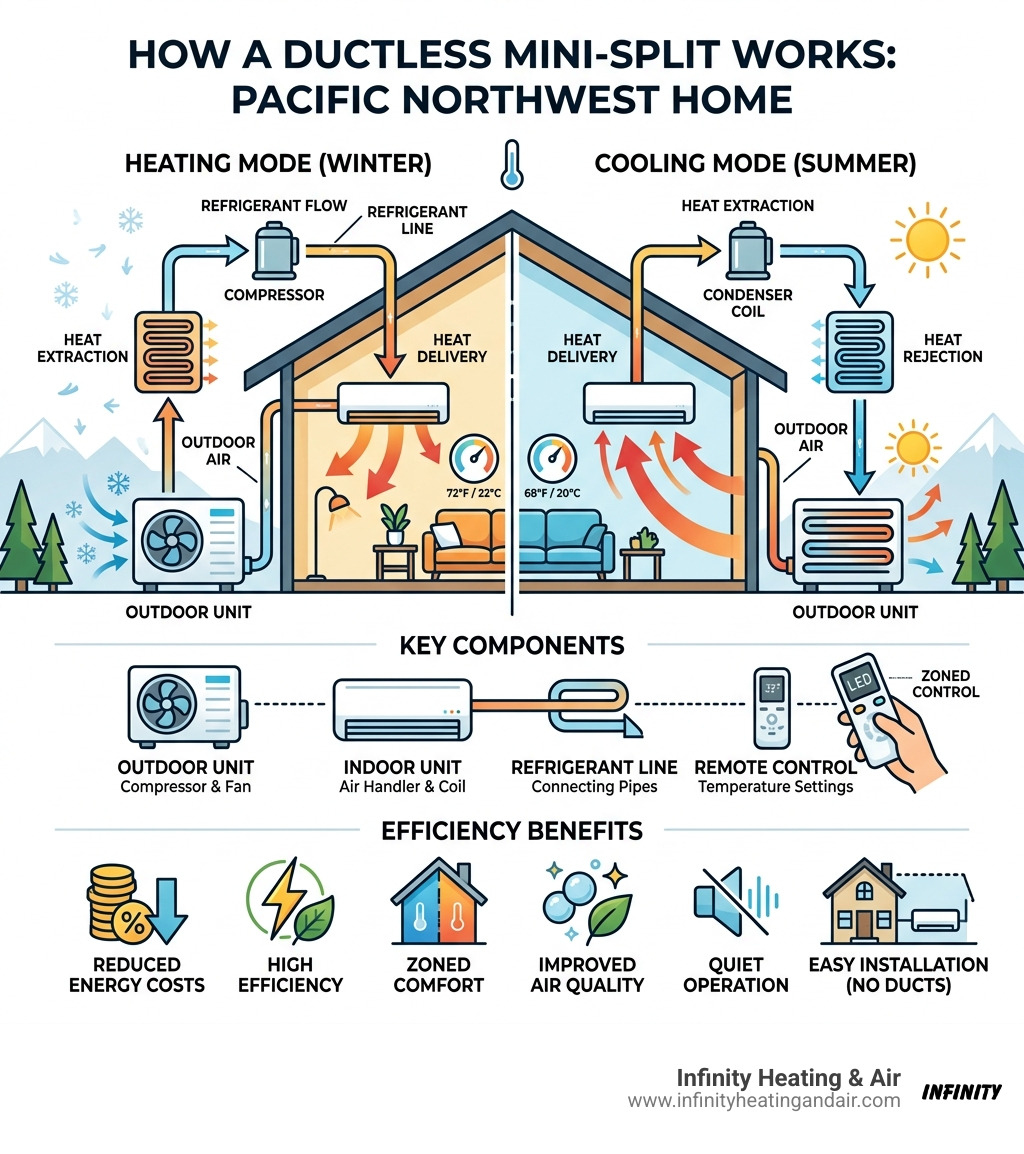
To understand why ductless heating and cooling for Pacific Northwest homes is so effective, we first need to look under the hood. Unlike a furnace that burns fuel to create heat, a ductless system (often called a mini-split) functions as a heat pump. It works by moving heat from one place to another.
The system is comprised of two primary parts: an outdoor compressor/condenser unit and one or more indoor air-handling units. These are connected by a small conduit that houses the power cable, refrigerant tubing, and a condensate drain line. Because there are no bulky ducts involved, the only physical connection needed between the inside and outside of your home is a small, three-inch opening in the wall.
One of the most significant technological leaps in these systems is inverter technology. Traditional HVAC systems are either "on" or "off"—they blast air until the thermostat is satisfied, then shut down completely. This creates uncomfortable temperature swings. Modern ductless systems use variable-speed operation. The inverter allows the compressor to adjust its speed precisely to meet the demand. It’s like using a dimmer switch instead of a standard on/off light switch, which leads to much higher efficiency and more consistent comfort.
If you’re curious about the specific advantages of going ductless, you can read more about Why You Should Install a Ductless Heating System.
The core components of a mini-split system
Inside your home, the air handler is a sleek, compact unit. It contains the evaporator coils, a blower fan, and a multi-stage air filter. As air passes through the unit, it is either heated or cooled and then quietly distributed into the room.
Because each indoor unit operates independently, you have total control over the environment in that specific room. Most systems come with a wireless remote, but as of 2026, smartphone integration is standard. You can adjust the temperature in your living room in Tacoma while you’re still at work in Seattle, ensuring your home is perfectly comfortable the moment you walk through the door.
Understanding the heat transfer process
The magic of a ductless system lies in the refrigerant cycle. In the summer, the system acts like an air conditioner, absorbing heat from your indoor air and "pumping" it outside. In the winter, the process is reversed thanks to a reversing valve. The outdoor unit absorbs heat from the outside air—even when it feels cold to us—and transfers it indoors.
This process is incredibly energy-conservative because moving heat requires far less electricity than generating it through electric resistance or burning fossil fuels. By eliminating the middleman (the ductwork), the system avoids the thermal loss that plagues traditional central air systems.
Why is a ductless heat pump the best choice for the unique Cascadian climate?

The Pacific Northwest, often referred to as the "Cascadian" region, presents unique challenges for HVAC systems. Our "shoulder seasons" are long, our winters are famously damp, and our summers now regularly see record-breaking heat. Ductless heating and cooling for Pacific Northwest homes addresses these variables perfectly.
Efficiency is measured by two main ratings: SEER2 (for cooling) and HSPF2 (for heating). In our region, HSPF2 is particularly important because we use our heating systems for a large portion of the year. While traditional ducted heat pumps usually range from 15.2 to 25 SEER2, mini-splits can reach an incredible 35 SEER2. This translates to massive energy savings over the life of the system.
Furthermore, the zoned comfort provided by ductless systems is a game-changer. If you have a multi-story home in Puyallup or Lacey, you know that the upstairs often stays too hot while the downstairs is chilly. With a ductless setup, you can set the bedroom to a cool 68°F for sleeping while keeping the home office at a cozy 72°F.
To keep these high-efficiency systems running at their peak, regular Mini Split Service is essential, especially given our local humidity levels.
Is ductless heating and cooling for Pacific Northwest homes effective in extreme cold?
A common myth is that heat pumps stop working when the temperature drops. While that may have been true decades ago, modern cold-climate models are specifically engineered for northern latitudes. Many of the systems we install are "extended capacity" models that have been tested in Scandinavia and the coldest parts of Canada.
These systems can maintain 80–85% of their heating capacity at temperatures as low as 5°F, and some models continue to provide heat down to -15°F or even -22°F. They utilize advanced defrost cycles to prevent ice buildup on the outdoor coils, ensuring that even during a rare Puget Sound snowstorm, your home stays warm.
Improving indoor air quality during wildfire season
In recent years, "wildfire season" has unfortunately become a part of life in Washington. When the smoke rolls into the South Sound, keeping your windows closed isn't enough. Traditional forced-air systems can actually pull in outdoor pollutants if the ductwork is leaky.
Ductless systems offer a superior solution. Because they don't rely on ducts, there's no risk of circulating dust or smoke from a crawlspace or attic. Furthermore, many premium units from brands like Panasonic feature nanoe™ X technology. This built-in air and surface purification system uses hydroxyl radicals to inhibit pollutants, capture pet dander, and reduce allergens. It’s an extra layer of protection that helps you breathe easier during the hazy months.
How do ductless mini-splits compare to traditional ducted HVAC systems?
When choosing between a traditional ducted system and a ductless one, the differences are stark.
| Feature | Ductless Mini-Split | Traditional Ducted HVAC |
|---|---|---|
| Energy Waste | Near 0% (No ducts) | Up to 30% (Leaky ducts) |
| Zoning | Individual room control | Single thermostat for whole house |
| Installation | Fast (1-2 days), non-invasive | Extensive, requires ductwork |
| Efficiency (SEER2) | Up to 35 | Typically 15-25 |
| Noise Level | Whisper-quiet (20-25 dB) | Loud (Blower and duct noise) |
Research from the U.S. Department of Energy shows that duct losses can account for more than 30% of energy consumption for heating and cooling. In a traditional system, you are essentially paying to heat your attic or crawlspace. Ductless heating and cooling for Pacific Northwest homes eliminates this waste entirely.
For those looking to transition, our Mini Split Installation & Replacement team can help evaluate if your current home is a candidate for a full conversion or a hybrid approach.
Why ductless heating and cooling for Pacific Northwest homes is the ultimate efficiency upgrade
The financial impact of going ductless is significant. Homeowners in the Pacific Northwest can save up to 50% on their monthly heating and cooling bills when switching from electric baseboard or wall heaters. Even when compared to a traditional gas furnace, the electricity reduction is notable—heat pumps can reduce electricity usage for heating by up to 50%.
Because there is no thermal loss through metal pipes in the walls, every bit of energy you pay for goes directly into the air in your room. This targeted heating ensures you aren't wasting money conditioning guest rooms or basements that aren't being used.
Flexible installation for historic and modern architecture
The Pacific Northwest is home to a beautiful variety of architecture, from historic Craftsman homes in Tacoma to modern ADUs (Accessory Dwelling Units) in Olympia. Many of these older homes were built with radiator or baseboard heat and lack the space for bulky ductwork.
Ductless systems are the ultimate "non-invasive" upgrade. We don't have to tear down walls or drop ceilings to install them. This preserves the aesthetic integrity of historic homes while providing modern comfort. For new builds, like modern "tiny homes" or backyard studios, the small footprint of a mini-split is often the only feasible solution.
Which types of homes in the PNW benefit most from ductless installations?
While almost any home can benefit from a mini-split, certain scenarios make them the clear winner.
- Older Homes: Houses built before central air was common often rely on inefficient electric baseboard or radiant systems. Ductless units are a perfect replacement, offering both heating and cooling in one package.
- Additions and Remodels: If you're adding a sunroom, a master suite, or finishing a basement, extending your existing ductwork is often expensive and can strain your current furnace. A ductless unit provides independent comfort for the new space.
- Homes with Inconsistent Temperatures: If you have that one room that is always freezing in the winter or boiling in the summer, a single-zone mini-split can solve the problem once and for all.
If you already have a system that isn't performing as it should, our experts in Mini Split Repair can diagnose and fix issues to restore your home's comfort.
Solving comfort issues in problem rooms
Many homes in areas like Federal Way or Gig Harbor have "problem rooms"—think of a bonus room over a garage or a sunroom with lots of glass. These areas are rarely served well by a central thermostat. Because a ductless unit has its own thermostat, it can react to the specific heat load of that room (like the sun beating through a window) without affecting the rest of the house.
Ideal applications for secondary dwellings and workspaces
Ductless systems are the gold standard for detached structures. Whether it’s a detached garage in Graham, a guest house in University Place, or a retail space in Puyallup, these units offer a standalone solution. They are also popular in commercial settings like medical offices and restaurants where quiet, reliable climate control is a necessity.
Frequently Asked Questions about Ductless Systems in Washington
We hear a lot of questions from our neighbors in Pierce and Thurston counties about these systems. Here are the facts to help you make an informed decision.
How do I maintain my system?Maintenance is simpler than you might think. Homeowners should clean the filters in the indoor units every few weeks—most are washable and easy to pop out. You should also ensure the outdoor unit is clear of leaves and debris. However, professional tune-ups are vital for longevity. A well-maintained system can last 15 to 20 years.
Are there myths I should know about?One common myth is that they are "ugly." Modern units are incredibly sleek and can be mounted high on a wall, near the floor, or even recessed into the ceiling. Another myth is that they are noisy. In reality, the indoor units operate at sound levels as low as 21 dB—about the same as a whisper or a quiet library.
How long does the installation process take?
One of the biggest advantages of ductless heating and cooling for Pacific Northwest homes is the speed of installation.
- Single-zone systems: Typically take 4 to 8 hours. We can usually have you up and running in a single day.
- Multi-zone systems: Depending on the number of indoor heads (usually 2 to 8), installation may take 1 to 2 days.
Because we don't have to install ductwork, the process is clean and non-intrusive. We pride ourselves on leaving your home as clean as we found it.
Can I control my system with a smart home hub?
Yes! Most modern systems from leading manufacturers come with built-in Wi-Fi capability. You can use proprietary apps like Daikin ONE+ or Mitsubishi Kumo Cloud to monitor your system. Many are also compatible with Alexa and Google Home, allowing for voice control. If you prefer a traditional wall thermostat, those options are available as well.
What brands are best for the Pacific Northwest?
We work with the industry’s most reliable brands because local parts availability and long-term durability matter.
- Daikin: Known for their incredible warranties and inverter technology.
- Mitsubishi: A pioneer in "Hyper-Heating" technology for cold climates.
- Panasonic: Offers advanced nanoe™ X air purification.
- Bryant: Features the Evolution series with excellent SEER2 ratings.
Choosing a reputable brand ensures that if you ever need service in the future, parts will be readily available in the Northwest.
Conclusion
At Infinity Heating & Air, we understand that your home is your sanctuary. Whether you are in Tacoma, Olympia, or anywhere in between, we are dedicated to crafting endless comfort with reliable, expert service. Ductless heating and cooling for Pacific Northwest homes isn't just a trend—it's a smarter, cleaner, and more efficient way to live in our beautiful corner of the world.
With our 24/7 emergency service and flexible financing options, we make it easy to upgrade your home’s climate. Don't let the damp winters or smoky summers dictate your comfort.
Contact our team for a Mini Split consultation today and discover how a ductless system can transform your home.
Written & reviewed by the Infinity Heating & Air team — licensed WA HVAC contractor (INFINHA841B8). Family-owned in Graham, answering 24/7 across the South Sound.
Choose Infinity & enjoy endless comfort.
Your perfect home environment awaits — call (253) 740-5135 or schedule service online and our team will take it from there.
Open 24/7 · 100% Satisfaction Guaranteed · Graham, WA