What to Expect When Your HVAC Tech Is Expecting (to Clean Your Coils)
Discover what does an HVAC maintenance visit include: coil cleaning, refrigerant checks, safety inspections & more for peak efficiency.
What Does an HVAC Maintenance Visit Include? Here's Your Quick Answer
What does an HVAC maintenance visit include is a fair question — and you deserve a straight answer before diving into the details.
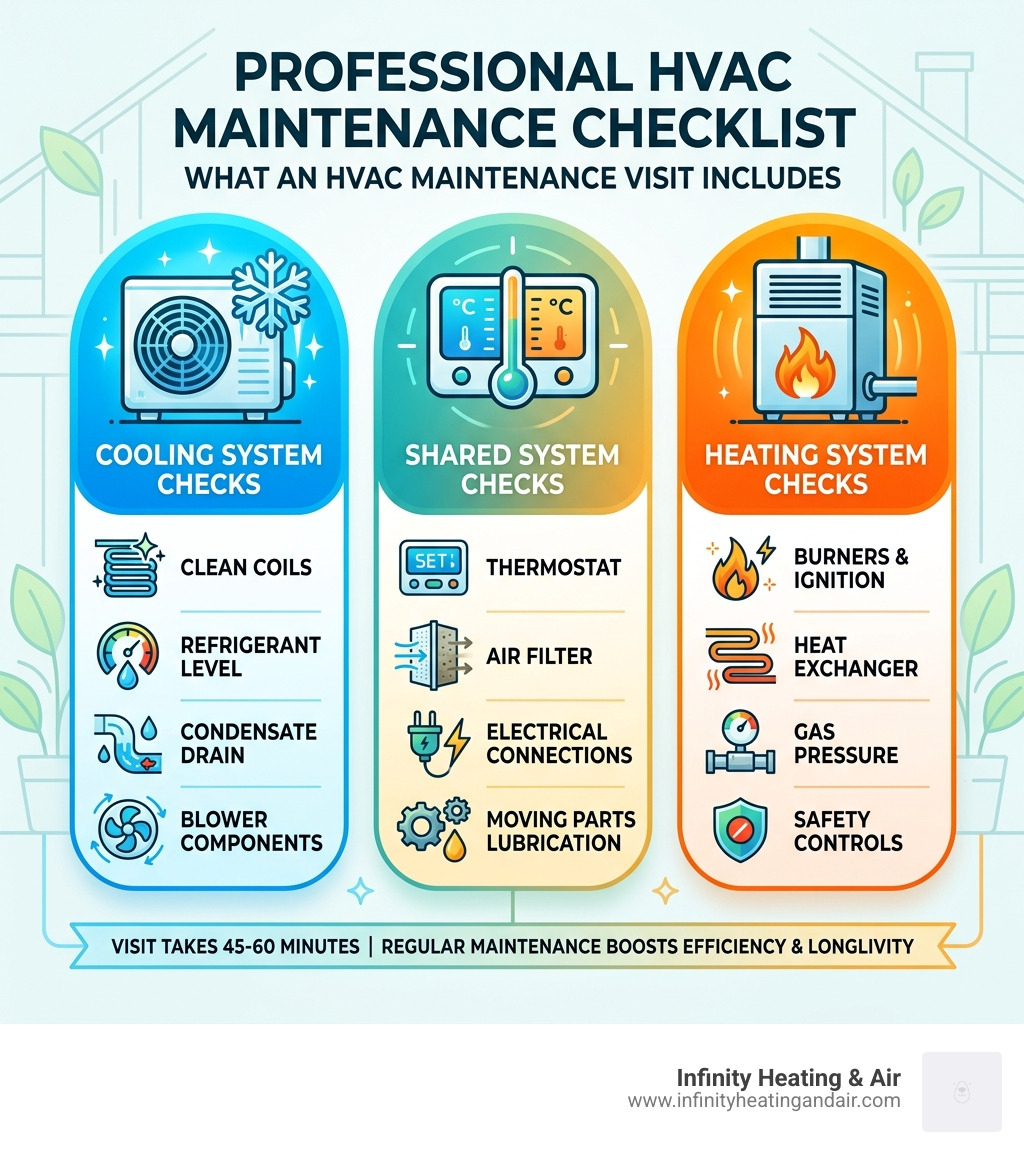
Here's what a standard professional HVAC maintenance visit covers:
| Category | What the Technician Does |
|---|---|
| Thermostat | Tests calibration and settings |
| Air Filter | Inspects, cleans, or replaces |
| Electrical Connections | Tightens connections, measures voltage and amperage |
| Moving Parts | Lubricates motors and bearings to reduce friction |
| Condensate Drain | Clears clogs to prevent water damage and mold |
| Evaporator & Condenser Coils | Cleans to restore heat transfer efficiency |
| Refrigerant Level | Checks for proper charge and leaks (cooling systems) |
| Blower Components | Inspects and adjusts for proper airflow |
| Safety Controls | Tests startup, shutdown, and limit switches |
| Heating Components | Checks burners, heat exchanger, gas pressure, and ignition (heating systems) |
Most visits take 45 minutes to an hour. Anything shorter likely means something got skipped.
Here in Northwest Washington, where winters are damp and summers are increasingly warm, a skipped maintenance visit can mean a system that quits exactly when you need it most. Research consistently shows that regular preventive care can extend the life of an HVAC system by up to 48% — and a clean air filter alone can cut energy use by up to 15%.
Think of it like an oil change for your car. Small, routine care prevents the kind of failures that cost far more to fix than they ever would have cost to prevent.
Why Routine Service is Essential for Your Home’s Comfort
In the South Puget Sound area, we deal with a unique mix of salt air, heavy pollen, and high humidity. These environmental factors aren't just a nuisance; they are actively working against your heating and cooling equipment. When we talk about what does an hvac maintenance visit include, we are really talking about an insurance policy for your home’s comfort.
The stakes of skipping these visits are higher than most homeowners realize. For starters, there is the issue of system longevity. A central HVAC system typically has a lifespan of 15 to 20 years, but that number is based on the assumption that the unit is being cared for. Without it, you might find yourself looking at a full replacement much sooner than expected.
Furthermore, The True Cost of Neglecting HVAC Maintenance often shows up in your monthly utility bills. According to the U.S. Department of Energy, airflow problems can reduce your system's efficiency by up to 15%. When your system has to work harder to push air through a dirty filter or over grimy coils, it consumes significantly more electricity.
There is also the matter of your warranty. Most manufacturers specifically state in their fine print that damage caused by a lack of maintenance is not covered. If your compressor fails in April 2026 and you can't show proof of annual service, you might be stuck paying for the entire repair out of pocket. By investing in HVAC Service Maintenance, you keep that warranty valid and ensure your indoor air quality remains high, protecting your family from the dust and allergens that thrive in unserviced ducts.
What Does an HVAC Maintenance Visit Include for Cooling Systems?
When the warm weather hits places like Tacoma or Puyallup, you want to know your AC is ready to handle the load. A cooling-focused visit is designed to optimize heat transfer. If the heat can’t leave your house efficiently, your home stays warm and your bills go up.
One of the most critical steps in this process is AC Coil Cleaning. Your system has two sets of coils: the evaporator coil (inside) and the condenser coil (outside). If these are coated in dust or Northwest cottonwood fuzz, they can't "breathe." This forces the system to run longer cycles, which creates unnecessary wear and tear.
During a professional visit, we also look closely at refrigerant levels. An AC doesn't "consume" refrigerant; if it’s low, that means there is a leak. Detecting a small leak now is much better than waking up to a warm house in the middle of a July heatwave. We also prioritize clearing the condensate drain lines. Because air conditioners pull moisture out of the air, that water has to go somewhere. If the drain is plugged with algae or debris, it can back up and cause significant water damage to your floors or ceilings.
Following a comprehensive AC Maintenance Checklist ensures that every component, from the blower motor to the fan blades, is balanced and clean. This is especially important for Spring AC and HVAC Maintenance for the South Puget Sound Area, as it prepares the unit for the heavy lifting of summer. We also take a moment to straighten any bent outdoor condenser fins to ensure maximum airflow.
Essential Steps: What Does an HVAC Maintenance Visit Include for Your AC?
Beyond the heavy cleaning, there are several technical calibrations required for a healthy system. We perform AC Service Maintenance that goes deep into the electrical and mechanical guts of the machine:
- Thermostat Calibration: We verify that the temperature your thermostat "sees" is actually what is happening in the room. A miscalibrated thermostat can cause the system to short-cycle or run too long.
- Electrical Connection Tightening: Heating and cooling cycles cause components to expand and contract. Over time, wires can wiggle loose. We tighten these to prevent sparks or component failure.
- Voltage and Amperage Measurements: We measure the "draw" of your motors. If a motor is pulling too much power, it’s a sign that it’s working too hard and might be nearing the end of its life.
- Lubrication of Moving Parts: Friction is the enemy of efficiency. We lubricate bearings and motors to ensure everything spins freely, which reduces the electricity needed to start the system.
- System Controls: We test the start-up and shut-down cycles to ensure the system responds correctly to your commands and safety limits.
Heating System Tune-Ups and Safety Inspections
In Northwest Washington, our heating systems are the real workhorses. Whether you have a furnace or a boiler, Heating Service Maintenance is primarily about two things: efficiency and safety.
The most critical part of a furnace inspection is checking the heat exchanger for cracks. The heat exchanger is the barrier between the fire (and its toxic exhaust gases) and the air you breathe. Even a microscopic crack can allow carbon monoxide to enter your living space. This is why carbon monoxide testing is a non-negotiable part of our visit.
We also focus on Furnace Filter Replacement. A dirty filter doesn't just lower air quality; it can cause a furnace to overheat and shut down as a safety precaution. We clean the burner assembly to ensure a clean, efficient burn and check the gas pressure to make sure the system isn't "over-firing," which can damage the equipment.
For those managing larger properties, our Commercial Heat Pump Maintenance Graham WA Guide highlights how these checks become even more vital when the system is running nearly 24/7 to keep a business comfortable. We also inspect the ignition system—whether it’s a pilot light or a modern hot-surface igniter—to ensure you aren't left in the cold due to a simple starting failure.
Heat Pump Specifics: What Does an HVAC Maintenance Visit Include for Year-Round Systems?
Heat pumps are unique because they work double-duty, providing both heat in the winter and cooling in the summer. Because they run year-round, they require a bit more specialized attention.
When providing Heat Pump Maintenance Tacoma WA Tips, we always emphasize the defrost cycle. In our damp Washington winters, ice can build up on the outdoor coils. The heat pump has to be able to "defrost" itself automatically. If this system fails, the unit will turn into a block of ice and stop heating your home.
During Heat Pump Service Maintenance, we also check:
- The Reversing Valve: This is the "brain" that tells the heat pump whether to be a heater or an air conditioner.
- Auxiliary Heating Strips: These are the backup electric heaters that kick in when it gets exceptionally cold outside. We test them to make sure they work when needed but aren't running unnecessarily (which is very expensive).
- Outdoor Coil Clearance: We ensure that no leaves, snow, or debris are blocking the outdoor unit, as heat pumps need a massive amount of airflow to extract heat from the outside air.
Homeowner DIY Tasks vs. Professional Service
While a professional technician is needed for the technical "heavy lifting," there is plenty you can do to keep your system happy between visits. We encourage our neighbors in places like Lakewood and Olympia to take an active role in their home’s health.
One of the best things you can do is follow a Spring HVAC Checklist Preparing for Summer. This includes simple things like making sure your registers aren't blocked by furniture or curtains. If you have pets or live in a particularly dusty area, you should check your air filters every 30 days.
However, it’s important to know where the DIY ends and the professional service begins. Opening up a furnace or an AC unit involves high-voltage electricity and pressurized chemicals. For your safety and to keep your HVAC Service Plan in good standing, leave the internal components to the experts.
| Task | Homeowner | Professional |
|---|---|---|
| Replace/Clean Air Filters | X | X |
| Clear Debris from Outdoor Unit | X | X |
| Inspect Vents for Obstructions | X | |
| Clean Evaporator/Condenser Coils | X | |
| Tighten Electrical Connections | X | |
| Check Refrigerant Levels | X | |
| Test Safety Controls & CO Levels | X | |
| Lubricate Moving Parts | X |
Frequently Asked Questions About HVAC Service
We get a lot of questions from homeowners in Federal Way and University Place about what happens during these calls. Here are the answers to the most common queries.
How long does a typical maintenance visit take?
A thorough HVAC maintenance visit usually takes between 45 minutes and 90 minutes.
If a technician is in and out of your house in 20 minutes, they likely only performed a "clipboard inspection"—meaning they looked at things but didn't actually clean or test them. A proper visit requires time to take the panels off, scrub the coils, measure the electrical draw of the motors, and run the system through its full performance cycles to ensure everything is operating within manufacturer specifications.
How often should I schedule an HVAC maintenance visit?
The industry standard, which we follow here in Northwest Washington, is twice a year.
Ideally, you should schedule your cooling maintenance in the spring (before the first heatwave) and your heating maintenance in the fall (before the first frost). If you have a heat pump, these two visits are even more critical because the system never gets a "season off." Signing up for a Maintenance Plan is the easiest way to ensure you never forget these dates, as most plans include automatic reminders and priority scheduling.
What are the signs I need an HVAC maintenance visit right away?
You shouldn't always wait for your scheduled appointment if your system is acting up. Watch out for these red flags:
- Unusual Noises: Squealing, banging, or grinding sounds often mean a belt is slipping or a motor bearing is failing.
- Rising Energy Bills: If your electricity or gas bill jumps significantly without a change in weather, your system is likely losing efficiency.
- Uneven Temperatures: If the upstairs is sweltering while the downstairs is freezing, you may have airflow or ductwork issues.
- Musty Odors: This can indicate mold growth in the coils or a clogged condensate drain that is holding stagnant water.
Conclusion
At Infinity Heating & Air, we believe that "endless comfort" starts with a proactive approach to maintenance. Whether you are in Tacoma, Puyallup, or Olympia, your HVAC system is one of the most expensive and important appliances you own. Treating it with the care it deserves ensures that it will be there for you when the Northwest weather does its worst.
Don't wait for a breakdown to find out what's going on inside your system. From safety checks to deep coil cleanings, our team is ready to provide the expert HVAC Service Maintenance you need to keep your home comfortable all year long. Give us a call today to get your system back in peak condition!
Written & reviewed by the Infinity Heating & Air team — licensed WA HVAC contractor (INFINHA841B8). Family-owned in Graham, answering 24/7 across the South Sound.
Choose Infinity & enjoy endless comfort.
Your perfect home environment awaits — call (253) 740-5135 or schedule service online and our team will take it from there.
Open 24/7 · 100% Satisfaction Guaranteed · Graham, WA