What a Better Living Environment Means for Your Family
Discover how designing your home environment improves comfort with science-backed tips on air, temperature, biophilia & HVAC for family well-being.

Why How Designing Your Home Environment Improves Comfort Matters for Your Family
How designing your home environment improves comfort is one of the most impactful things you can do for your family's well-being — and it doesn't require a full renovation to see real results.
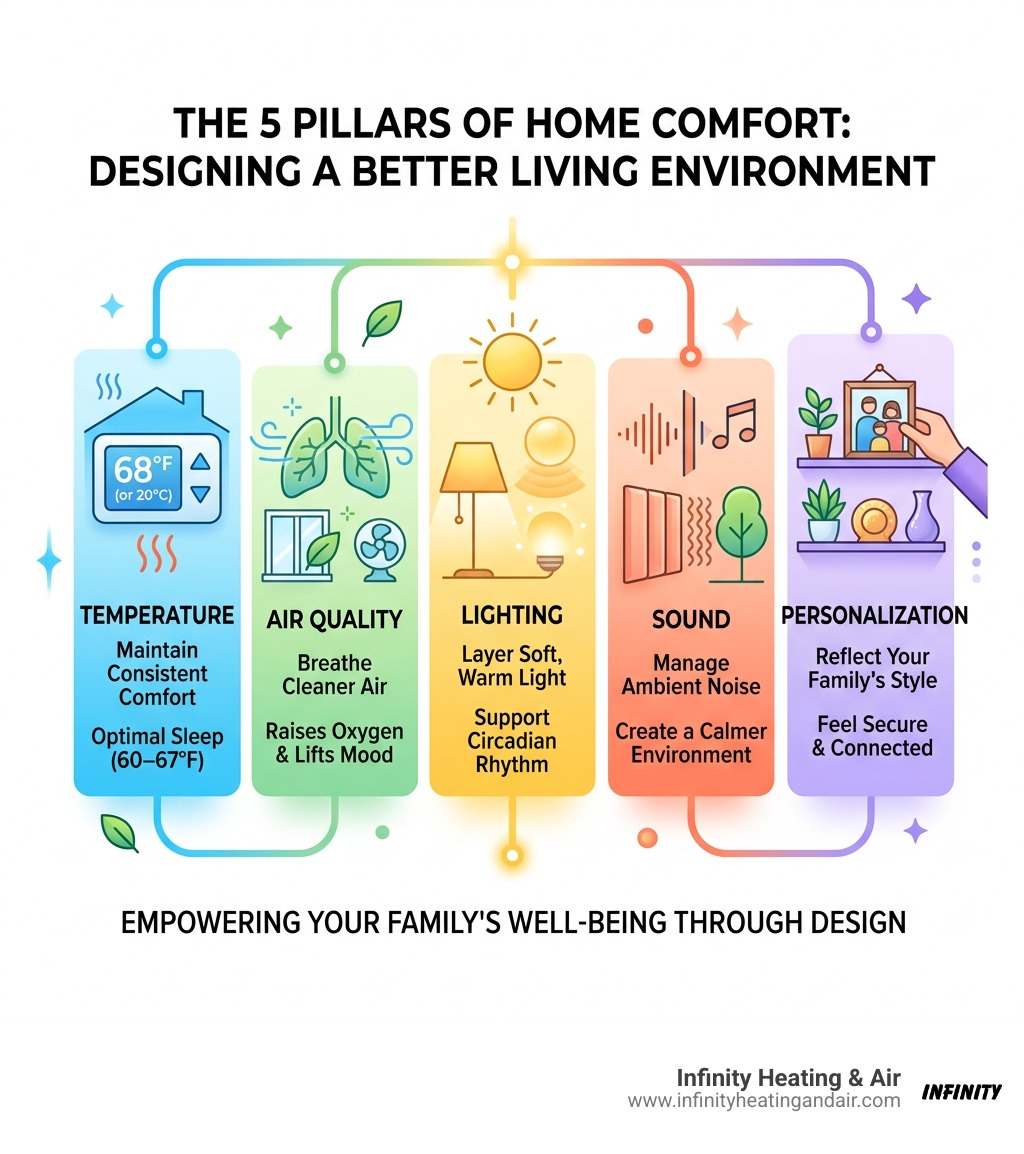
Here's a quick look at the key ways smart home design boosts comfort:
- Temperature control — Maintaining 60–67°F in bedrooms improves sleep quality
- Air quality — Clean indoor air raises oxygen levels, lifts mood, and sharpens focus
- Lighting — Soft, layered warm light supports your body's natural circadian rhythm
- Color and texture — Cool tones like blues and greens can reduce cortisol levels by up to 18%
- Decluttering — An organized space reduces mental noise and helps you feel in control
- Biophilic elements — Plants, natural materials, and daylight reduce stress and improve mood
- Sound management — Absorbing ambient noise creates a calmer, safer-feeling environment
Your home is more than four walls. It's where your body resets after a long day, where your kids wind down, and where your mind either finds calm — or stays on edge.
Research backs this up. Studies show that even small, intentional changes to a living space can reduce stress by more than 20% within a matter of months. The design of your environment directly shapes how you think, sleep, and feel every single day.
For homeowners in Northwest Washington, where weather swings between cold, damp winters and warm summers, getting your indoor environment right is especially important. Temperature, humidity, and air quality aren't just background details — they're the invisible foundation everything else is built on.
The Science of How Designing Your Home Environment Improves Comfort

When we talk about home comfort, we often think of "coziness," but there is a deep scientific layer beneath that feeling. Environmental psychology is the study of how our physical surroundings interact with our minds. Our brains are constantly scanning our environment to see if we are safe, and the design choices we make can either trigger a "fight or flight" response or signal to our nervous system that it is time to relax.
One of the most powerful tools in our design toolkit is biophilic design—the practice of bringing nature indoors. Research shows that humans have an innate biological need to connect with the natural world. When we incorporate plants, natural light, and organic materials like wood or stone, we see a measurable reduction in cortisol, the body’s primary stress hormone.
Evidence-based design takes this a step further by using proven data to influence layout and material choices. For example, research indicates that materials like glass and wood are superior for creating restorative spaces, while excessive use of cold metals can actually increase feelings of anxiety. By focusing on these elements, we can create a "healing environment" that supports mental health. Of course, a beautiful layout only works if the home feels physically comfortable, which is why Advantages of a Custom Designed Comfort System are so vital; they ensure the "bones" of your environment—the air and temperature—match the beauty of your decor.
Psychological Safety and Spatial Flow
Our brains are hardwired with evolutionary preferences. One of the most famous is the concept of "prospect and refuge." This is the idea that we feel most comfortable when we have a clear view of our surroundings (prospect) but also feel protected from behind (refuge). Think of a high-backed reading chair tucked into a corner with a view of the room—that’s classic refuge.
The shapes in our home also matter. Neuropsychological studies show that people generally perceive curved forms as safer and more welcoming than sharp, angular ones. In fact, people tend to linger longer in rooms with curved furniture or architectural details.
Good spatial flow—or "wayfinding"—is another invisible comfort booster. When you can move intuitively through your home without bumping into furniture or backtracking, your brain experiences less "cognitive load." This intuitive movement starts with Understanding the Basics of Your Home Heating System and how your home’s layout affects heat distribution, ensuring there are no "dead zones" that disrupt your sense of ease as you move from room to room.
How Designing Your Home Environment Improves Comfort Through Color and Texture
Color is a direct line to our emotions. If you’ve ever walked into a bright red room and felt a sudden burst of energy (or even irritation), you’ve experienced color psychology. To improve comfort, we often recommend cool tones like soft blues and muted greens. These colors are proven to ease stress and can reduce cortisol levels by up to 18%.
Texture provides what we call "tactile safety." When your feet sink into a plush rug or your hands brush against a soft velvet cushion, your body interprets these sensations as signals of security. We suggest using "sensory anchors"—specific items like a favorite heavy blanket or a textured throw—to help ground you after a stressful day.
A great rule of thumb for balancing these elements is the 60-30-10 rule:
- 60% of the room should be a dominant, calming neutral color.
- 30% should be a secondary color (like a soft blue or green).
- 10% should be an accent color or texture (like wood grains or metallic finishes).
Optimizing the "Invisible Foundations": Air, Temperature, and Sound
You can have the most beautiful home in Tacoma or Puyallup, but if it’s drafty, loud, or smells like stale air, you won't feel comfortable. These "invisible foundations" are often the most critical aspects of how designing your home environment improves comfort.
Acoustic privacy is a major factor in psychological comfort. Spaces that are too loud can cause irritability, while spaces that are too quiet can feel eerie. Using soft materials like drapes, rugs, and even bookshelves can help absorb ambient noise.
Thermal comfort—the state of feeling "just right"—is equally important. If a room is too hot or too cold, it impairs your ability to think clearly and increases stress. This is often where homeowners struggle, as How Ductwork Quality Affects Your Comfort plays a huge role in whether that conditioned air actually reaches you or gets lost in the walls.
Precision Temperature Control for Better Sleep
Sleep is the cornerstone of mental and physical health, and your environment dictates its quality. Our bodies follow a circadian rhythm that is highly sensitive to light and temperature. As we prepare for sleep, our core body temperature naturally drops.
The ideal sleeping temperature for most people is between 60°F and 67°F. If your bedroom is warmer than this, you’re more likely to experience restless sleep or wake up feeling groggy. Many families in Northwest Washington find that their upstairs bedrooms stay too hot in the summer or too cold in the winter. Implementing Seasonal HVAC Preparation Live in Comfort Year-Round ensures your system is calibrated to hit those specific sleep-friendly numbers regardless of the weather in Auburn or Lacey.
Improving Air Quality and Respiratory Health
We spend about 90% of our time indoors, yet indoor air can be significantly more polluted than outdoor air. Exposure to poor air quality isn't just a respiratory issue; it physically changes the brain. A 2022 review found that 95% of studies on air pollution and mental health showed that polluted air negatively impacts brain function, leading to increased symptoms of anxiety and depression.
On the flip side, high-quality air increases oxygen levels in the brain, which boosts mood and focus. For homes in our region, choosing the right filtration and delivery system is key.
| Feature | Central AC / Forced Air | Ductless Mini-Split |
|---|---|---|
| Filtration | Uses a central filter; depends on duct cleanliness | Multi-stage filters in each indoor unit |
| Air Distribution | Can move dust/allergens through ducts | Direct, localized air delivery |
| Zoning | Typically one thermostat for the whole house | Individual temperature control per room |
| Efficiency | High, but loses energy in ductwork | Extremely high; no duct energy loss |
If you suffer from allergies or are concerned about dust, Why You Should Install a Ductless Heating System can be a game-changer, as it eliminates the ductwork where pollutants often hide and provides superior air filtration.
Practical Strategies for a Personalized Sanctuary
Transforming your home into a sanctuary doesn't have to happen all at once. It starts with personalization and the removal of "mental noise." Clutter is a major source of stress; it forces the brain to multitask, even if you aren't consciously looking at the mess.
Mindful cleaning—like taking the time to smell the soap while washing dishes—has been shown to reduce nervousness by 27%. Once the clutter is gone, focus on "eye rest spots." These are areas of the room, like a clean tabletop or a piece of art, where your eyes can land and rest without being overwhelmed by visual information.
When choosing how to heat or cool these personalized spaces, it’s helpful to understand HVAC Unit Types and Which One Works for You so that your equipment matches your lifestyle. A quiet home office might benefit more from a silent ductless unit than a loud central vent.
How Designing Your Home Environment Improves Comfort with Biophilic Elements
Adding nature to your home is one of the fastest ways to improve comfort. This goes beyond just buying a plant (though that helps!).
- Fractal Patterns: Fractals are patterns that repeat at different scales, like the veins in a leaf or the branches of a tree. Our brains find these patterns incredibly relaxing. You can find them in certain wallpapers, textiles, or by simply having plants like ferns in your line of sight.
- Natural Light: Maximize your windows. Natural light regulates your circadian rhythm, keeping you alert during the day and sleepy at night. If you have a room with little light, use mirrors to bounce what light you do have around the space.
- Indoor Plants: Varieties like snake plants or peace lilies don't just look good; they actively scrub toxins from the air.
If you are debating between different cooling methods, a Central AC vs Ductless Mini-Split Comparison can help you decide which system will best support your biophilic goals—for instance, ductless units are often quieter and less intrusive in a nature-focused design.
Frequently Asked Questions about Home Environment Design
How can I improve my home comfort on a small budget?
You don't need a massive budget to make a big difference. Start by decluttering one "stress zone" (like a junk drawer or entryway). Swap out harsh, "daylight" LED bulbs for "warm white" (2700K) bulbs to create a softer evening ambiance. Rearrange your furniture to follow "prospect and refuge" principles—place your favorite chair where you have a view of the door but feel "tucked in." Finally, simply opening your windows for 15 minutes a day can significantly improve indoor air freshness.
What is the ideal humidity level for a healthy home?
The "sweet spot" for indoor humidity is between 30% and 50%. In Northwest Washington, our winters can get very dry (thanks to heating systems), while our summers can get clammy. If humidity is above 60%, you risk mold and dust mite growth. If it’s below 30%, you’ll deal with dry skin, static electricity, and irritated sinuses. Using a hygrometer to monitor these levels is a simple, low-cost way to stay in the comfort zone.
Which room should I prioritize for a comfort redesign?
Always start with the bedroom. Because sleep has the largest ripple effect on your physical and mental health, optimizing your sleeping environment offers the highest return on investment. Once your bedroom is a cool, dark, and quiet sanctuary, move to the "high-traffic" social areas like the living room or kitchen.
Conclusion
At Infinity Heating & Air, we believe that how designing your home environment improves comfort is the secret to a happy, healthy family life. Whether you are in Tacoma, Olympia, Federal Way, or any of our surrounding Northwest Washington communities, your home should be a place where you can truly breathe easy.
From precision temperature control that helps you sleep to advanced air filtration that protects your family's health, we are here to help you build that invisible foundation of comfort. We specialize in crafting custom solutions that fit your home's unique layout and your family's specific needs.
Ready to transform your home into a true sanctuary of endless comfort? Contact our Northwest Washington HVAC experts at Infinity Heating & Air today. Whether you need a system tune-up, a new installation, or 24/7 emergency service, we are here to ensure your home environment is exactly what your family deserves.
Written & reviewed by the Infinity Heating & Air team — licensed WA HVAC contractor (INFINHA841B8). Family-owned in Graham, answering 24/7 across the South Sound.
Choose Infinity & enjoy endless comfort.
Your perfect home environment awaits — call (253) 740-5135 or schedule service online and our team will take it from there.
Open 24/7 · 100% Satisfaction Guaranteed · Graham, WA