Is Your AC Trying to Tell You Something with Those Weird Sounds?
Decode ac making strange noises what they mean! Learn normal vs. urgent sounds, DIY fixes, and when to call pros in Puyallup.
What Your AC's Strange Noises Are Trying to Tell You
If ac making strange noises what they mean is the question on your mind right now, here's a quick answer before we dive deeper:
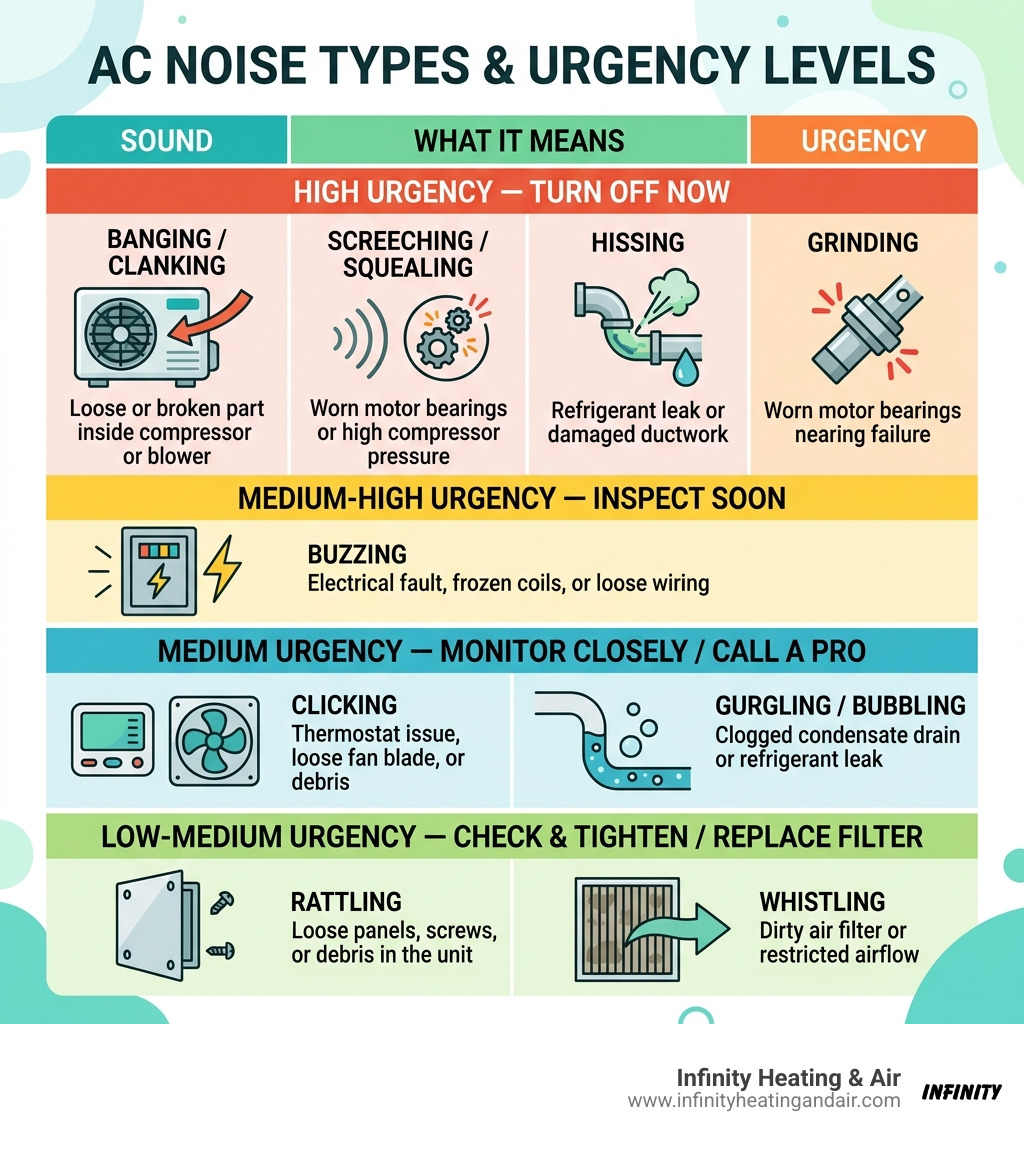
| Sound | What It Likely Means | Urgency |
|---|---|---|
| Banging / Clanking | Loose or broken part inside compressor or blower | High — turn off now |
| Screeching / Squealing | Worn motor bearings or high compressor pressure | High — turn off now |
| Hissing | Refrigerant leak or damaged ductwork | High — turn off now |
| Buzzing | Electrical fault, frozen coils, or loose wiring | Medium-High — inspect soon |
| Clicking | Thermostat issue, loose fan blade, or debris | Medium — monitor closely |
| Rattling | Loose panels, screws, or debris in the unit | Low-Medium — check and tighten |
| Whistling | Dirty air filter or restricted airflow | Low-Medium — replace filter |
| Gurgling / Bubbling | Clogged condensate drain or refrigerant leak | Medium — call a pro |
| Grinding | Worn motor bearings nearing failure | High — turn off now |
Modern AC systems are engineered to run quietly — typically between 25 and 55 decibels, about the level of a quiet conversation. Some high-efficiency indoor units run as low as 19 decibels. You might barely notice them at all.
That's exactly why a new or worsening sound is worth paying attention to. Your AC isn't being dramatic. When it starts making unfamiliar noises, it's usually signaling that something inside needs attention — and catching it early is almost always cheaper and easier than waiting.
In Northwest Washington, where weather swings between damp, cold winters and warm summers, your AC system works hard. Moisture, temperature changes, and debris from trees and wind all put extra stress on components. That stress often shows up first as sound.
Establishing a Baseline: Normal vs. Problematic AC Sounds
To understand ac making strange noises what they mean, we first need to define what "quiet" actually sounds like in April 2026. Most homeowners become so accustomed to the background hum of their HVAC system that they stop "hearing" it altogether. This is your operational baseline.
A healthy air conditioner should produce a steady, gentle whirring from the indoor blower and a consistent hum from the outdoor condenser. You might hear a single, soft click when the system starts or stops—that is simply the contactor engaging or disengaging. You may also hear the "whoosh" of air moving through your vents. These are all signs of a system in peak condition.
| Normal Sounds | Warning Signs |
|---|---|
| Steady, low hum | Loud, rhythmic banging |
| Gentle air whoosh | High-pitched screaming |
| Soft startup click | Rapid, repetitive clicking |
| Quiet vibration | Sizzling or electrical buzzing |
Modern units, such as the Hitachi airHome range, have pushed the boundaries of silence, operating at levels as low as 19dB. To put that in perspective, a quiet conversation is usually around 50dB. If your system suddenly jumps from a whisper to a shout, it’s time for Air Conditioning Diagnostics to identify the culprit before a minor vibration turns into a major mechanical failure.
AC making strange noises what they mean: A Diagnostic Guide
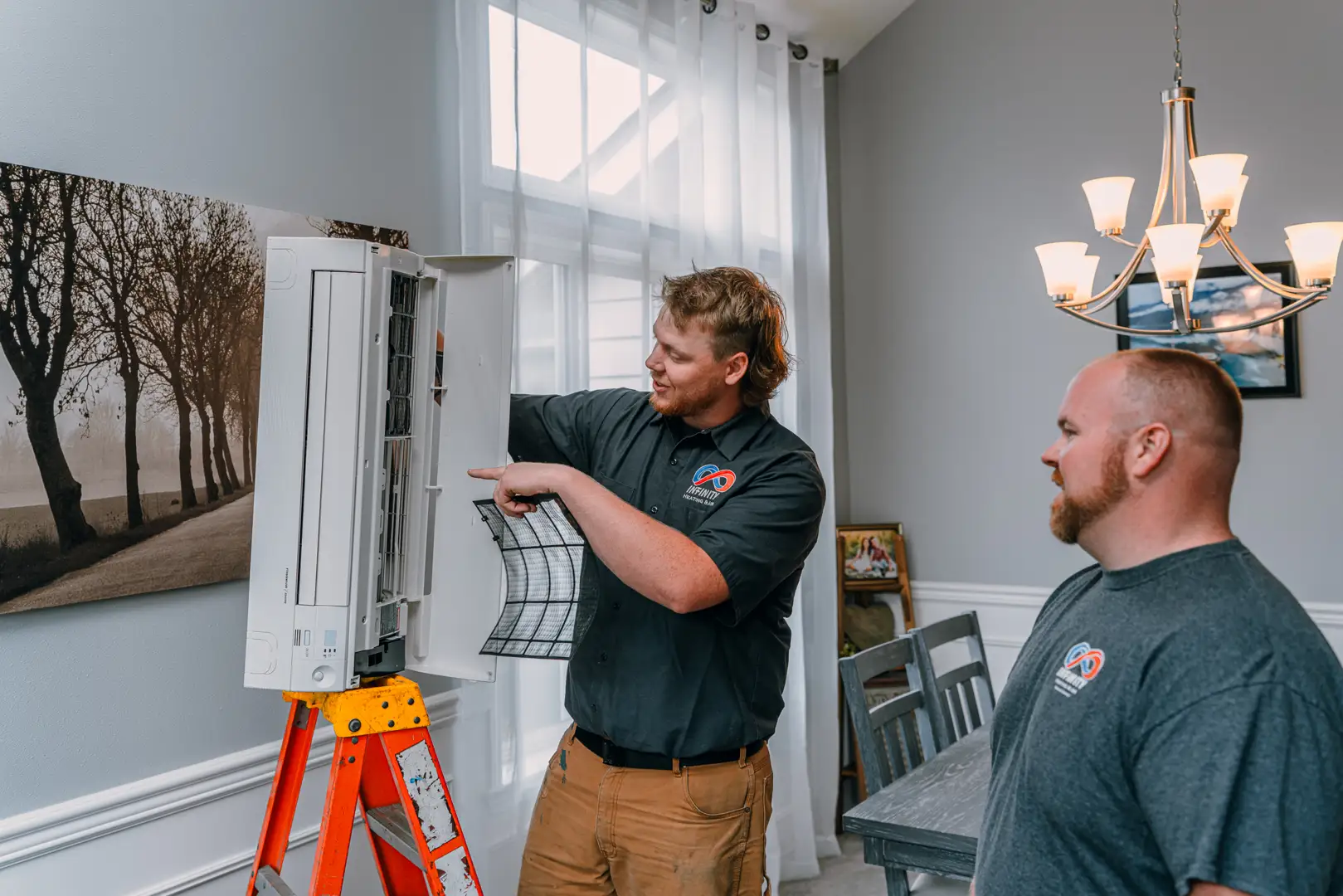
When we talk about ac making strange noises what they mean, we are often translating mechanical "pain" into human language. Most noises stem from three main issues: mechanical failure, loose components, or airflow restrictions. If you hear something new, the first step is to determine where it's coming from—the indoor air handler or the outdoor condenser unit. Identifying the location helps our technicians at Infinity Heating & Air narrow down the potential AC Repair needs quickly.
Identifying ac making strange noises what they mean for indoor air handlers
The indoor portion of your AC system is responsible for moving air through your home. Because it's located inside, often in a closet, attic, or crawlspace, these noises can be particularly distracting.
- Thwapping: If you hear a sound like a playing card in bicycle spokes, something is likely stuck in the blower fan blades. This is often a piece of debris, a loose flap of insulation, or even a small toy that found its way into a return vent.
- Whistling: This "tea kettle" effect is almost always an airflow issue. It happens when the system is "suffocating" because it can't pull enough air through. This is frequently caused by a severely clogged filter or closed dampers. Checking your AC Maintenance Checklist can help you stay ahead of these preventable sounds.
- Clanking: This usually points to a blower assembly that has become unbalanced or a fan blade that has detached and is hitting the housing. If you hear metal-on-metal clanking, turn the system off immediately to prevent the fan from shattering.
Decoding ac making strange noises what they mean for outdoor condenser units
The outdoor unit houses the "heart" of your system: the compressor. This is where the most serious (and potentially expensive) noises occur.
- Banging or Clanking: If your outdoor unit sounds like it’s hosting a drum solo, it often indicates a mechanical failure within the compressor. Internal parts like connecting rods, piston pins, or the crankshaft can break loose and rattle around inside the sealed compressor housing.
- Rattling: In the South Puget Sound area, we see a lot of rattling caused by Northwest Washington's wind and trees. Twigs, pebbles, or fir needles can fall into the unit and get knocked around by the fan blades.
- Grinding: This is the sound of motor bearings that have lost their lubrication. If you catch this early during AC Service Puyallup, we can often lubricate or replace the motor. If you wait until the grinding stops, the motor has likely seized, requiring a full replacement.
High-Urgency Sounds: When to Turn Off Your System Immediately
Some noises are "polite" warnings, while others are emergencies. If you hear the following sounds, do not wait. Go to your thermostat and switch the Air Conditioning system to "Off" immediately. Running a system with these issues is like driving a car with a broken engine rod—it will only lead to catastrophic destruction.
Screeching, Hissing, and Bubbling
- Screeching: A high-pitched scream or screeching sound that lasts for about 15 seconds upon startup often signals dangerously high internal pressure in the compressor. This is a major safety concern. In older systems, it could also be a slipped blower belt, but in modern beltless systems, it’s almost always the compressor or failing motor bearings.
- Hissing: A persistent hissing sound is the classic sign of a refrigerant leak. Refrigerant (like R-410A or Puron) is a hazardous chemical that requires EPA licensing to handle. Leaks can occur in the copper lines, the evaporator coil, or the expansion valve.
- Bubbling: If the hissing sounds more like "gurgling" or finishing a drink through a straw, it means air has entered the refrigerant lines. This can lead to acid formation inside the system, which will eventually eat through the compressor. Prompt AC Coil Cleaning and leak repair are vital here.
Electrical Buzzing and Persistent Clicking
- Buzzing: A loud electrical buzz or sizzling sound is a fire hazard. It often indicates frayed wires, a failing capacitor (the part that gives the motor a "kick" to start), or a stuck contactor relay.
- Persistent Clicking: While one click is normal, rapid-fire clicking indicates an electrical communication issue. The thermostat is trying to tell the system to start, but a relay switch or capacitor isn't responding. This can eventually burn out your control board if left unaddressed. Regular AC Maintenance Puyallup is the best way to catch these electrical gremlins before they leave you in the heat.
Troubleshooting and DIY Fixes for Minor Rattles
Not every noise requires a service call. If you're hearing a low-urgency rattle or whistle, there are a few things you can check safely at home.
- Tighten Loose Panels: The constant vibration of the AC can eventually loosen the screws on the metal panels of your outdoor unit. Grab a screwdriver and ensure everything is snug.
- Clear the Debris: Ensure there is at least a 2-foot clearance around your outdoor condenser. In our area, blackberry vines, tall grass, and fallen leaves can quickly encroach on the unit, causing rattling or restricted airflow.
- Check the Filter: A whistling vent is often just a system "suffocating" behind a layer of dust. Check your air filter; if you can't see light through it, replace it. This is the simplest part of Spring AC and HVAC Maintenance you can do yourself.
- Inspect the Vents: Ensure that at least 80% of your home's supply and return vents are open and unblocked by furniture or rugs. Closed vents increase pressure in the ductwork, leading to whistling and popping sounds.
The Role of Maintenance in Preventing Noisy AC Issues
The vast majority of catastrophic AC failures could have been prevented with a simple tune-up. At Infinity Heating & Air, our AC Service & Maintenance is designed to silence your system before it even starts making noise.
During a professional maintenance visit, we perform several "silencing" tasks:
- Lubrication: We apply non-detergent oil to motor bearings. This prevents the friction that leads to screeching and grinding.
- Electrical Tightening: We check and tighten all electrical connections. Loose wires are a primary cause of buzzing and can lead to dangerous electrical shorts.
- Coil Cleaning: Dirty coils force the compressor to work harder and run louder. We ensure they are pristine for maximum efficiency.
- Refrigerant Check: We verify that your refrigerant levels are exactly where they should be, preventing the bubbling and hissing sounds associated with leaks.
For homeowners in Tacoma, Puyallup, or Olympia, Spring AC and HVAC Maintenance for the South Puget Sound Area is particularly important to clear out the dampness and debris accumulated over the winter months.
Frequently Asked Questions about AC Noises
Is it safe to run my AC if it is making a loud banging noise?
No. A loud banging or clanking noise usually means a metal part has come loose or broken inside the compressor or blower motor. Continuing to run the unit can turn a relatively simple repair into a total system failure. Turn the system off at the thermostat and call us for an inspection.
Why does my air conditioner make a whistling sound like a tea kettle?
This is typically caused by restricted airflow. The most common culprit is a filthy air filter. If the filter is clean, you may have a blockage in your ductwork, a closed damper, or your fan speed may be set too high for your duct capacity.
Can weather conditions in the South Puget Sound cause my outdoor unit to rattle?
Absolutely. High winds in places like Gig Harbor or Sumner can blow twigs and fir needles into the top of the condenser. Additionally, the expansion and contraction of metal ductwork during our temperature swings can cause "popping" or "crackling" sounds, which are generally normal. However, if a rattle persists after the weather clears, it’s worth a professional look.
Conclusion
Your air conditioner is one of the most significant investments in your home comfort. When it’s working perfectly, you shouldn't even notice it's there. But when you start noticing ac making strange noises what they mean, it’s your system’s way of asking for help.
At Infinity Heating & Air, we are Northwest Washington’s experts in crafting endless comfort. Whether you are in Puyallup, Tacoma, Lacey, or anywhere else in the South Puget Sound, our team is ready to help. We offer 24/7 emergency service because we know that AC issues don't always happen during business hours.
With proper care, a modern AC system can last 15 to 20 years. Don't let a small noise shorten that lifespan. If your system is reaching the end of its road and the noises have become constant, we can also assist with AC Installation & Replacement to restore the "Symphony of Silence" to your home.
Ready to silence the screeching and get back to cool, quiet comfort? Contact us today at Infinity Heating & Air!
Written & reviewed by the Infinity Heating & Air team — licensed WA HVAC contractor (INFINHA841B8). Family-owned in Graham, answering 24/7 across the South Sound.
Choose Infinity & enjoy endless comfort.
Your perfect home environment awaits — call (253) 740-5135 or schedule service online and our team will take it from there.
Open 24/7 · 100% Satisfaction Guaranteed · Graham, WA