A Simple Guide to How Your Ductless System Actually Functions
Discover how ductless mini split systems work: cooling/heating cycles, components, sizing, installation & maintenance for efficient home comfort.
What Homeowners in Northwest Washington Need to Know About How Ductless Mini Split Systems Work
How ductless mini split systems work comes down to one simple idea: they move heat instead of making it.
Here's the short version:
- An outdoor unit houses the compressor and condenser
- One or more indoor units contain the evaporator coil and fan
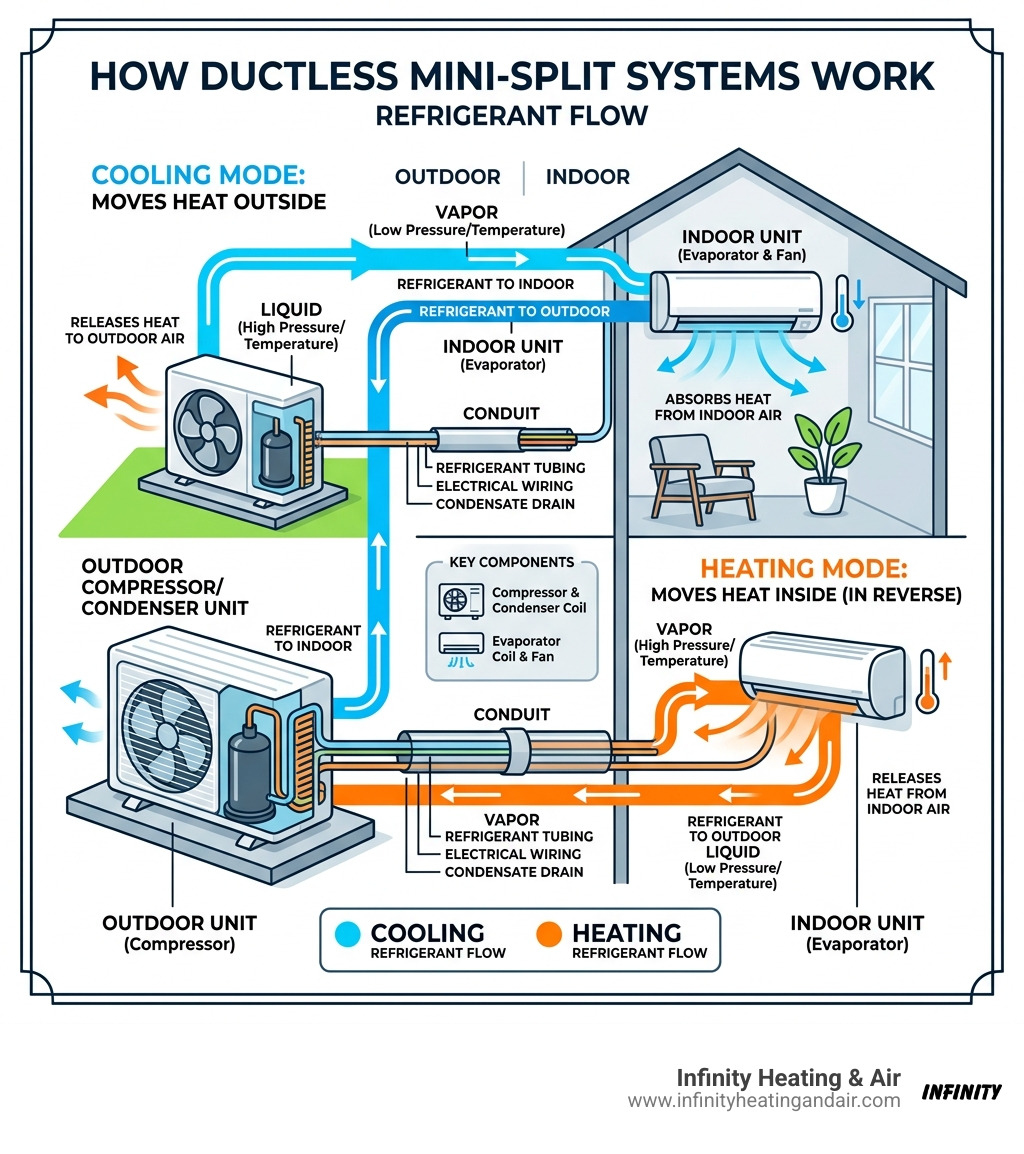
- A conduit (just a 3-inch hole in your wall) connects them with refrigerant tubing, electrical wiring, and a condensate drain
- Refrigerant circulates between the two units, absorbing heat indoors and releasing it outside (cooling mode) — or doing the reverse to heat your home
- Each indoor unit controls its own zone, so you only condition the rooms you're actually using
No ducts. No 20-30% energy loss through leaky ductwork. Just precise, room-by-room comfort.
That's why over 1.75 million American homes have already made the switch — and why mini splits are a natural fit for the varied climates of Northwest Washington.
The sections below walk through every detail: the refrigerant cycle, components, efficiency ratings, sizing, installation, and maintenance. Whether you're retrofitting an older home, finishing a basement, or replacing aging equipment, this guide covers it all.
The Core Mechanics: How Ductless Mini Split Systems Work
To truly understand how ductless mini split systems work, we have to look past the sleek white box on the wall and dive into the science of thermodynamics. At its heart, a Mini Split is a heat pump that utilizes the vapor compression cycle.
Unlike a furnace that burns fuel to generate heat, or a traditional air conditioner that only cools, a mini split is a reversible system. It uses a chemical called refrigerant to "grab" heat from one place and dump it in another. This process is incredibly efficient because moving existing heat requires significantly less electricity than creating it from scratch.

The system relies on the physical property of refrigerants to change states from liquid to gas and back again. When a liquid evaporates into a gas, it absorbs a massive amount of heat. When that gas condenses back into a liquid, it releases that heat. By controlling where these phase changes happen, we can control the temperature of your home in Tacoma or Olympia.
The Cooling Cycle: How Ductless Mini Split Systems Work to Remove Heat
When you set your thermostat to "cool" on a humid July afternoon in Puyallup, the indoor unit goes to work. Inside that wall-mounted head is an evaporator coil. Cold, liquid refrigerant flows through this coil while a quiet fan pulls warm air from your room across it.
As the air passes over the cold coils, two things happen:
- Heat Absorption: The refrigerant inside the coil absorbs the heat from your indoor air, causing the refrigerant to evaporate into a gas.
- Dehumidification: Moisture in the air hits the cold coil and condenses into water droplets. This water collects in a pan and exits your home via the condensate drain.
The now-warm refrigerant gas travels through the conduit to the outdoor unit, where the compressor squeezes it, raising its temperature even higher so it can dump that heat into the outdoor air—even if it's already warm outside!
The Heating Cycle: How Ductless Mini Split Systems Work in Cold Weather
This is where the magic happens. In the winter, a component called the reversing valve flips the flow of the refrigerant. Now, the outdoor unit acts as the evaporator. It might seem strange to think about "extracting heat" from 40-degree air in Lacey, but there is actually plenty of thermal energy available even in cold temperatures.
Modern systems are engineered to maintain high heating capacity even when temperatures drop well below freezing. The refrigerant absorbs ambient heat from the outdoor air, is compressed to a high-temperature gas, and is sent indoors. The indoor unit then releases that heat into your living room. This year-round versatility makes mini splits the "Swiss Army Knife" of HVAC.
Breaking Down the Main Components of a Mini Split
A mini split system is elegantly simple, consisting of four primary parts that work in perfect harmony. If any of these components aren't performing correctly, you might notice a drop in comfort, which is why regular Mini Split Service is so important.
- The Outdoor Compressor/Condenser: This is the "engine" of the system. It sits outside your home and handles the heavy lifting of compressing the refrigerant and circulating it through the lines.
- The Indoor Air Handler: This is the unit you see inside. It contains the fan, the evaporator coil, and the air filters.
- The Conduit: This is the umbilical cord of the system. It houses the power cable, refrigerant tubing, suction tubing, and the condensate drain line.
- The Line Set: These are the copper tubes that carry the refrigerant back and forth between the indoor and outdoor units.
Inverter Technology and Efficiency Ratings
One of the biggest secrets to how ductless mini split systems work so efficiently is inverter technology. Traditional HVAC systems are either "on" or "off." They blast at 100% capacity until the house reaches the target temperature, then they shut down. This is like flooring the gas pedal on your car and then slamming on the brakes at every red light.
Inverter-driven compressors are "variable speed." They can slow down or speed up to match the exact heating or cooling load of the room. Once they reach the desired temperature, they cruise along at a low energy state to maintain it. This prevents the energy-intensive "startup" spikes and keeps your home at a much more consistent temperature.
When shopping for a system, keep an eye on these ratings:
- SEER2 (Seasonal Energy Efficiency Ratio): Measures cooling efficiency. Higher is better. Some ductless units reach a staggering 35+ SEER2.
- HSPF2 (Heating Seasonal Performance Factor): Measures heating efficiency.
- ENERGY STAR: Look for this label to ensure the unit meets strict federal efficiency guidelines.
| System Type | Typical SEER2 Range | Energy Loss via Ducts |
|---|---|---|
| Standard Central AC | 14 - 20 | 20% - 30% |
| Ductless Mini Split | 15 - 35+ | 0% |
Indoor Unit Styles and Placement
Ductless doesn't have to mean "big white box on the wall." While wall-mounted units are the most common and cost-effective, we have several options to fit the aesthetic of your Northwest Washington home:
- Wall-Mounted: High on the wall, out of the way, and excellent for airflow.
- Ceiling Cassette: These sit flush with your ceiling, showing only a decorative grille. They are perfect for a sleek, modern look.
- Floor-Mounted: Ideal for rooms with low windows or slanted ceilings (like attics). They look similar to a traditional radiator but much slimmer.
- Slim Duct: These are hidden in a closet or above a ceiling, using very short duct runs to serve one or two small rooms. This gives you the ductless "feel" with a completely hidden appearance.
Single-Zone vs. Multi-Zone: Customizing Your Home Comfort
One of the most compelling reasons to learn how ductless mini split systems work is the concept of zoning.
In a single-zone system, one outdoor unit connects to one indoor unit. This is perfect for a garage workshop in Federal Way or a new sunroom addition in Gig Harbor.
In a multi-zone system, a single outdoor compressor can power up to five (and sometimes more) indoor units. Each of these units is controlled by its own thermostat. This means you can keep your bedroom at a crisp 68 degrees while the guest room stays at 72. Why You Should Install a Ductless Heating System often comes down to this: you stop wasting money heating and cooling empty rooms.
Sizing Your System for Maximum Performance
Sizing is the most critical part of the design process. If a unit is too small, it will run constantly and never get the room comfortable. If it is too large, it will "short cycle," turning on and off rapidly. This prevents the unit from properly dehumidifying the air and puts massive wear and tear on the compressor.
We calculate the necessary BTU (British Thermal Units) capacity based on:
- Square Footage: The primary factor.
- Ceiling Height: Higher ceilings mean more air to condition.
- Insulation Quality: Better insulation requires fewer BTUs.
- Window Placement: South-facing windows in the summer add a significant heat load.
A general rule of thumb is that 12,000 BTUs can handle roughly 400-650 square feet, but a professional load calculation is always necessary for a perfect fit.
Professional Installation and Long-Term Maintenance
The beauty of a mini split is the "non-invasive" installation. Unlike central air, which requires tearing open walls to run bulky ductwork, a mini split requires only a small three-inch hole to pass the conduit through.
However, don't let the small hole fool you—this is not a DIY project. Mini Split Installation & Replacement requires handling high-voltage electricity and pressurized refrigerant. A professional ensures the line sets are properly flared and vacuum-tested to prevent leaks that could damage the environment and your system's efficiency.
Keeping Your System Running for 20 Years
A high-quality mini split can last two decades if you treat it right. Because these systems don't have ducts to hide dust and mold, the maintenance is actually quite straightforward for the homeowner:
- Clean the Filters: Most indoor units have washable filters. You should pop them out and rinse them every 4-6 weeks (more often if you have pets).
- Clear the Outdoor Unit: Ensure leaves, snow, or shrubs aren't blocking the airflow to the outdoor compressor.
- Annual Professional Tune-ups: Once a year, have a technician perform a deep clean of the coils and check the refrigerant charge. If you ever notice a weird smell or a drop in performance, don't wait—call for Mini Split Repair immediately to prevent a small issue from becoming a total system failure.
Frequently Asked Questions about Ductless Mini Splits
Do mini splits pull air from the outside?
No. This is a common myth! Mini splits recycle the air already inside your home. The conduit only carries refrigerant and electricity; it does not move air. The unit pulls air in from the room, passes it over the heating or cooling coils, and pushes it back out.
How do I properly size a mini split for my room?
While you can use BTU charts based on square footage (e.g., 9,000 BTUs for a standard bedroom), we look at the "whole picture." This includes your home's insulation, the number of windows, and even how many people typically use the room. We use specialized software to ensure your system is perfectly sized.
Can a mini split replace my central furnace?
In many cases, yes! Modern "hyper-heating" mini splits are designed to be primary heat sources in cold climates. However, some homeowners in the Pacific Northwest choose to keep their old baseboard heaters or furnace as a "backup" for those rare, extreme weather events, though they rarely need to turn them on.
Conclusion
Understanding how ductless mini split systems work is the first step toward a more comfortable, energy-efficient home. By moving heat instead of generating it and eliminating the "energy tax" of leaky ducts, mini splits offer a level of comfort that traditional systems simply can't match.
At Infinity Heating & Air, we are proud to be the Northwest Washington experts in ductless technology. From the initial design in Tacoma to a precision installation in Olympia, we are dedicated to crafting endless comfort for our neighbors. If you're ready to experience the quiet, zoned efficiency of a Mini Split, we're here to help you every step of the way.
Written & reviewed by the Infinity Heating & Air team — licensed WA HVAC contractor (INFINHA841B8). Family-owned in Graham, answering 24/7 across the South Sound.
Choose Infinity & enjoy endless comfort.
Your perfect home environment awaits — call (253) 740-5135 or schedule service online and our team will take it from there.
Open 24/7 · 100% Satisfaction Guaranteed · Graham, WA