Ductless vs Central HVAC for Your New Home Addition
Discover ductless vs central HVAC for home additions. Compare efficiency, zoned control & costs for Northwest Washington additions. Get expert advice!
Choosing the Right HVAC System for Your Home Addition in Northwest Washington
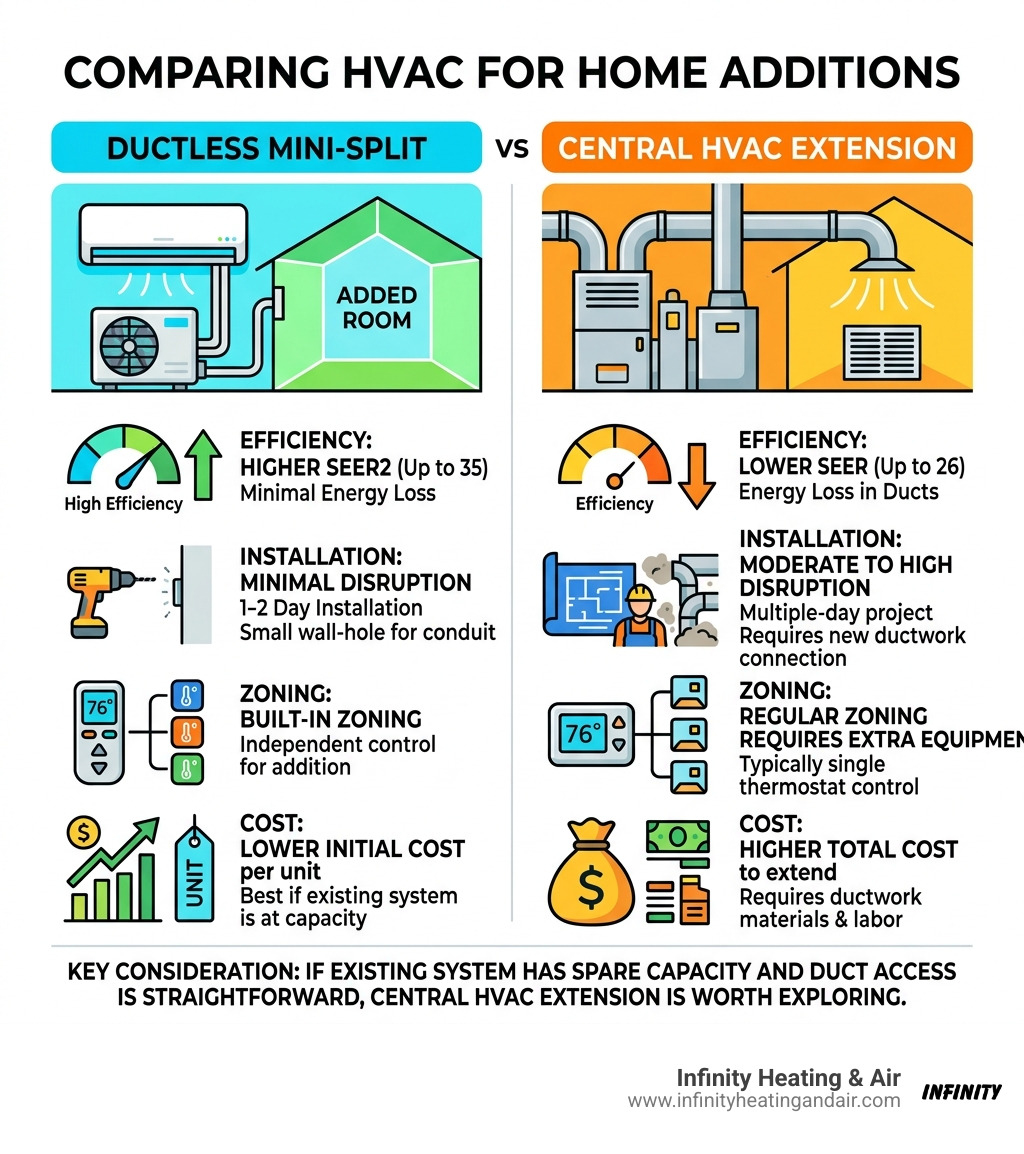
Ductless vs central HVAC for home additions is one of the most important decisions you'll face when expanding your home. The short answer: ductless mini-splits are usually the better fit for most additions, but extending central HVAC makes sense if your existing system has spare capacity and ductwork access is straightforward.
Here's a quick side-by-side to help you decide:
| Factor | Ductless Mini-Split | Central HVAC Extension |
|---|---|---|
| Best for | Sunrooms, garages, detached spaces | Integrated additions with duct access |
| Installation disruption | Minimal (1-2 days) | Moderate to high (several days) |
| Energy efficiency | Higher (up to 35 SEER2) | Lower (up to 26 SEER) |
| Ductwork required | No | Yes |
| Zoned control | Built-in | Requires extra equipment |
| Works for heating too | Yes (heat pump) | Only if existing system heats |
| Ideal when existing system is at capacity | Yes | No |
Home additions create a unique challenge. Your new space needs reliable year-round comfort, but it may be far from your main unit, separated by walls, or simply too much load for your current system to handle — especially during Northwest Washington's cold winters and warm summers.
Getting this decision wrong means either an uncomfortable room or a strained system that fails sooner than it should.
The sections below walk you through everything you need to make a confident choice.
Understanding the Core Differences: Ductless vs Central HVAC for Home Additions
When we look at ductless vs central hvac for home additions, we are essentially comparing two different philosophies of air distribution. To make the best choice for your home in Tacoma, Puyallup, or Olympia, it helps to understand the HVAC basics that drive these systems.
A central HVAC system is a "whole-house" solution. It uses a single large outdoor compressor and a centralized indoor air handler (often part of your furnace) to condition air. This air is then pushed through a complex network of ducts hidden behind your walls and ceilings. It relies on a single thermostat to tell the entire house when it’s time to cool down or warm up.
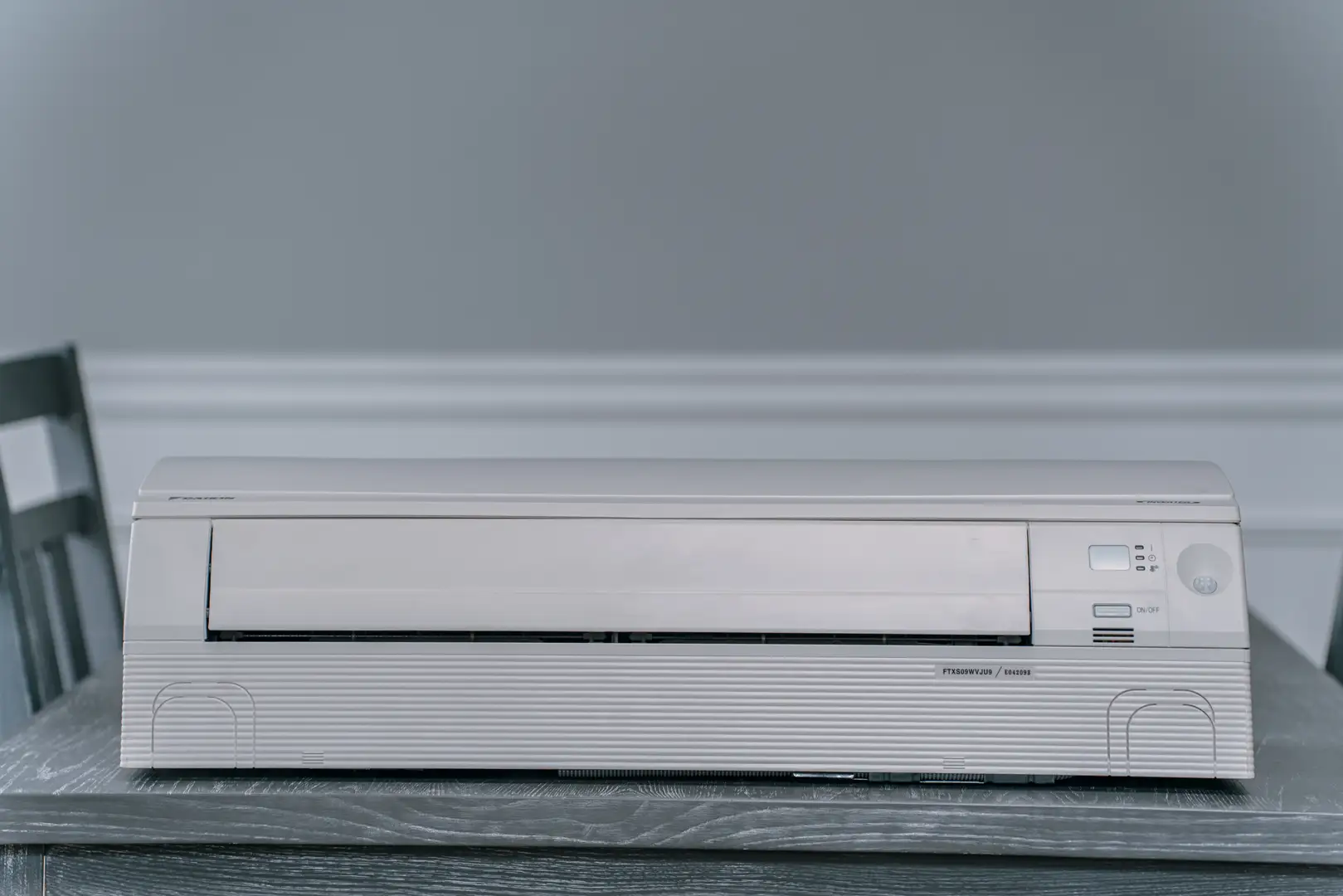
In contrast, a ductless system—often called a mini-split—is a "point-of-use" solution. It also has an outdoor compressor, but instead of large ducts, it uses small refrigerant lines to connect directly to one or more indoor air handlers mounted on the wall or ceiling of the specific room you are conditioning.
How Ductless Mini-Splits Work in New Spaces
A Mini Split is incredibly efficient because it skips the middleman: the ductwork. The system consists of an outdoor unit and an indoor unit connected by a conduit. This conduit houses the power cable, refrigerant tubing, and a condensate drain.
For a new home addition, this means we only need to drill a small, three-inch hole in your exterior wall to connect the two units. Because each indoor unit has its own thermostat, the addition becomes its own independent zone. You can keep your new sunroom at 72 degrees without affecting the temperature in the rest of your home.
Extending Central HVAC to Your Addition
Extending your current system involves Ductwork Installation & Replacement to bring air from your existing furnace or AC into the new room. While this sounds simple, it is a delicate engineering task.
We have to consider "static pressure"—the resistance to airflow within the ducts. If we add too much ductwork, the blower motor in your existing unit might not be strong enough to push air all the way to the end of the line. Furthermore, we must ensure a proper "airflow balance." This means adding not just a supply register to blow air in, but also a return vent to pull air back out. Without a return, the new room can become a "pressure cooker" of stale air that never feels quite right.
When to Choose a Mini-Split for Your Addition
In our experience serving Northwest Washington, there are specific scenarios where a ductless system is the clear winner. Many homeowners ask why you should install a ductless heating system, and the answer usually comes down to flexibility and efficiency.
- Sunrooms: These rooms have a high "glass-to-wall" ratio, meaning they heat up fast in the sun and cool down fast at night. A mini-split can react quickly to these temperature swings without forcing your main house system to run.
- Garages and Workshops: If you're converting a garage into a gym or hobby shop, you likely don't want to share air with the rest of the house (to keep smells or dust out of the living room). A ductless unit provides isolated comfort.
- Basements: Since heat rises, basements are notoriously difficult to balance with a main floor system. A dedicated mini-split ensures the basement stays cozy during our damp Washington winters.
Energy Efficiency and Zoned Control
One of the biggest advantages of ductless vs central hvac for home additions is efficiency. Statistics show that 20% to 30% of conditioned air is lost through leaks and poor connections in ductwork. By eliminating ducts, mini-splits deliver 100% of the air they condition directly into the room.
Modern mini-splits use inverter technology, which acts like a dimmer switch for your HVAC. Instead of turning full-on and full-off (which wastes energy), the variable-speed compressor adjusts its speed to maintain a perfect, steady temperature. This allows some ductless units to reach staggering efficiency ratings of up to 35 SEER2, compared to the 16 to 26 SEER2 range typical of central systems.
Factors Influencing Ductless vs Central HVAC for Home Additions
When we visit a home in Federal Way or Gig Harbor for an assessment, we look at several key factors:
- Distance: Is the addition on the opposite side of the house from the furnace? Long duct runs lose significant heating and cooling power.
- Structural Limitations: Is there a vaulted ceiling or a concrete slab that makes running new ducts impossible?
- Usage Patterns: Will this room be used every day, or only when guests stay over? Ductless allows you to turn the unit off entirely when the room is empty.
Evaluating Your Existing System for a Central Extension
Before you decide to tap into your existing system, we must perform a "Manual J load calculation." This is a professional assessment of how much heating and cooling your home actually needs based on square footage, insulation, and window placement.
Most central systems are sized specifically for the original footprint of the home. If we add a 500-square-foot addition, your existing furnace might become undersized. An undersized system will "short cycle," turning on and off rapidly, which leads to higher energy bills and a shorter equipment lifespan. This is why regular HVAC Service & Maintenance is so vital; we can tell you exactly how much "spare" capacity your current system has left.
| Feature | Ductless Mini-Split | Central HVAC Extension |
|---|---|---|
| Installation Timeline | 1 - 2 Days | 3 - 7 Days |
| Wall/Ceiling Cutting | One 3-inch hole | Significant cutting for ducts |
| Permit Requirements | Standard electrical/mechanical | May require structural review |
| Noise Level | Whisper quiet (19-26 dB) | Audible airflow at registers |
Impact of Ductless vs Central HVAC for Home Additions on Air Quality
Air quality is a major concern for Northwest Washington families, especially during allergy season or wildfire smoke events.
Central systems rely on a single filter. Over time, dust, pet dander, and allergens can accumulate inside the ductwork, where they are recirculated throughout the house every time the fan kicks on.
Ductless units, however, have multi-stage filtration built into each indoor head. Because there are no ducts to collect dust, the air stays cleaner. Many mini-split units also feature advanced dehumidification modes, which are excellent for preventing that "musty" basement smell during our rainy months.
Performance and Lifestyle Considerations for 2026
As we look toward the comfort standards of 2026, noise and aesthetics play a bigger role than ever. Modern mini-splits are designed to be "whisper quiet," often operating at decibel levels lower than a human conversation. This makes them ideal for home offices or nurseries where silence is golden.
Aesthetics are often the only area where central HVAC has an edge. With central air, the only thing visible is a small floor or ceiling register. Mini-splits require a unit mounted on the wall. However, modern designs are sleek and slim, and there are even "ceiling cassette" options that sit flush with the ceiling for a nearly invisible look.
From a resale perspective, both systems add value. A well-installed mini-split is seen as a premium "zoned" upgrade, while a central extension shows that the addition was fully integrated into the home's original design.
Maintaining Your Ductless vs Central HVAC for Home Additions
Maintenance requirements differ slightly between the two. For a central system, you’ll need to change the main filter every 1–3 months and have the ducts professionally cleaned every few years.
For a ductless system, the maintenance is even simpler but more frequent. You should pop open the front panel and rinse the reusable filters every 2–4 weeks. Beyond that, both systems require an annual professional tune-up to ensure the refrigerant levels are correct and the electrical components are safe.
Frequently Asked Questions about HVAC for Additions
Can a mini-split provide both heating and cooling for year-round comfort?
Absolutely. Most modern mini-splits are "heat pumps," meaning they can reverse the refrigeration cycle. In the summer, they move heat from inside to outside. In the winter, they can extract heat from the outdoor air (even when it's cold!) and move it inside. They are incredibly effective for Northwest Washington's climate.
Will extending my ductwork strain my current furnace or air conditioner?
It definitely can. If your current system is already 10–12 years old, it was likely designed to handle exactly the square footage you had when it was installed. Adding more space without upgrading the unit can cause it to work overtime, leading to a breakdown in the middle of a cold snap.
Which system is better for a detached addition like a guest suite or ADU?
Ductless is almost always the answer here. Running insulated ductwork underground to a detached building is extremely expensive and results in massive energy loss. A standalone mini-split is the industry standard for Accessory Dwelling Units (ADUs) and guest houses.
Conclusion
At Infinity Heating & Air, we believe in "endless comfort." Whether you are in Auburn, Puyallup, or Tacoma, choosing between ductless vs central hvac for home additions doesn't have to be a headache.
If your addition is an integrated part of your home and your current HVAC system is relatively new with plenty of power, extending your ductwork might be the most seamless option. However, if you want maximum energy efficiency, independent temperature control, and a quick, non-invasive installation, a ductless mini-split is the 2026 standard for modern home comfort.
Don't guess when it comes to your home's air quality and temperature. Let our Northwest Washington experts provide a professional assessment to ensure your new space is the sanctuary you intended it to be.
Schedule your consultation for a new mini-split today with Infinity Heating & Air and experience the difference that expert service makes.
Written & reviewed by the Infinity Heating & Air team — licensed WA HVAC contractor (INFINHA841B8). Family-owned in Graham, answering 24/7 across the South Sound.
Choose Infinity & enjoy endless comfort.
Your perfect home environment awaits — call (253) 740-5135 or schedule service online and our team will take it from there.
Open 24/7 · 100% Satisfaction Guaranteed · Graham, WA