Duct Sealing Tips to Boost Performance and Save Big
Discover how leaky ducts waste energy and money. Seal leaks, boost HVAC efficiency, cut bills in Northwest Washington homes!
How Leaky Ducts Waste Energy and Money — And What You Can Do About It
How leaky ducts waste energy and money is simpler to understand than most homeowners think. Here's the short version:
The quick answer:
- Leaky ducts let conditioned air escape into attics, crawlspaces, and wall cavities before it reaches your living rooms
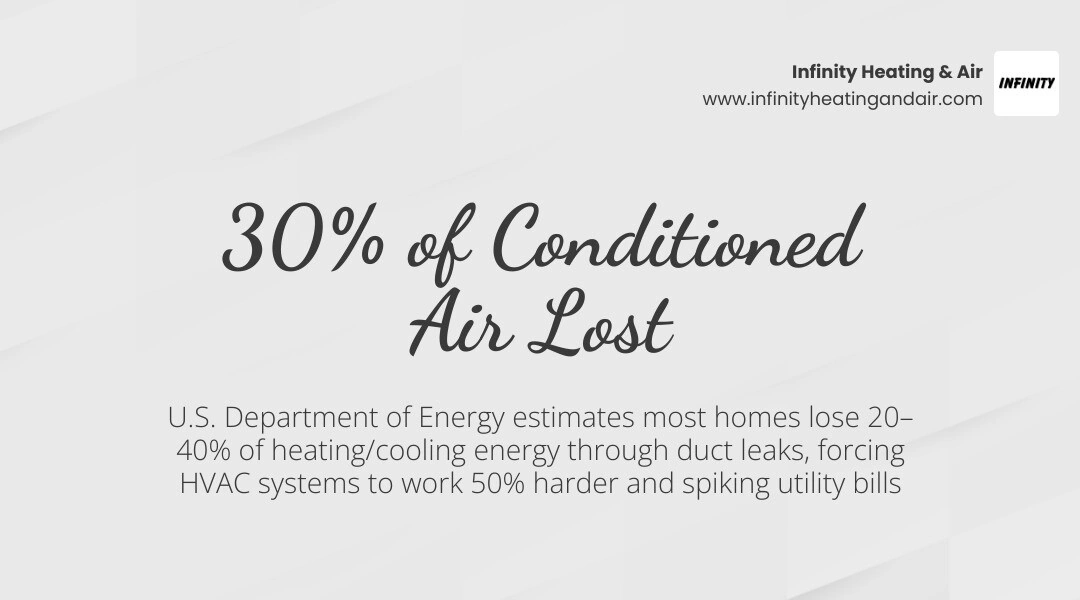
- The U.S. Department of Energy estimates most homes lose 20–30% of conditioned air through duct leaks
- Some systems lose up to 40% of heating and cooling energy this way
- Your HVAC has to run longer and work harder to compensate — driving up energy bills every month
- Sealing your ducts can cut heating and cooling costs by 20–40%
Your duct system is basically a highway for conditioned air. When that highway has potholes — gaps, loose joints, tears — the air you paid to heat or cool leaks out before it ever reaches you.
For homeowners in Northwest Washington, where winters are cold and heating systems run hard, those leaks add up fast. A duct system losing just 20% of airflow forces your HVAC to work 50% harder to keep up. That means more wear on your equipment, higher utility bills, and rooms that never quite feel comfortable.
The frustrating part? Most duct leaks are completely hidden. They're in your attic, behind walls, or under your floors — out of sight and easy to ignore until the energy bills tell a different story.
Understanding How Leaky Ducts Waste Energy and Money
To fix a problem, we first have to understand what it looks like. In a perfect world, your HVAC system would be a "closed loop." The air handler pushes warm or cool air through the supply ducts, it arrives in your room, and the return ducts pull it back to be filtered and re-conditioned.
However, most homes in areas like Tacoma, Puyallup, and Olympia are far from perfect. Over time, the materials that hold your ducts together — like old tape or staples — begin to fail. When this happens, your system becomes an "open" system. Instead of circulating air within your living space, it starts dumping expensive, conditioned air into your attic or crawlspace.

This creates a massive efficiency gap. Think of it like trying to drink through a straw that has five or six tiny holes in it. You have to suck twice as hard just to get a sip. That is exactly what your furnace or heat pump is doing every single day. If you are noticing that your system never seems to turn off, or your energy bills are creeping up despite no change in your habits, you are likely seeing exactly how leaky ducts waste energy and money.
If you suspect your system is outdated or beyond simple sealing, you might want to explore Ductwork Installation & Replacement to see if a total system refresh is more cost-effective for your home's long-term health.
Why leaky ducts waste energy and money in Northwest Washington attics
In Northwest Washington, our climate presents unique challenges. We experience significant "thermal cycling" — the process where materials expand and contract due to temperature changes. In places like Auburn or Enumclaw, a summer afternoon might be warm, but a winter night is freezing. If your ducts are in an unconditioned attic, they are subjected to these extremes.
This temperature swing causes duct joints to pull apart. Once a gap opens, you face two types of loss:
- Air Leakage: The actual physical loss of heated air into the attic.
- Conductive Loss: Even if the air stays inside the duct, if the duct isn't insulated well, the heat escapes through the metal walls into the cold attic air.
In many cases, conductive heat loss is just as damaging to your wallet as the leaks themselves. When you combine the two, typical duct systems can lose up to 40% of their total heating or cooling energy. That is essentially like taking 40 cents out of every dollar you spend on utilities and throwing it directly into the wind.
How leaky ducts waste energy and money by straining HVAC equipment
It isn't just about the monthly bill; it's about the "health" of your furnace or heat pump. When ducts leak 20% of their air, the system has to work 50% harder to reach the temperature set on your thermostat.
Imagine running a marathon while breathing through a straw. You might finish, but your heart and lungs are going to be under immense stress. For an HVAC system, this stress leads to:
- Shortened Lifespan: A furnace designed to last 15–20 years might give out after just 10 or 12 because it was forced to run double-duty.
- Frequent Repairs: Overworked motors, blowers, and heat exchangers are more likely to fail, leading to emergency service calls in the middle of a cold January night in Lakewood or University Place.
To put this in perspective, look at the table below comparing a sealed system to an unsealed one:
| Feature | Sealed Duct System | Leaky Duct System (30% Leakage) |
|---|---|---|
| Air Delivery | ~97% reaches living space | ~70% reaches living space |
| System Workload | Normal | 50% Higher |
| Estimated Lifespan | 15–20 Years | 10–12 Years |
| Annual Energy Cost | Baseline | $200–$800 higher (depending on home size) |
Common Signs Your Home is Losing Conditioned Air
Most homeowners don't spend their weekends crawling through their attics in Puyallup or Spanaway to inspect ductwork. Fortunately, your home will usually tell you when something is wrong.
One of the most common signs is uneven temperatures. If your living room is nice and toasty but the bedroom at the end of the hall feels like a walk-in freezer, you likely have a leak in the branch duct serving that room. You might also notice whistling or rushing noises coming from your vents, which often indicates air is being forced through a small gap or a restricted area.
Another red flag is excessive dust. Leaky return ducts act like a vacuum, pulling in dust, insulation fibers, and dirt from your attic or crawlspace and blasting them into your living rooms. If you feel like you're dusting your furniture every two days, your ducts might be to blame.
If you live in the Tacoma area and notice these signs, our team specializing in Ductwork Installation & Replacement Tacoma WA can help diagnose whether you need a simple seal or a more significant repair.
Identifying visible duct damage and disconnected joints
If you are brave enough to peak into your attic or crawlspace, there are several things you can look for yourself.
- Disconnected Joints: Look for places where two pieces of metal pipe have completely separated.
- Tears in Flexible Ducting: Flex ducts are often damaged by rodents or simply by being stepped on. Look for the inner plastic liner poking through the insulation.
- Old "Duct Tape": Ironically, standard silver cloth duct tape is terrible for ducts. It dries out and peels off within a few years. If you see tape hanging off your ducts like old skin, that joint is leaking.
- Rodent Damage: In Northwest Washington, squirrels and rats love the warmth of ducts. They can chew through flexible ductwork in a single night.
Testing for restricted return airflow at home
There is a simple "trick" we often recommend to homeowners to check for return air issues. This is called the door movement test.
- Close all your exterior windows and doors.
- Turn on your HVAC system's fan (or turn the heat up so it starts running).
- Go to a bedroom and close the door almost all the way, leaving just a tiny crack.
- Watch the door. If it swings shut on its own or gets pushed open, you have a pressure imbalance.
If the door moves, it means the air being pushed into the room has no easy way to get back to the furnace. This forces the air to find "leaks" under doors or through wall cavities, which is incredibly inefficient. This is often solved by installing jumper ducts or transfer grilles to allow air to flow freely even when doors are closed.
The Hidden Impact of Duct Leaks on Air Quality and Safety
While we often focus on how leaky ducts waste energy and money, the impact on your health and safety is arguably more important. Your ductwork isn't just a series of pipes; it's the "respiratory system" of your home.
When ducts leak, especially return ducts, they create a vacuum effect. If that leak is in a damp crawlspace in Olympia or a dusty attic in Federal Way, it pulls that air directly into your home. This can lead to:
- Mold and Mildew: Our Northwest Washington humidity can cause moisture to build up in unconditioned spaces. Leaky ducts pull that moisture in, leading to mold growth inside the system.
- Allergens: Pollen, dust mites, and pest droppings are common in attics. Leaks allow these to bypass your high-quality air filters.
- Chemical Vapors: If your ducts run through a garage, they can pull in fumes from stored gasoline, paints, or car exhaust.
For those concerned about what has already been pulled into their system, we highly recommend reading our Air Duct Sanitization Ultimate Guide to understand how to clear out these contaminants.
How leaky return ducts pull in contaminants
A leak in the "supply" side (the air coming out of the vents) wastes money. A leak in the "return" side (the air going back to the furnace) ruins air quality. Because the return side is under negative pressure, it literally sucks air from whatever environment it is in.
In many older homes in the Puyallup and Tacoma areas, builders used "panned joists" or wall cavities as returns instead of actual metal ducting. These are notoriously leaky and pull in dust from inside the walls. This is why professional sealing is so vital. You can learn more about the technical side of this in our Air Duct Sealing Complete Guide.
Perhaps the most dangerous risk is backdrafting. If your home has a gas water heater or furnace, leaky ducts can create enough pressure imbalance to pull combustion gases — including carbon monoxide — back down the chimney and into your living space. This is why we always recommend having CO detectors installed on every level of your home, especially if you suspect duct issues.
Professional Methods for Sealing Leaky Ducts
So, how do we fix it? While some minor leaks can be handled by a handy homeowner, professional sealing is the only way to ensure a truly airtight system.
At Infinity Heating & Air, we use several advanced methods to ensure your home stops "bleeding" money. If you are in the Puyallup area, our experts in Ductwork Installation & Replacement Puyallup WA can evaluate which method is right for your specific home layout.
Why mastic sealant outperforms standard tapes
If there is one thing we want you to take away from this guide, it's this: Stop using "duct tape" on your ducts. Standard cloth-backed tape is not designed for the heat and pressure of an HVAC system. It will fail, and it will fail quickly.
Professionals use duct mastic. Mastic is a thick, gooey substance (similar to peanut butter in consistency) that is brushed onto joints. Once it dries, it creates a flexible, permanent, and airtight seal.
- Durability: Mastic can last 20 years or more.
- Gap Bridging: It can fill small gaps and cracks that tape simply can't cover. For larger gaps, we use a fiberglass mesh tape as a "bridge" and then apply mastic over it.
- Moisture Resistance: In our damp Washington climate, mastic holds up far better than adhesives.
For certain applications, we also use UL-181 rated foil tape. This is a specialized metal tape with an incredibly strong adhesive designed specifically for high-heat environments.
The benefits of professional duct leakage diagnostics
How do we know if the sealing worked? We don't just guess. We use technology to prove it.
- Blower Door Testing: We temporarily seal your house and use a powerful fan to measure exactly how much air is escaping through the "envelope" of your home.
- Duct Blaster Tests: This is like a blower door test, but specifically for your ducts. It pressurizes the duct system to find the exact percentage of air loss.
- Thermal Imaging: Using infrared cameras, we can literally "see" the hot or cold air leaking out of your walls or ceilings. This allows us to pinpoint hidden leaks without tearing down drywall.
Maximizing Efficiency: Why Duct Placement and Maintenance Matter
If you are building a new home or doing a major renovation in areas like Gig Harbor or Steilacoom, the placement of your ducts is just as important as the sealing.
Traditionally, ducts were thrown into attics or crawlspaces because it was easy. However, these are "unconditioned" spaces — meaning they are the same temperature as the outdoors. This forces your ducts to fight the elements.
The advantage of placing ducts in conditioned spaces
The gold standard for modern energy efficiency is keeping your ducts inside the conditioned space of your home. This can be done by:
- Using dropped ceilings (soffits) to hide ducts.
- Running ducts between floors in a multi-story home.
- Building a "sealed" attic with spray foam insulation on the roofline.
When ducts are inside the conditioned space, any minor leaks that do occur simply leak into your living room rather than the attic. This eliminates conductive heat loss and ensures that 100% of the energy you pay for stays inside your home.
We also recommend a trunk and branch or radial design. These configurations ensure that air travels the shortest distance possible to reach its destination, reducing the "static pressure" on your blower motor and further saving you money.
Frequently Asked Questions about Duct Performance
How much can I save by sealing my ducts?
For a typical 1,200 to 1,500 square foot home in Northwest Washington, sealing leaky ducts can save you between $200 and $400 annually. In larger homes, the savings can be even more significant. Most homeowners find that professional duct sealing pays for itself in energy savings within just 2 to 3 years.
Can I use standard silver duct tape for repairs?
Absolutely not! Despite the name, standard "duct tape" is not UL-rated for HVAC use. The adhesive dries out due to the constant heat of your furnace, and the tape will peel off. Always use UL-181 rated foil tape or, better yet, duct mastic.
How often should my ductwork be inspected for leaks?
We recommend a professional duct inspection every 3 to 5 years. However, if you live in an older home or have recently had issues with rodents in your attic or crawlspace, you should have them checked sooner. It’s also a great idea to have your ducts inspected whenever you are replacing your furnace or heat pump to ensure your new, high-efficiency equipment isn't being wasted on a leaky delivery system.
Conclusion
At the end of the day, understanding how leaky ducts waste energy and money is the first step toward a more comfortable, affordable home. Whether you are in Tacoma, Puyallup, or any of the surrounding communities we serve, Infinity Heating & Air is here to help you stop the "air leaks" in your budget.
From Auburn to Yelm, our team of Northwest Washington HVAC experts is dedicated to crafting endless comfort for your family. We don't just fix pipes; we optimize your entire home environment for health, safety, and efficiency. Don't let your hard-earned money vanish into your attic this winter.
Schedule your professional duct inspection today and let us help you save big while staying cozy all year long!
Written & reviewed by the Infinity Heating & Air team — licensed WA HVAC contractor (INFINHA841B8). Family-owned in Graham, answering 24/7 across the South Sound.
Choose Infinity & enjoy endless comfort.
Your perfect home environment awaits — call (253) 740-5135 or schedule service online and our team will take it from there.
Open 24/7 · 100% Satisfaction Guaranteed · Graham, WA