Step-by-Step Guide to HVAC Repair vs Replacement Cost Guide
Compare hvac repair vs replacement cost guide factors to decide when upgrading your Northwest Washington system makes financial sense.
Should You Repair or Replace Your HVAC System? A Complete Cost Guide
This hvac repair vs replacement cost guide gives you a clear framework for one of the most stressful home decisions you'll face — especially when your system quits during a Northwest Washington cold snap or summer heat surge.
Here's the quick answer most homeowners need:
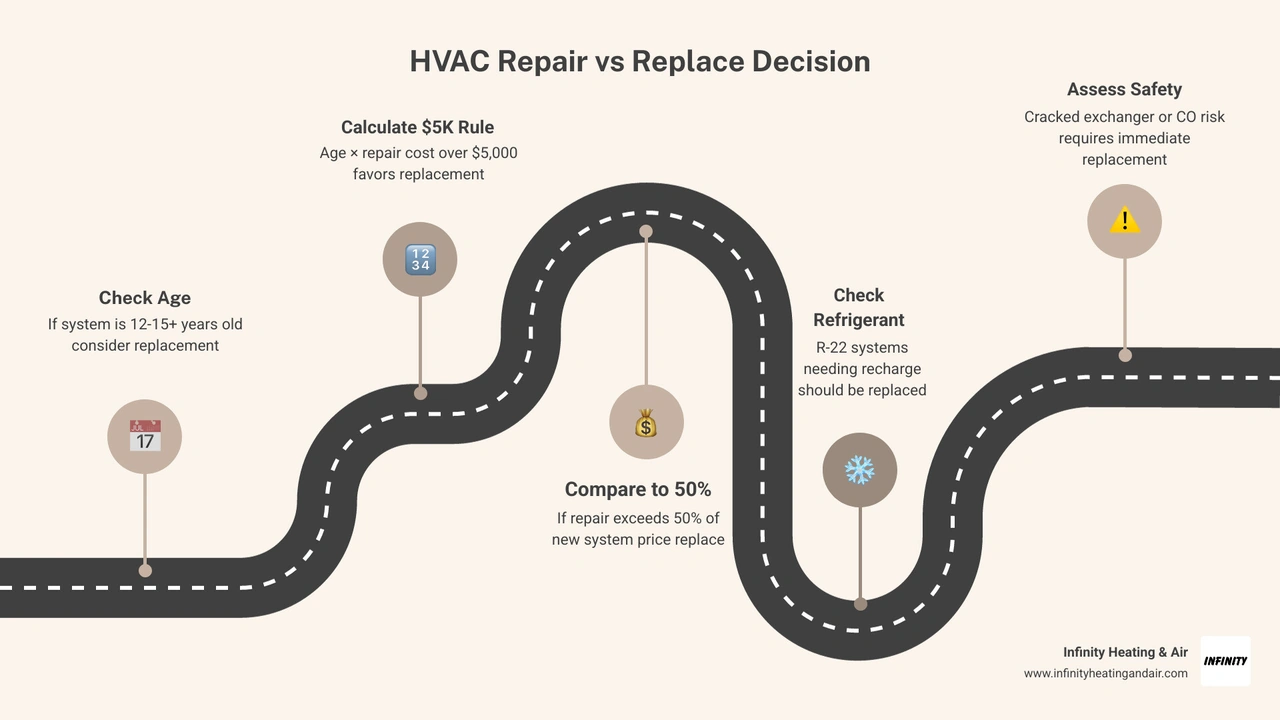
Repair or Replace? Quick Decision Guide
| Situation | Likely Best Choice |
|---|---|
| System under 10 years old, minor repair needed | Repair |
| Repair cost under 30% of new system price | Repair |
| System age × repair cost is under $5,000 | Repair |
| System is 12–15+ years old with major failure | Replace |
| Repair cost exceeds 50% of new system price | Replace |
| System age × repair cost exceeds $5,000 | Replace |
| System uses R-22 refrigerant, needs recharge | Replace |
| Cracked heat exchanger or carbon monoxide risk | Replace immediately |
Two rules drive most repair-vs-replace decisions:
- The $5,000 Rule — Multiply your system's age (in years) by the repair cost. If the result is over $5,000, replacement is usually the smarter move.
- The 50% Rule — If the repair quote exceeds half the cost of a new system, invest in the new system instead.
Most homeowners face this decision at the worst possible time — when something breaks down and the pressure to act fast is high. That's exactly when having a clear framework matters most.
The good news: the numbers usually point clearly in one direction once you know what to look at. The sections below walk you through every factor — system age, efficiency ratings, safety concerns, refrigerant type, and available rebates — so you can make a confident, informed choice.
The Mathematical Framework: Your hvac repair vs replacement cost guide
When you are staring at a repair quote, it is easy to feel overwhelmed. However, we find that stripping away the emotion and looking at the cold, hard numbers often reveals the best path forward. At Infinity Heating & Air, we want our neighbors in Tacoma, Puyallup, and Olympia to feel confident in their investment.
Deciding whether to call for HVAC Repair or opt for a full system swap often comes down to the cumulative investment you are making in an aging machine. If you have already spent significant amounts on service calls over the last three years, a new repair might just be another "band-aid" on a system that is fundamentally failing.
Applying the Age-Multiplication Formula
The $5,000 rule is one of the most reliable heuristics in the industry. To use it, simply take the age of your unit and multiply it by the repair quote you just received.
For example, if you have a 12-year-old furnace and the technician quotes a repair that would normally be considered mid-range, you multiply 12 by that amount. If the total exceeds $5,000, the financial break-even point has likely passed. In these cases, the money spent on the repair is essentially "lost" because the system is already nearing the end of its mechanical life. You can learn more about how these numbers stack up in our guide on How Much Does HVAC Installation Cost A Breakdown.
The 50% Threshold for Major Components
Another vital metric is the 50% rule. This is particularly relevant when a major component fails—such as a compressor in an air conditioner or a blower motor in a furnace. If the quote to fix that specific part is more than half the price of a brand-new, high-efficiency unit, we almost always recommend replacement.
Investing 50% of the price of a new system into a unit that is already out of warranty and likely less efficient is rarely a sound long-term budgeting move. For homeowners looking for the most Affordable HVAC Solutions Ultimate Guide, prioritizing a new unit with a fresh 10-year warranty often provides much better peace of mind than a major repair on a "zombie" system.
System Age and Lifespan Thresholds
In home comfort, age is more than just a number—it represents mechanical fatigue. Every year your system runs through a Northwest Washington winter, it undergoes hundreds of thermal cycles, expanding and contracting as it heats and cools. Over time, this stress leads to cracks, leaks, and electrical failures. Knowing When to Replace Your HVAC System is largely about understanding these natural lifespans.
How Age Influences Your hvac repair vs replacement cost guide
Generally, you can expect a well-maintained gas furnace to last 15 to 20 years. Central air conditioners and heat pumps typically have a slightly shorter lifespan, often landing between 12 and 17 years.
Once a system hits the 15-year benchmark, the technology gap becomes significant. A unit from 2011 is vastly less efficient than a 2026 model. Even if the old unit "works," it is likely costing you significantly more in monthly utilities than a modern equivalent. Regular care can help, and you can see the impact of upkeep in our article Annual HVAC Maintenance Is It Worth It.
Regional Climate Impact on Longevity
In areas like Gig Harbor, Lacey, and Federal Way, our climate plays a unique role in HVAC health. While we don’t deal with the extreme salt air of the coast or the desert heat of the south, our high humidity can lead to corrosion and biological growth inside units.
Furthermore, our long heating seasons mean furnaces in Pierce and Thurston Counties work much harder than those in milder climates. We often see systems begin to decline 3 to 5 years earlier than the national average if they haven't been properly cared for. We explore these local risks in The True Cost of Neglecting HVAC Maintenance.
Critical Signs It’s Time to Invest in a New System
Sometimes, the signs of a failing system are subtle. You might notice that the master bedroom is always five degrees colder than the living room, or you might hear a "thump" every time the heat kicks on. These are indicators that your system is struggling to maintain the airflow and pressure required to keep your home comfortable. When these issues become chronic, it's time to look into HVAC Installation Replacement.
Common warning signs include:
- Frequent Cycling: The system turns on and off every few minutes (short-cycling).
- Rising Energy Bills: Your utility costs are climbing despite similar weather patterns.
- Strange Noises: Squealing, grinding, or banging sounds often indicate mechanical failure.
- Humidity Issues: Your home feels "muggy" in the summer or "bone dry" in the winter.
Safety Triggers and Immediate Replacement
While many HVAC decisions are financial, some are purely about safety. There are certain failures that we consider "immediate replacement" triggers. The most common is a cracked heat exchanger in a gas furnace. This component separates the combustion gases (including carbon monoxide) from the air you breathe. If it is cracked, there is no "repair"—the part must be replaced, and because it is the "heart" of the furnace, a full system replacement is almost always the only logical path.
Other safety concerns include fire hazards from frayed internal wiring or repeated electrical failures that trip your home's breakers. If you suspect a safety issue, you should immediately seek HVAC Service Maintenance to protect your family.
The R-22 Refrigerant Phase-Out
If your air conditioner or heat pump was installed before 2010, there is a high chance it uses R-22 refrigerant (often called Freon). Due to environmental regulations, R-22 is no longer produced.
If an R-22 system develops a leak, the cost to recharge it has become astronomical because technicians must rely on limited, reclaimed supplies. We typically advise against major repairs on R-22 systems. Investing in a modern system that uses current, environmentally friendly refrigerants is a much smarter use of your home improvement budget.
Long-Term Value: Efficiency Ratings and ROI
When comparing the hvac repair vs replacement cost guide data, you have to look beyond the initial purchase price. A new system is an investment that pays "dividends" every month through lower utility bills.
Modern systems are rated using several key metrics:
- SEER2 (Seasonal Energy Efficiency Ratio): Measures cooling efficiency.
- AFUE (Annual Fuel Utilization Efficiency): Measures how much fuel a furnace converts to heat.
- HSPF2 (Heating Seasonal Performance Factor): Measures heat pump heating efficiency.
| Feature | 2010 Standard System | 2026 High-Efficiency System |
|---|---|---|
| Cooling Efficiency | 10–13 SEER | 18–24+ SEER2 |
| Heating Efficiency (Gas) | 80% AFUE | 96%–98% AFUE |
| Monthly Energy Waste | High (20%–40%) | Minimal (2%–5%) |
| Technology | Single-Stage (On/Off) | Variable-Speed (Precise) |
Maximizing ROI with an hvac repair vs replacement cost guide
The return on investment (ROI) for a new system has never been higher, thanks to federal incentives. Under the Inflation Reduction Act, homeowners may be eligible for tax credits up to $2,000 for high-efficiency heat pumps. When you combine these tax credits with local utility rebates and the monthly energy savings, the "payback period" for a new system is significantly shorter than it was a decade ago. We provide more details on navigating these incentives in our Affordable HVAC Solutions Ultimate Guide.
Variable-Speed Technology and Comfort
One of the biggest "unseen" benefits of replacement is the jump in comfort. Older systems are either 100% "on" or 100% "off," which leads to temperature swings. Modern variable-speed systems can run at lower speeds for longer periods, providing incredibly consistent temperatures and superior humidity control. This also improves indoor air quality by keeping air moving through your filtration system more consistently.
Frequently Asked Questions about HVAC Decisions
What is the best time of year to replace my system in Northwest Washington?
The "shoulder seasons"—spring and fall—are generally the best times. During the peak of summer or the dead of winter, HVAC companies are focused on emergency repairs. By scheduling in the spring or fall, you often get faster installation times and may have access to seasonal manufacturer promotions.
Should I replace my furnace and AC at the same time?
In most cases, yes. Your furnace and AC (or heat pump) share the same blower motor and ductwork. They are designed to work as a matched set. Replacing them together ensures maximum efficiency, saves on labor costs, and means you won't have to deal with another major installation in a few years when the other half of the system inevitably fails.
How does a high-efficiency system impact my home's resale value?
A new, high-efficiency HVAC system is a major selling point. Homebuyers in Washington are increasingly conscious of energy costs. Having a documented history of a new installation with a transferrable warranty can make your home stand out and potentially increase its market value.
Conclusion
At Infinity Heating & Air, we are proud to be the Northwest Washington experts in crafting endless comfort. Whether you are in Tacoma, Olympia, Federal Way, or any of our surrounding communities, our goal is to provide reliable, expert service that respects your budget and your home.
We understand that deciding between a repair and a replacement is a big choice. That is why we offer 24/7 emergency service and flexible financing options to ensure you never have to choose between your comfort and your financial security.
Our Service Areas Include:Auburn, Bonny Lake, Buckley, DuPont, Eatonville, Edgewood, Elk Plain, Enumclaw, Federal Way, Fife, Fir Crest, Frederickson, Gig Harbor, Graham, Kapowsin, Lacey, Lake Tapps, Lakewood, Milton, Olympia, Orting, Parkland, Puyallup, Roy, South Hill, South Prairie, Spanaway, Steilacoom, Summit, Sumner, Tacoma, Tehaleh, Tumwater, University Place, and Yelm.
Don't stay in the dark about your home's health. Schedule your professional system evaluation with Infinity Heating & Air today, and let us help you find the most cost-effective path to a comfortable home.
Written & reviewed by the Infinity Heating & Air team — licensed WA HVAC contractor (INFINHA841B8). Family-owned in Graham, answering 24/7 across the South Sound.
Choose Infinity & enjoy endless comfort.
Your perfect home environment awaits — call (253) 740-5135 or schedule service online and our team will take it from there.
Open 24/7 · 100% Satisfaction Guaranteed · Graham, WA