A – Z Guide to Heat Pump Advantages Over Traditional Heating
Discover heat pump advantages over traditional heating with year-round efficiency, lower emissions, and reliable comfort for Pacific Northwest homes.
Why Heat Pump Advantages Over Traditional Heating Matter in 2026
The heat pump advantages over traditional heating are hard to ignore — especially if you're tired of high energy bills or running separate systems for heating and cooling.
Here's a quick look at what sets heat pumps apart:
| Advantage | Heat Pump | Traditional Heating |
|---|---|---|
| Energy efficiency | 2–4x more efficient | Limited by fuel conversion |
| Heating and cooling | Yes — one system | Heating only (furnace/boiler) |
| Carbon emissions | Up to 40% less than gas | Higher — burns fossil fuels |
| Cold climate performance | Down to -20°F (modern units) | Reliable but fuel-dependent |
| Operating cost | Lower over time | Higher, especially oil/propane |
| Safety | No combustion, no CO risk | Carbon monoxide risk |
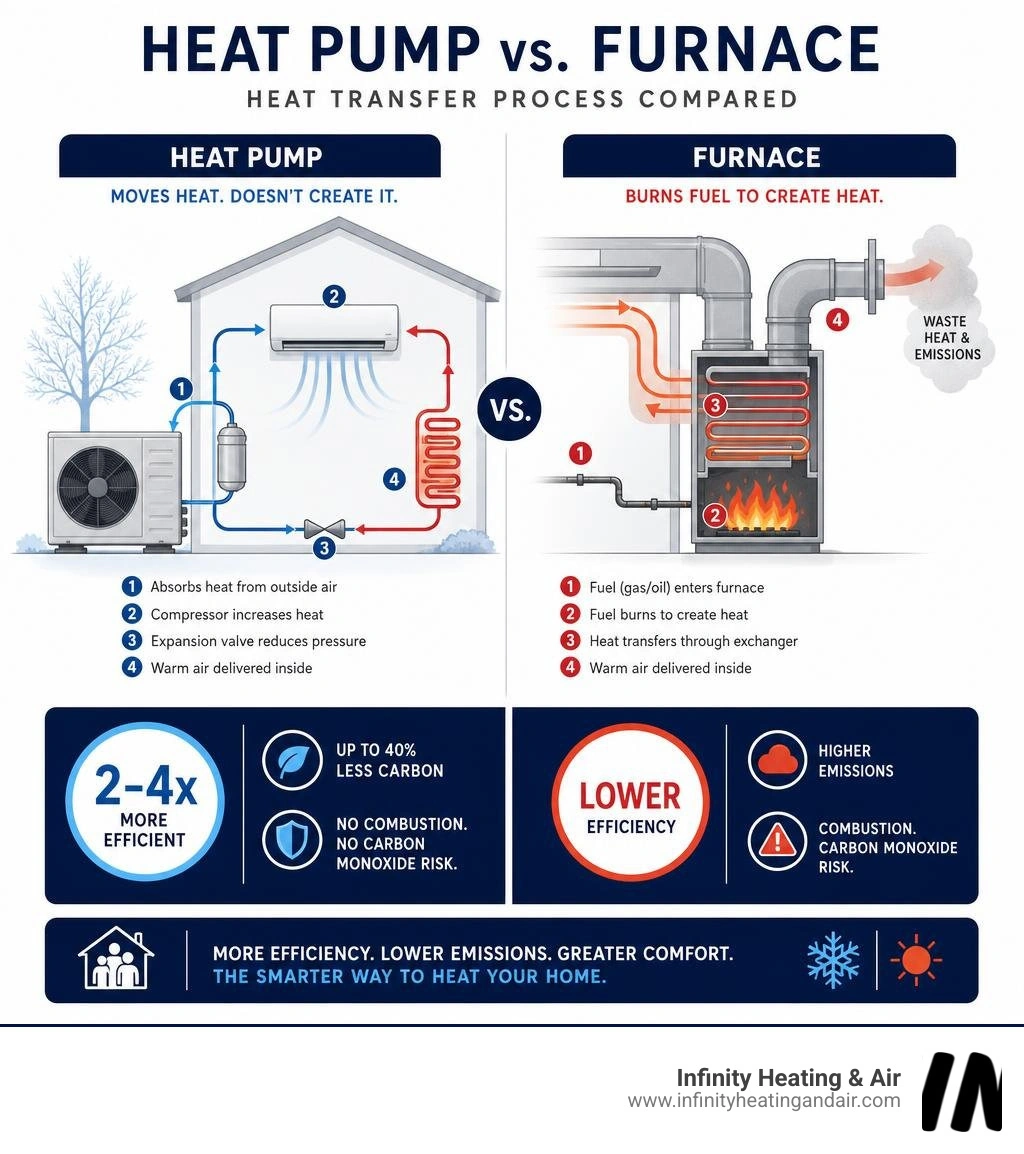
Heat pumps move heat rather than burning fuel to create it. That one difference changes everything — efficiency, safety, comfort, and environmental impact.
In the Pacific Northwest, where winters are mild but still demand reliable heat, this technology fits especially well. Over 115,000 heat pumps have been installed in Maine alone — one of the coldest U.S. states — proving these systems can handle real winters. And with heat pumps now accounting for more than half of all residential heating equipment sales in the U.S., this isn't a fringe technology anymore.
This guide walks through every key advantage, from energy savings to cold-weather performance, so you can make a confident, informed decision.
Core Heat Pump Advantages Over Traditional Heating
To understand why so many homeowners are making the switch, we have to look at how these systems operate. Traditional heating systems, like gas furnaces or oil boilers, generate heat through combustion. They burn a fuel source to create warmth, which is then pushed through your vents or radiators. Electric resistance baseboard heaters work similarly, using raw electrical current to create thermal energy.
Heat pumps, on the other hand, do not create heat. Instead, they act like a thermal transport service. Even on a chilly day in Western Washington, there is still thermal energy present in the outdoor air. A heat pump uses a closed loop of refrigerant, a compressor, and an expansion valve to capture this outdoor warmth and pump it inside.

This fundamental difference leads to the most celebrated heat pump advantages over traditional heating:
- Dual-Functionality: A heat pump is a year-round comfort machine. In the winter, it brings heat indoors. In the summer, a reversing valve flips the flow of refrigerant, allowing the system to extract heat from inside your home and dump it outdoors — acting exactly like a high-efficiency central air conditioner.
- Fossil Fuel Independence: Because heat pumps run entirely on electricity, they allow you to disconnect from natural gas, propane, or heating oil lines.
- Reduced Carbon Footprint: By eliminating combustion, switching to an air-source heat pump can cut your home's heating-related greenhouse gas emissions by roughly 40% compared to a standard gas furnace.
If you want to dive deeper into how these systems specifically benefit our local climate, check out our guide on Heat Pump Benefits for Pacific Northwest Homeowners.
Understanding the Heat Pump Advantages Over Traditional Heating in Energy Efficiency
When we talk about traditional heating systems, the absolute physical limit of their efficiency is 100%. That means if you put in one unit of energy, you get exactly one unit of heat out of it. In reality, even high-efficiency condensing gas furnaces top out around 95% to 98% efficiency because some heat always escapes through the exhaust flue. Electric resistance heaters are technically 100% efficient at converting electricity to heat, but they require massive amounts of power to do so.
Heat pumps shatter this 100% ceiling. Because they are moving heat rather than generating it, their Coefficient of Performance (COP) is regularly between 2.0 and 4.0. This means that for every single unit of electricity used to run the compressor and fans, the system delivers two to four units of heat into your home.
In other words, a heat pump can operate at 200% to 400% efficiency.
This translates to massive energy reductions. Today's advanced heat pumps can reduce the electricity used for heating by up to 75% compared to standard electric resistance options like baseboard heaters or electric furnaces. This incredible leap in efficiency is largely made possible by variable-speed inverter-driven compressors. Unlike older single-stage systems that blast on at full power and then shut off completely, variable-speed compressors constantly modulate their output to match your home's exact heating needs.
For a detailed breakdown of how these efficiency gains can lower your monthly utility bills in local areas like Puyallup, take a look at our Affordable Heat Pump Puyallup Guide.
Environmental and Safety Heat Pump Advantages Over Traditional Heating
Beyond saving energy, heat pumps offer major safety and environmental advantages that traditional combustion-based systems simply cannot match.
When you heat your home with a natural gas, propane, or oil furnace, you are bringing open flames and combustion byproducts into your living space. If a heat exchanger cracks or a vent pipe becomes blocked, there is a real risk of carbon monoxide (CO) leaking into your indoor air. Because heat pumps run purely on electricity and use a sealed refrigerant cycle, they carry zero risk of carbon monoxide poisoning or gas leaks.
Additionally, because they do not rely on combustion, they help protect your home's indoor air quality. They don't dry out the air as aggressively as gas furnaces, and because they run more continuously at lower, gentler speeds, they provide superior air filtration. When paired with high-quality media filters, they keep dust, pollen, and wildfire smoke out of your breathing zone.
From a global perspective, residential heating is a major contributor to greenhouse gas emissions. Transitioning to a heat pump immediately lowers your home's carbon footprint. As our regional electrical grids in Washington continue to transition toward cleaner, renewable energy sources like wind, solar, and hydro, your heat pump's operation becomes cleaner and more sustainable every single year.
Comparing Heat Pumps to Furnaces, Boilers, and Central AC
Choosing a new climate control system for your home often feels like a balancing act between comfort, efficiency, and long-term reliability. To make things simple, let's look at how heat pumps compare directly to the three most common traditional HVAC systems.
| Feature | Heat Pump | Gas/Oil Furnace | Gas/Oil Boiler | Central AC |
|---|---|---|---|---|
| Primary Energy Source | Electricity | Natural Gas / Propane / Oil | Natural Gas / Propane / Oil | Electricity |
| Operational Method | Heat Transfer | Combustion | Combustion | Heat Transfer |
| Functions Provided | Heating & Cooling | Heating Only | Heating Only | Cooling Only |
| Max Practical Efficiency | 300% – 400% | 95% – 98% | 90% – 95% | N/A (Cooling Only) |
| Heat Delivery Style | Gentle, continuous | Hot, cyclical blasts | Radiant water/steam | N/A |
| Carbon Monoxide Risk | None | Low to Moderate | Low to Moderate | None |
Many homeowners wonder whether they should stick with traditional split systems or move to more flexible setups. If you are comparing your options in the South Puget Sound region, you will find our analysis of Central Air vs Mini Split for the South Puget Sound Area Homes highly valuable.
Heat Pumps vs. Traditional Furnaces and Boilers
The primary complaint homeowners have about traditional furnaces is the "rollercoaster" effect. A gas furnace waits until your home drops below your thermostat setting, turns on with a loud roar, blasts hot air (often up to 120°F) into the rooms, and then shuts off once the target temperature is reached. This creates noticeable hot and cold spots, drafts, and constant on-and-off noise.
Boilers offer a more comfortable radiant heat, but they are slow to react to temperature changes, require complex piping networks, and offer no way to cool your home when summer temperatures spike.
Modern heat pumps eliminate these issues through continuous low-level operation. Because they run on variable-speed inverter compressors, they maintain a incredibly steady indoor temperature. Instead of waiting for your home to freeze before kicking on, they run quietly in the background, supplying a steady stream of warm air that matches the exact heat loss of your home. The result is a home with no cold corners, no drafts, and whisper-quiet operation.
If your current system is struggling to keep up with the winter chill, you can read our troubleshooting resource on Heat Pump Not Heating Diagnosis Puyallup WA.
Heat Pumps vs. Standard Central Air Conditioners
In the heat of summer, a heat pump and a central air conditioner are practically identical. They use the exact same refrigeration cycle, compressor, condenser coils, and evaporator coils to pull heat out of your home and push it outside.
The key difference lies in a small but incredibly important component inside the heat pump called the reversing valve.
A standard central air conditioner can only move heat in one direction: from inside to outside. When autumn arrives, your air conditioner sits idle for the next six to eight months while your furnace takes over. A heat pump, however, uses its reversing valve to change the direction of the refrigerant flow. Suddenly, the outdoor coil becomes the evaporator (absorbing heat from the outdoor air) and the indoor coil becomes the condenser (releasing heat into your home).
By choosing a heat pump over a standard central AC, you are purchasing a system that provides top-tier cooling performance in July, while also serving as an incredibly efficient heating system all winter long.
If you ever run into issues where your system is running but not lowering the temperature, check out our guide on what to do when your Heat Pump Not Cooling.
Performance in Cold Climates and Advanced Technologies
A common misconception lingering from the 1980s and 1990s is that heat pumps do not work when the temperature drops below freezing. While it is true that early models struggled in freezing weather, the technology has undergone a massive evolution.
Today's cold-climate heat pumps are specifically engineered to handle sub-zero temperatures. Thanks to advanced technologies like flash gas injection, electronic expansion valves, and variable-speed inverter compressors, modern systems can maintain high heating capacities even when outdoor temperatures drop well below 0°F. Some models continue to operate efficiently down to -15°F or even -25°F.
Even at these extreme temperatures, there is still usable heat energy in the outdoor air. Modern refrigerants can boil at extremely low temperatures, allowing them to absorb outdoor warmth even when it feels freezing to us.
If you are experiencing performance issues during a cold snap in the South Sound, our Heat Pump Not Heating Lacey WA Guide can help you identify whether your system is performing a normal defrost cycle or if it requires professional service.
When to Consider a Dual-Fuel or Hybrid System
While modern cold-climate heat pumps can easily handle the winter weather in areas like Tacoma, Puyallup, and Lacey, some homeowners prefer to install a dual-fuel or hybrid system.
A dual-fuel system pairs an electric heat pump with a high-efficiency gas furnace.
How does this work?
- Mild to Cool Weather: The heat pump does all the work, heating your home with maximum electrical efficiency.
- Extreme Cold snap: When temperatures drop to a point where the heat pump's efficiency begins to decrease, the system automatically switches over to the gas furnace.
- Optimized Comfort: The furnace provides rapid, high-temperature heat during the coldest days of the year, then hands the job back to the heat pump once the weather warms up.
This setup offers the ultimate peace of mind, ensuring you always have the most cost-effective and reliable heat source active, regardless of how wild the winter weather gets.
System Types, Lifespan, and Maintenance Considerations
Every home is unique, which is why heat pumps come in several configurations to match your existing infrastructure.
- Ducted Air-Source Heat Pumps: These systems connect directly to your home’s existing ductwork, making them a seamless replacement for a traditional furnace and air conditioner setup.
- Ductless Mini-Split Heat Pumps: Ideal for homes without existing ducts (such as those with older baseboard or wall heaters). They use compact indoor air handlers mounted on the wall or ceiling, connected to an outdoor compressor by small refrigerant lines.
- Geothermal (Ground-Source) Heat Pumps: These systems exchange heat with the earth rather than the air. While they require a more complex installation process involving underground pipe loops, they offer the highest efficiency and longest lifespan of any HVAC technology.
If you are planning an upgrade in the Tacoma area, you can learn more about the process in our comprehensive Heat Pump Installation Tacoma WA Guide.
Lifespan and Durability of Modern Systems
On average, a well-maintained air-source heat pump will last between 15 to 20 years. This lifespan is highly comparable to a standard central air conditioner or a modern condensing furnace. Geothermal heat pumps last even longer, with indoor components lasting up to 24 years and underground loops lasting 50 years or more.
Because a heat pump works year-round — cooling in the summer and heating in the winter — its compressor logs more operational hours than a furnace that sits idle all summer. However, because modern variable-speed compressors start up slowly and run continuously at low speeds rather than constantly cycling on and off at full blast, they experience significantly less mechanical wear and tear.
When the time comes to retire your old, inefficient heater, check out our Professional Heat Pump Replacement Guide Tacoma WA to understand your options.
Essential Maintenance for Year-Round Efficiency
Because your heat pump is a hard-working, year-round system, regular maintenance is absolutely essential to protect your investment and keep your energy bills low.
Fortunately, basic homeowner maintenance is simple:
- Change Your Filters: Check your indoor air filters every 30 to 90 days. A clogged filter restricts airflow, forcing your heat pump to work harder and run less efficiently.
- Keep the Outdoor Unit Clear: Keep leaves, snow, weeds, and debris away from your outdoor unit. The system needs clear airflow around all sides to transfer heat effectively.
- Schedule Professional Tune-Ups: Because the system handles both heating and cooling, we highly recommend scheduling professional maintenance twice a year — once in the spring before the cooling season, and once in the fall before the heating season.
During a professional tune-up, our technicians will check refrigerant levels, clean the coils, inspect electrical connections, and ensure the condensate drain is clear. For a complete checklist of what to look for, visit our Ultimate Heat Pump Maintenance Tacoma WA guide.
Frequently Asked Questions About Heat Pumps
Do heat pumps really work in freezing temperatures?
Yes! Modern cold-climate heat pumps are engineered to perform exceptionally well in sub-zero temperatures. Thanks to variable-speed inverter compressors and advanced refrigerants, they can extract heat from outdoor air even at temperatures down to -15°F or -25°F. For extreme climates or older, poorly insulated homes, they can be paired with supplemental electric backup strips or installed as part of a dual-fuel system with a gas furnace.
Can I use my existing ductwork for a heat pump installation?
In most cases, yes. If your home already has a ducted forced-air furnace, a ducted heat pump can typically connect directly to your existing duct network. However, because heat pumps move a slightly higher volume of air at a lower temperature compared to gas furnaces, our technicians will perform a static pressure test to ensure your current ducts are sized correctly and sealed properly to prevent energy loss.
If you are located in Puyallup, you can read our Best Heat Pump Installation Puyallup Guide for more information on ducted retrofits.
How do state and federal incentives affect the transition to a heat pump?
In 2026, state and local utility programs play a massive role in making heat pumps more affordable. Many local utilities in Western Washington offer substantial rebates for upgrading from inefficient electric resistance heat or fossil fuel systems to high-efficiency heat pumps. When combined with state-level clean energy programs, these incentives can significantly lower the net cost of your installation.
For homeowners looking to maximize their savings in the Tacoma area, our Affordable Heat Pump Replacement Guide Tacoma WA outlines the best ways to combine local rebates and incentives.
Conclusion
The heat pump advantages over traditional heating are clear: unmatched energy efficiency, safer operation, reduced environmental impact, and the convenience of year-round heating and cooling from a single, reliable system. Whether you are looking to replace an aging furnace or bring central air conditioning to your home for the first time, a heat pump is the smartest investment you can make for your home's comfort and your long-term energy budget.
At Infinity Heating & Air, we are proud to be your Northwest Washington HVAC and home air quality experts. We serve communities across the region, including Auburn, Puyallup, Tacoma, Graham, Lacey, Olympia, and beyond. Our team is dedicated to crafting endless comfort with reliable, expert service.
If you are ready to experience the comfort and savings of a modern heat pump, contact us today to schedule your in-home consultation!
Written & reviewed by the Infinity Heating & Air team — licensed WA HVAC contractor (INFINHA841B8). Family-owned in Graham, answering 24/7 across the South Sound.
Choose Infinity & enjoy endless comfort.
Your perfect home environment awaits — call (253) 740-5135 or schedule service online and our team will take it from there.
Open 24/7 · 100% Satisfaction Guaranteed · Graham, WA