How to Lower AC Bills During Summer with These 5 Quick Changes
Discover how to lower AC bills during summer with 5 quick changes that boost efficiency, cut cooling costs, and keep your home comfortable all season.
Why Your Summer AC Bill Is Higher Than It Should Be
If you're wondering how to lower AC bills during summer, you're not alone. Up to 50% of your home's summer power bill comes from cooling — and the average household spends around $1,900 per year on utilities, with nearly half going to heating and cooling.
The good news? A few targeted changes can make a real dent in that number.
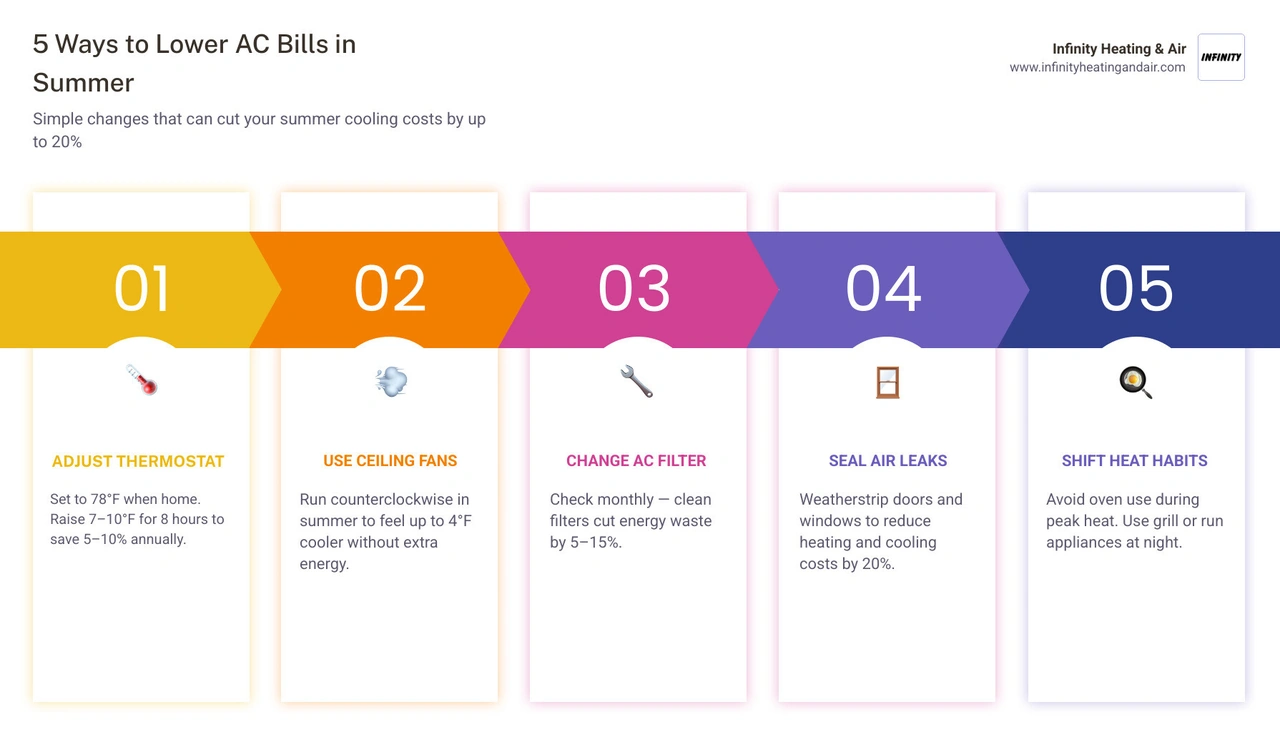
Here are 5 quick ways to lower your AC bill this summer:
- Adjust your thermostat — Set it to 78°F when home. Raising it 7–10°F for 8 hours a day can save 5–10% annually on cooling.
- Use ceiling fans correctly — Run them counterclockwise in summer to feel up to 4°F cooler without touching the thermostat.
- Change your AC filter — A clogged filter wastes 5–15% more energy. Check it monthly.
- Seal air leaks — Caulking and weatherstripping around doors and windows can cut heating and cooling costs by up to 20%.
- Shift heat-producing habits — Avoid the oven during peak afternoon heat. Use a grill, microwave, or run the dryer at night.
Northwest Washington summers are getting hotter and longer. When your AC runs harder to keep up, your bill climbs fast. The sections below break down each of these strategies in detail — so you can start saving right away.
1. Master Your Thermostat to Lower AC Bills During Summer

Your thermostat is the "brain" of your cooling system, and if you aren't managing it correctly, you're essentially leaving money on the table. In May 2026, we are seeing more homeowners in the Northwest realize that micro-adjustments lead to macro-savings.
One of the most effective statistics to keep in mind is that each degree you set your thermostat above 75°F could save you between 10% and 15% in energy used. While it is tempting to "crank" the AC down to 65°F when you get home from a walk at Point Defiance Park, your unit won't actually cool the house any faster. It will simply run longer and work harder, driving up your costs. If you notice your home isn't reaching the set temperature even after a long wait, you should read our guide on AC Not Cooling Properly What to Check.
How to lower ac bills during summer with smart scheduling
The key to efficiency is automation. Programmable and smart thermostats allow you to create 8-hour cycles that align with your daily routine. By adjusting your thermostat 7 to 10 degrees higher for just 8 hours a day (for example, while you are at work in Tacoma or Olympia), you can save up to 10% a year on cooling.
Smart home integration takes this a step further by allowing you to pre-cool your home 30 minutes before you arrive. This prevents the system from running at full blast all afternoon while the house is empty. Additionally, remember the "20-degree rule": most air conditioners are designed to cool a home to about 20 degrees lower than the outside temperature. If it's 100°F in Puyallup, asking your AC to hit 68°F is a recipe for a massive bill and potential system failure. If your old unit can't keep up with modern Washington summers, it might be time to consult an AC Installation Guide Tacoma WA.
Optimal temperature settings for pets and sleep
We often get asked what the "magic number" is. For maximum efficiency, 78°F is the gold standard when you are home. When you are away for more than four hours, consider bumping that up to 82°F.
If you have pets, you don’t need to keep the house like an icebox. Most dogs and cats are perfectly comfortable between 75°F and 80°F, provided they have plenty of water. Over time, your body will actually acclimate to slightly warmer indoor temperatures, making 78°F feel perfectly pleasant. Also, ensure your thermostat is placed on a centralized interior wall away from direct sunlight or kitchen appliances, as "ghost" heat can cause the sensor to misread the temperature and run the AC unnecessarily.
2. Maximize Airflow and Passive Cooling
Airflow is your best friend when looking for how to lower AC bills during summer. While an air conditioner actually removes heat from the air, fans work on a different principle: the wind chill effect. Fans cool people, not rooms, by moving air across your skin to accelerate evaporation.
Because of this, ceiling fans can cut back on air conditioning needs significantly, potentially saving up to 40% on your electricity usage. However, the golden rule of fans is to turn them off when you leave the room. Leaving a fan running in an empty room is just wasting pennies!
How to lower ac bills during summer by using ceiling fans correctly
To get the most out of your fans in places like South Hill or Lakewood, you must ensure they are rotating counterclockwise during the summer. This direction pushes a cool breeze directly downward. Combining a fan with your AC allows you to raise the thermostat by about 4 degrees without any loss in comfort.
Don't forget about spot ventilation. Your bathroom and kitchen exhaust fans are designed to pull heat and humidity out of your home. Use the bathroom fan during and after showers, and keep the kitchen fan running while you’re cooking. This prevents your AC from having to work double-time to remove that extra moisture. For residents in the South Hill area, keeping that airflow balanced is a key part of AC Service Maintenance South Hill WA.
Window treatments and shading strategies
Your windows are essentially giant heat magnets. Installing window coverings like blinds, curtains, or even smart blinds that close automatically during the peak heat hours (usually 11 a.m. to 3 p.m.) can drastically reduce heat gain.
If you’re looking for a more "green" solution, landscaping is incredibly effective. Planting deciduous trees to shade the south and west sides of your home can increase your AC unit’s efficiency by up to 10%. Awnings and heat-reflective window films are also great low-cost investments that pay for themselves in energy savings over a few seasons.
3. Prioritize Essential System Maintenance
You wouldn't drive your car 50,000 miles without an oil change, yet many homeowners expect their AC to run for years without a tune-up. This is one of the most common reasons for high utility bills.
Clearing a clogged A/C unit filter alone can save 5% to 15% in energy use. When a filter is packed with dust and pet dander, your blower motor has to work significantly harder to pull air through, which consumes more power and puts unnecessary strain on your system's components. For a full list of what to keep an eye on, check out our AC Maintenance Checklist.
Identifying when your system is working too hard
How do you know if your system is struggling? Common Signs Your AC Needs Repair include frequent "short-cycling" (turning on and off every few minutes), unusual grinding or squealing noises, or a sudden spike in your bill that doesn't match the weather.
In Puyallup, the humidity can sometimes make the system feel like it's cooling, but the air remains "heavy." This usually indicates that the evaporator coils are dirty or the refrigerant is low. Regular AC Service Maintenance Puyallup WA ensures these issues are caught before they lead to a total system breakdown in the middle of a July heatwave.
Professional servicing for peak efficiency
While homeowners can change filters and clear debris from the outdoor condenser unit, a professional technician is needed to check refrigerant levels, tighten electrical connections, and perform mold removal within the air handler.
In Lakewood, we often see older systems with low SEER (Seasonal Energy Efficiency Ratio) ratings. While a new unit is an investment, modern high-efficiency systems can slash your cooling costs by half compared to a unit from fifteen years ago. Keeping up with AC Service Maintenance Lakewood WA can help extend the life of your current unit while keeping it as efficient as possible.
4. Seal the Envelope and Upgrade Insulation
Think of your home like a cooler. If the lid is cracked open, the ice is going to melt. Many homes in University Place and Tacoma have "leaks" where expensive, cooled air escapes into the attic or outside. Sealing air leaks with caulk and weatherstripping around doors and windows can save you up to 20% on your annual heating and cooling costs.
Ductwork integrity and attic insulation
One of the most overlooked areas for energy loss is the ductwork. In the average home, leaky ducts can lose up to 15% of the air that you’ve already paid to cool. Sealing and insulating ducts—especially those running through unconditioned spaces like crawlspaces or attics—is a major win for your wallet.
Furthermore, 90% of single-family homes in the U.S. are under-insulated. If your attic insulation is thin, the heat from the sun-baked roof will radiate directly into your living space. Adding insulation and ensuring proper attic ventilation keeps that heat out and the cool air in. If you're considering a more robust overhaul, look into AC Installation Replacement Tacoma WA.
Long-term upgrades for Northwest Washington homes
For residents in Graham or University Place, long-term upgrades like zoned HVAC systems or ductless mini-splits can provide the biggest savings. Zoned systems allow you to cool only the rooms you are actually using, rather than wasting energy on an empty guest room or basement.
Ductless systems are especially popular for older homes in Graham that lack existing ductwork, offering incredible SEER ratings and whisper-quiet operation. For more information on maintaining these specialized systems, see our guide on AC Service Maintenance Graham WA or AC Service Maintenance University Place WA.
5. Adjust Daily Habits to Reduce Indoor Heat
Sometimes the best way to lower your AC bill is to stop fighting against yourself. Every time you run the dishwasher, dryer, or oven, you are pumping heat into your home that your AC then has to work to remove.
Managing water heating and appliance loads
Water heating accounts for about 18% of the energy consumed in your home. By simply lowering your water heater temperature to 120°F, you save money on the heating itself and reduce the ambient heat in your laundry room or basement.
Try to shift your appliance usage to off-peak hours—usually after 6 p.m. Many utility programs in Washington offer lower rates during these times.
| Appliance | Heat Impact | Efficiency Tip |
|---|---|---|
| Oven | High | Use a microwave, toaster oven, or outdoor grill. |
| Dishwasher | Moderate | Run full loads only; use the "air dry" setting. |
| Clothes Dryer | High | Dry clothes at night or use an outdoor line. |
| Lighting | Low-Moderate | Switch to LEDs, which stay cool to the touch. |
Taking advantage of utility programs
Many local utility providers in the Northwest offer "direct load control" programs, where they might offer a bill credit in exchange for the ability to cycle your AC for short periods during extreme peak demand events.
Additionally, look for energy audits and rebate programs for upgrading to ENERGY STAR certified appliances. These programs are designed to help you make your home more efficient with less out-of-pocket expense. Using tools like bill forecast alerts can also help you track your usage in real-time so you aren't surprised by a high bill at the end of the month.
Frequently Asked Questions About How to Lower AC Bills During Summer
What is the best temperature to set my AC in the summer?
For the best balance of comfort and cost-savings, 78°F is recommended while you are home. If this feels too warm initially, try lowering it by one degree each day until you acclimate.
Does turning the AC off when I leave the house save money?
If you will be gone for more than four hours, yes. However, for shorter trips, it is better to raise the temperature by 7–10 degrees rather than turning it off completely. Turning it off entirely allows the walls and furniture to soak up heat, making the AC work much harder to "recover" when you return.
How often should I change my AC filter to keep bills low?
In the Northwest, you should check your filter every 30 days. If you have pets or live in a dusty area (like near construction in Frederickson or Spanaway), you may need to replace it every month. At a minimum, never go more than 90 days without a fresh filter.
Conclusion
Lowering your AC bills doesn't require a lifestyle of suffering in the heat. By combining smart technology, consistent maintenance, and a few habit shifts, you can stay perfectly comfortable while keeping your utility costs under control. Whether you are in Tacoma, Puyallup, or any of our surrounding service areas, the team at Infinity Heating & Air is here to help you achieve endless comfort.
From designing high-efficiency systems to providing 24/7 emergency service, we are your local experts in home air quality. Don't let a struggling AC drain your bank account this summer. Schedule your professional AC maintenance today and make sure your system is ready for the heat!
Written & reviewed by the Infinity Heating & Air team — licensed WA HVAC contractor (INFINHA841B8). Family-owned in Graham, answering 24/7 across the South Sound.
Choose Infinity & enjoy endless comfort.
Your perfect home environment awaits — call (253) 740-5135 or schedule service online and our team will take it from there.
Open 24/7 · 100% Satisfaction Guaranteed · Graham, WA