Efficiency Ratings Explained for Homeowners
Learn efficiency ratings explained for homeowners with SEER2, HSPF2, AFUE, and Energy Star tips to boost savings and comfort.
Why Efficiency Ratings Matter for Every Homeowner
Efficiency ratings explained for homeowners comes down to one simple idea: these numbers tell you how much useful heat or cooling you get for every dollar of energy spend.
Here's a quick-reference breakdown of the most important ratings you'll see on HVAC equipment and homes:
| Rating | What It Measures | Higher or Lower is Better? |
|---|---|---|
| SEER2 | Cooling efficiency over a full season | Higher is better |
| HSPF2 | Heat pump heating efficiency over a season | Higher is better |
| AFUE | Furnace/boiler fuel-to-heat conversion rate | Higher is better |
| HERS Index | Whole-home energy efficiency vs. a reference home | Lower is better |
| Energy Star | Certification that a product meets EPA efficiency thresholds | Certified = top ~25% of products |
| U-Factor | Heat loss through windows | Lower is better |
| SHGC | Solar heat gain through windows | Lower = less heat in (good for hot climates) |
Most homeowners only see these labels when shopping for a new system — and by then, the jargon can feel overwhelming. But understanding even the basics puts you in a much stronger position to choose equipment that actually saves money, not just looks good on a spec sheet.
The gap between a low-efficiency and high-efficiency system isn't small. Upgrading from an older 80% AFUE furnace to a modern 95% AFUE unit, for example, means 15 cents less wasted for every dollar you spend on heat. Over a Northwest Washington winter, that adds up fast.
This guide breaks down every major rating in plain language — and explains what they actually mean for your comfort and your utility bill.
Decoding the Alphabet Soup: Efficiency Ratings Explained for Homeowners
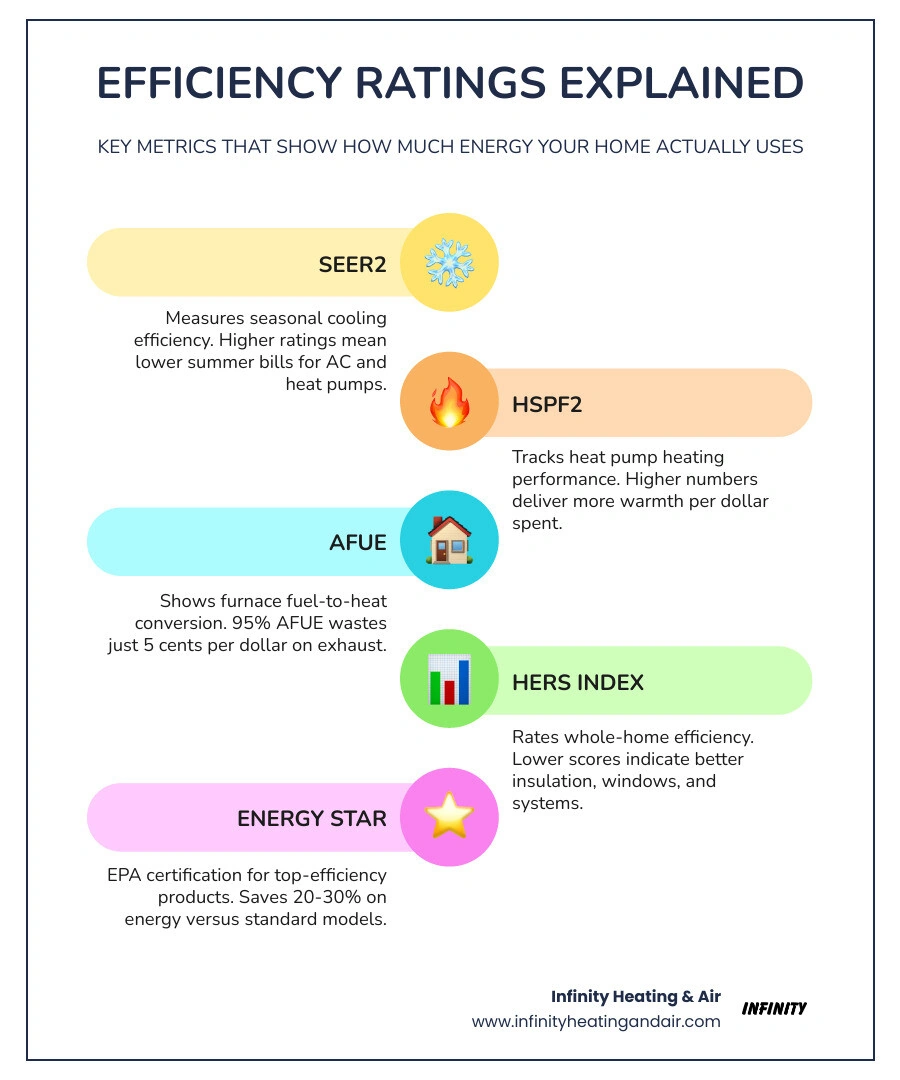
When we talk about efficiency ratings explained for homeowners, it can often feel like you’re reading a bowl of alphabet soup. SEER, HSPF, AFUE—these acronyms are more than just industry jargon; they are the keys to understanding your home's energy consumption.
In HVAC, efficiency is defined by how much output (heating or cooling) you get compared to the input (electricity or fuel). For example, a furnace with a 95% AFUE rating converts 95 cents of every dollar into heat, while the other 5 cents literally goes up the exhaust pipe.
The Core Ratings at a Glance
| Metric | Full Name | Primary Application |
|---|---|---|
| SEER2 | Seasonal Energy Efficiency Ratio 2 | Air Conditioners & Heat Pumps (Cooling) |
| HSPF2 | Heating Seasonal Performance Factor 2 | Heat Pumps (Heating) |
| AFUE | Annual Fuel Utilization Efficiency | Furnaces & Boilers |
| HERS | Home Energy Rating System | Whole Home Performance |
Beyond the equipment itself, the HERS Index provides a snapshot of your entire home’s efficiency. A typical home built to 2006 standards scores a 100. A home with a HERS Index of 70 is 30% more efficient than that standard. On the other hand, the Energy Star label is a voluntary program by the EPA that identifies the top-performing products in each category.
Understanding these metrics is the first step toward a more comfortable, cost-effective home. To dive deeper into how these systems interact, you can learn more about energy efficient HVAC solutions tailored for our local climate.
Understanding Cooling and Heating Performance Metrics
To truly grasp efficiency ratings explained for homeowners, we need to look at how these numbers are calculated. Efficiency isn't just about how powerful a system is; it's about how gracefully it uses energy to achieve its goal.
The Role of BTUs and Watt-Hours
Most HVAC ratings are based on the relationship between BTUs (British Thermal Units) and watt-hours. A BTU is the amount of energy needed to raise the temperature of one pound of water by one degree Fahrenheit. When we measure cooling, we look at how many BTUs of heat are removed from your home per watt-hour of electricity consumed.
The 2023 DOE Standards Shift
As of 2023, the Department of Energy (DOE) updated the testing standards to better reflect real-world conditions. This led to the creation of SEER2 and HSPF2. The primary difference is the "static pressure" used during testing. Old SEER tests assumed perfectly smooth, oversized ductwork. SEER2 uses a higher static pressure (0.5 inches vs. 0.1 inches) to simulate the resistance found in actual home duct systems. This makes the new ratings roughly 5% to 7% more accurate—and usually slightly lower numerically—than the old versions.
Whether you are looking at a traditional setup or considering a central AC vs ductless mini split comparison, these ratings provide the baseline for your expectations.
What is a good SEER2 efficiency rating explained for homeowners?
For homeowners in Northwest Washington, a "good" SEER2 rating usually starts around 14.3, which is the current federal minimum for our region. However, "good" and "great" are two different things.
- Standard (14.3 - 15 SEER2): Reliable, meets code, but offers basic on/off functionality.
- High Efficiency (16 - 18 SEER2): Often includes two-stage compressors that can run at a lower speed on milder days.
- Ultra-High Efficiency (20+ SEER2): These units utilize variable-speed technology. Think of it like a dimmer switch for your lights rather than a standard on/off switch. These systems can adjust their output in tiny increments, maintaining a perfectly steady temperature and superior humidity control.
Energy Star certification for central air conditioners typically requires a minimum of 15.2 SEER2. If you see the "Energy Star Most Efficient" label, you're looking at the absolute pinnacle of current technology.
Heating efficiency ratings explained for homeowners: AFUE and HSPF2
In our neck of the woods, heating is usually the biggest line item on the utility bill.
AFUE (Annual Fuel Utilization Efficiency) is for gas or oil furnaces. A high-efficiency unit generally lands between 90% and 98.5% AFUE. These are often called "condensing" furnaces because they have a second heat exchanger that extracts heat from exhaust gases until they condense into water. If your furnace has a white PVC exhaust pipe, it’s likely a high-efficiency model. If it has a metal flue, it’s likely an older 80% AFUE model or lower. You can explore the benefits of a high efficiency furnace to see how much fuel you could be saving.
HSPF2 (Heating Seasonal Performance Factor 2) is the heating equivalent of SEER2 for heat pumps. It measures the total heat output over the season divided by the total electricity used. A "good" HSPF2 rating is typically 7.5 or higher, with premium units reaching 9 or 10. In the Northwest, where winters are chilly but not usually Arctic, a high HSPF2 heat pump is an incredibly efficient way to stay warm.
Beyond the Label: Real-World Factors Affecting System Performance
One of the most important things we tell our neighbors in Tacoma and Puyallup is that the rating on the yellow EnergyGuide sticker is a lab rating. In the real world, your system's performance depends heavily on the environment it lives in.
The Critical Role of Installation and Sizing
A 20-SEER2 air conditioner will perform like a 14-SEER2 unit if it isn't installed correctly. This starts with a Manual J load calculation. We don't just guess the size of the unit based on square footage; we account for window orientation, insulation levels, and ceiling heights. An oversized unit will "short cycle," turning on and off rapidly, which kills efficiency and wears out the parts. Conversely, an undersized unit will run forever and never get you comfortable.
Ductwork and Insulation
Think of your HVAC system as the heart and your ductwork as the arteries. The EPA estimates that the average home loses 20% to 30% of its conditioned air through leaks in the ductwork. If your ducts are leaky or uninsulated in a cold crawlspace, you are paying to heat the outdoors.
For a better understanding of the investment involved in a proper setup, you can check out how much does HVAC installation cost: a breakdown.
The impact of home envelope and maintenance
Your home's "envelope"—the walls, roof, and windows—acts as a barrier. If your home has significant air leakage or poor attic insulation, your HVAC system has to work overtime regardless of its efficiency rating.
Maintenance is the other half of the equation. A dirty air filter or a clogged outdoor coil can drop your system's efficiency by 10% or more instantly. Regular professional tune-ups ensure that the 16 SEER2 you paid for is actually what you’re getting. There are also distinct benefits of choosing an Environment for Living HVAC partner, which focuses on a holistic approach to home comfort and efficiency.
Maximizing Savings with Energy Star and Federal Incentives
Navigating efficiency ratings explained for homeowners becomes much more rewarding when you look at the financial incentives available in 2026.
Energy Star Standards
The Energy Star program, run by the EPA and DOE, sets strict efficiency thresholds. Energy Star certified products don't just use less energy; they are often required to meet performance standards that ensure your comfort isn't sacrificed for savings. For example, Energy Star windows can reduce utility bills by an average of 13% compared to standard double-pane windows.
Federal Tax Credits and Rebates
Under current federal guidelines, homeowners can take advantage of significant tax credits for high-efficiency upgrades:
- Heat Pumps: You may be eligible for a tax credit up to $2,000 per year for a qualified heat pump installation.
- Central AC and Furnaces: Credits of up to $600 are often available for units that meet the highest efficiency tiers.
- Heat Pump Water Heaters: These units are incredibly efficient, using up to 70% less energy than standard electric tanks, and often qualify for both tax credits and local utility rebates.
Always keep your documentation and AHRI (Air Conditioning, Heating, and Refrigeration Institute) certificates, as these are required to prove your system meets the efficiency thresholds for these incentives.
Frequently Asked Questions about Home Efficiency
Does a higher SEER2 rating always guarantee lower utility bills?
Not necessarily. While a higher SEER2 unit uses less electricity to produce the same amount of cooling, your total bill is affected by your thermostat habits, your home's insulation, and even the weather. However, if you replace a 10-year-old unit with a modern high-efficiency system, you will almost certainly see a noticeable drop in your monthly energy costs.
How can I find the current efficiency rating of my existing HVAC system?
The easiest way is to look for the yellow EnergyGuide label on the side of your outdoor unit or furnace. If that’s missing, find the model number on the manufacturer's data plate and search for it online. For furnaces, a quick tip: if you see a metal exhaust pipe, it’s likely an 80% AFUE unit. If you see white PVC, it’s a high-efficiency condensing unit (90%+).
What is the HERS Index and how does it affect my home's resale value?
The HERS Index is a comprehensive rating of your home's energy performance. A lower score is better. According to RESNET, homes with lower HERS scores (meaning they are more energy-efficient) often sell for a premium. It provides buyers with a transparent look at what their future utility costs might look like, making an efficient home a much more attractive investment.
Conclusion
Understanding efficiency ratings explained for homeowners is the best way to ensure you're making a smart investment in your home’s future. Whether you’re looking to lower your carbon footprint, reduce your monthly bills, or simply enjoy a more consistent indoor temperature, the numbers don’t lie.
At Infinity Heating & Air, we are proud to serve our neighbors across Northwest Washington—from Tacoma and Olympia to Puyallup and Federal Way. We don’t just install equipment; we design comfort systems that are tailored to the unique needs of your home and our local climate. Our team is dedicated to providing reliable, expert service that takes the guesswork out of home efficiency.
Ready to see how a high-efficiency system can transform your home? Schedule your high-efficiency heat pump consultation today and let us help you craft endless comfort.
Written & reviewed by the Infinity Heating & Air team — licensed WA HVAC contractor (INFINHA841B8). Family-owned in Graham, answering 24/7 across the South Sound.
Choose Infinity & enjoy endless comfort.
Your perfect home environment awaits — call (253) 740-5135 or schedule service online and our team will take it from there.
Open 24/7 · 100% Satisfaction Guaranteed · Graham, WA