Why Your HVAC Hates the Rain
Discover how Pacific Northwest rain and humidity affect your HVAC: efficiency loss, mold, constant running & maintenance tips for Tacoma & Puyallup homes.
Why Pacific Northwest Rain and Humidity Are Hard on Your HVAC System
How pacific northwest rain and humidity affect your hvac is a question every homeowner in Western Washington eventually faces — and the short answer is: more than most people realize.
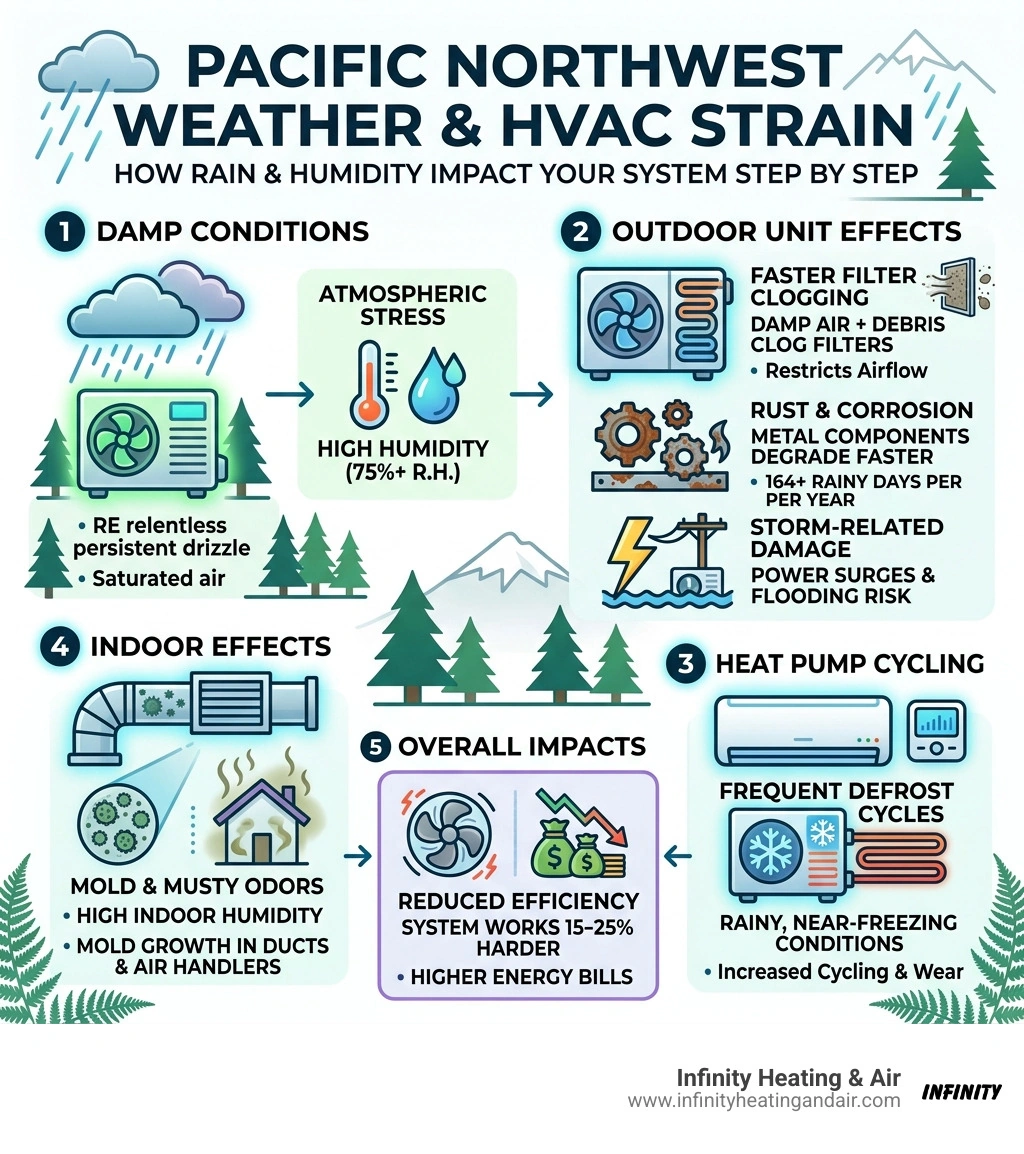
Here's a quick breakdown of the main impacts:
- Reduced efficiency — Humidity above 75% forces your system to work 15–25% harder to heat or cool your home
- More frequent defrost cycles — Heat pumps in rainy, near-freezing conditions cycle on and off more often, adding wear
- Faster filter clogging — Damp air and debris clog filters every 30–90 days, restricting airflow
- Rust and corrosion — With 164+ rainy days per year, metal components on outdoor units degrade faster
- Mold and musty odors — High indoor humidity creates ideal conditions for mold growth inside ducts and air handlers
- Storm-related damage — Atmospheric rivers, power surges, and flooding can compromise electrical components and ductwork
- Higher energy bills — All of the above combine to make your system run longer and consume more power
The Pacific Northwest's marine climate zone is genuinely one of the toughest environments for HVAC equipment. It's not extreme cold that does the damage — it's the relentless, persistent wetness. Steady drizzle, saturated air, and daily temperature swings of up to 30°F create a slow, grinding kind of stress that chips away at your system season after season.
As one local observation puts it: what looks mild on a weather app can quietly push your HVAC to its limits.
This guide covers everything you need to know to protect your system, keep your home comfortable, and avoid expensive breakdowns.
How Pacific Northwest rain and humidity affect your HVAC
In May 2026, as we transition from the heavy winter rains into the "June Gloom" of late spring, many homeowners in places like Tacoma and Puyallup notice their systems behaving strangely. The core issue is that our climate falls into a "marine" classification. This means we don't just deal with water falling from the sky; we deal with water suspended in the air.
| Condition | HVAC Efficiency Impact | Primary Stressor |
|---|---|---|
| Dry Air (Arid) | 100% (Baseline) | Dust/Heat |
| Humid Air (PNW) | 75% - 85% | Latent Heat & Moisture |
| Rainy/Damp (PNW) | 70% - 80% | Defrost Cycles & Corrosion |
When the air is saturated, your HVAC system faces the latent heat challenge. In a dry climate, an air conditioner or heat pump only has to lower the temperature. In the PNW, it has to remove gallons of water from the air before you even feel a difference in temperature. This extra work increases air density, making fans work harder and reducing overall cooling capacity.
Furthermore, if you live near the Puget Sound in areas like Steilacoom or Gig Harbor, saltwater mist can accelerate the corrosion of your outdoor condenser coils. To combat these efficiency losses, ensuring your home is tightly sealed is vital. Our Air Duct Sealing Complete Guide explains how to keep that damp, heavy air from leaking into your system in the first place.
How Pacific Northwest rain and humidity affect your HVAC efficiency
The physics of our weather is fascinating, but it’s also expensive. Water vapor has a high specific heat capacity, meaning humid air literally requires more energy to heat or cool than dry air. When humidity levels exceed the 75% threshold—which happens frequently in Western Washington—your energy bills can spike as the system runs longer cycles to achieve the same comfort level.
This constant thermal stress doesn't just hit your wallet; it wears out components like compressors and blower motors. In our region, Air Quality Washington is inextricably linked to how well your system manages this moisture. If the system can't keep up, your home feels "clammy" even if the thermostat says it's 70 degrees.
How Pacific Northwest rain and humidity affect your HVAC maintenance schedule
Because of our "ever-wet" environment, a standard maintenance schedule often isn't enough. While homeowners in drier states might change a filter every six months, PNW residents should look at a 30-90 day filter cycle. Damp air makes dust and pet dander "sticky," causing them to mat across the filter surface much faster.
Outdoor maintenance is equally critical. Our 164+ rainy days encourage moss and algae growth on outdoor units. If left unchecked, this organic debris traps moisture against the metal fins, leading to rust. Regular HVAC Service & Maintenance is the best way to ensure your coils are cleaned of moss and your condensate drains are clear of slime.
Why is my heat pump running constantly during Western Washington storms?

If you’ve ever looked out your window during a 45°F rainstorm and seen your heat pump "smoking" or steaming, don't panic! It’s likely just a defrost cycle. However, these cycles are exactly why your system seems to run constantly during our stormy seasons.
In the PNW, the 45°F threshold is actually harder on heat pumps than a 20°F dry day. When it is 45°F and raining, the air is saturated with moisture. As the heat pump extracts heat from that damp air, moisture flashes into frost on the outdoor coils. To melt this ice, the system must switch into "defrost mode," which temporarily reverses the system to warm the outdoor unit.
This frequent cycling creates significant strain:
- Startup Energy: Every time the system cycles, it uses 8-12% more energy than during steady-state operation.
- Thermal Fatigue: Rapid temperature swings (sometimes 30°F in a single day) cause metal components to expand and contract, which can lead to refrigerant leaks over time.
- Variable-Speed Benefits: Systems with variable-speed blowers handle this much better, as they can ramp up and down slowly rather than "crashing" on and off.
Neglecting these signs can lead to a total system failure. Understanding The True Cost of Neglecting HVAC Maintenance is key to realizing that a little steam is normal, but constant, labored running is a cry for help.
Concerned about musty smells in my Tacoma home. How do I stop HVAC mold?
In cities like Tacoma, Lakewood, and University Place, older homes often struggle with a specific PNW problem: the "old basement" smell. This musty odor is a direct result of how pacific northwest rain and humidity affect your hvac by turning your ductwork into a petri dish.
The EPA recommends a 30-50% humidity target for indoor air. When outdoor humidity stays at 90% for weeks, indoor levels often creep above 60%. This is the danger zone where mold spores thrive. You might notice condensation on your air vents or a damp feeling on your drywall.
To stop the growth, we recommend a multi-pronged approach:
- Kill the Source: Combating Mold and Mildew in Your HVAC Unit often requires UV lights or specialized cleaning.
- Verify the Air: If you're sneezing more often, Air Quality Testing can identify exactly what is circulating in your home.
- Local Solutions: For those in the South Sound, our IAQ Services Solutions Tacoma WA are designed specifically for the unique moisture loads of the Puget Sound area.
Dealing with atmospheric rivers and power surges in Puyallup
"Atmospheric rivers" have become a regular part of our vocabulary in Pierce and King Counties. These "firehoses of moisture" can dump months of rain in a few days, leading to flooded crawlspaces and basements in low-lying areas of Puyallup, Orting, and Sumner.
If you are facing a storm, keep the 15-inch rule in mind: if floodwaters reach within 15 inches of your furnace or outdoor unit's electrical components, the system is compromised. Water and electricity do not mix, and submerged gas valves are a major safety hazard.
Beyond flooding, windstorms often cause power surges and brownouts. A sudden voltage spike when the power flickers back on can fry the control board of a modern high-efficiency furnace in an instant. We highly recommend dedicated HVAC surge protection to guard against these PNW staples.
If your crawlspace has been damp for a long period, your ductwork insulation may have absorbed that moisture, becoming a heavy, soggy mess that breeds bacteria. In these cases, our Air Duct Sanitization Ultimate Guide can help restore your home's health. For residents in the valley, checking our IAQ Puyallup WA page can provide specific local advice for flood-prone zones.
Frequently Asked Questions about PNW HVAC Care
Why is my outdoor unit steaming in the rain?
This is almost always a normal defrost cycle. When it’s cold and wet, ice forms on the outdoor coils. The heat pump temporarily reverses itself to melt that ice, creating steam and a "whooshing" sound. It should only last a few minutes. If the unit stays encased in ice and never steams, then you have a problem.
How often should I change my filters during the rainy season?
We recommend checking them every 30 days and replacing them at least every 45 days during the peak rainy season (October through May). High humidity makes the filter fibers swell and traps more particles, which restricts airflow and can lead to a cracked heat exchanger if the system overheats.
What should I do after a major windstorm or atmospheric river?
First, perform a debris clearance. Ensure there is a 2-foot clearance around your outdoor unit—remove any branches, leaves, or "ever-wet" moss. Second, check that the unit is still level; saturated soil can cause pads to sink. Finally, listen for any new rattling or grinding noises that might indicate a bent fan blade from flying debris.
Conclusion
At Infinity Heating & Air, we understand that living in Northwest Washington means respecting the power of the rain. From the coastal winds of Gig Harbor to the river valleys of Puyallup and the suburban reaches of Federal Way, our climate demands more from your HVAC system than almost anywhere else in the country.
We are your local experts in crafting "endless comfort" through reliable, expert service. Whether you need a post-storm inspection, a whole-home dehumidifier, or a high-efficiency heat pump that can handle the 45-degree rain, we are here to help. Don't let the dampness win — Schedule your weather-ready HVAC maintenance today and ensure your system is ready for whatever the Pacific Northwest throws at it.
Written & reviewed by the Infinity Heating & Air team — licensed WA HVAC contractor (INFINHA841B8). Family-owned in Graham, answering 24/7 across the South Sound.
Choose Infinity & enjoy endless comfort.
Your perfect home environment awaits — call (253) 740-5135 or schedule service online and our team will take it from there.
Open 24/7 · 100% Satisfaction Guaranteed · Graham, WA