How to Adjust Filter Replacement Frequency in the Pacific Northwest
Learn how Pacific Northwest mild wet affects filter replacement frequency and discover the ideal schedule for your PNW HVAC system.
Why the Pacific Northwest's Mild, Wet Climate Changes Everything About Filter Replacement
Understanding how pacific northwest mild wet affects filter replacement frequency is simpler than you might think — and the short answer is: it makes filters clog faster, so you need to replace them more often than the national standard.
Here's a quick breakdown:
| Household Type | National Average | PNW Recommendation |
|---|---|---|
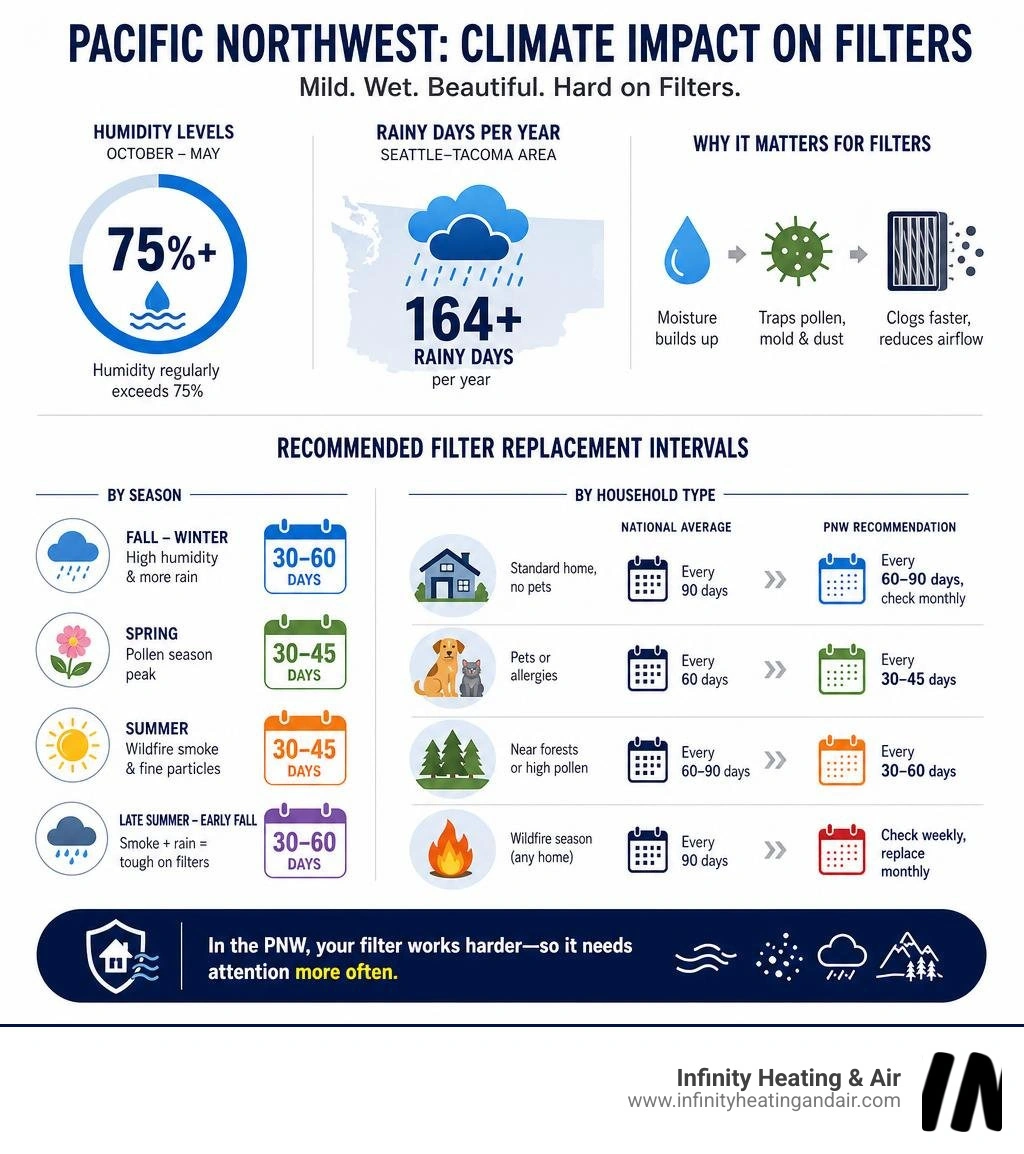
| Standard home, no pets | Every 90 days | Every 60-90 days, check monthly |
| Pets or allergies | Every 60 days | Every 30-45 days |
| Near forests or high pollen | Every 60-90 days | Every 30-60 days |
| Wildfire season (any home) | Every 90 days | Check weekly, replace monthly |
The Pacific Northwest's climate is deceptively demanding. Mild temperatures make it feel like your HVAC system isn't working hard — but it is. With humidity levels regularly exceeding 75% from October through May, and over 164 rainy days per year in the Seattle-Tacoma area, filters don't just collect dust. They absorb moisture, trap biological particles, and clog far more quickly than in drier parts of the country.
Add in seasonal Douglas fir and alder pollen surges each spring, plus summer wildfire smoke drifting in from eastern Washington and Oregon, and your filter is dealing with a year-round gauntlet of airborne challenges.
The result? A filter that would last 90 days in Phoenix or Denver may be struggling at 30-45 days in Bellingham or Olympia.
How Pacific Northwest Mild Wet Affects Filter Replacement Frequency
To truly understand why our filters take such a beating, we have to look at the physics of a damp climate. In drier regions, dust is light, powdery, and floats easily through the air. When it hits an air filter, it settles loosely on the fibers. Air can still pass around these loose particles relatively easily for months.
In Western Washington communities like Tacoma, Puyallup, and Lacey, our air is rarely dry. When the relative humidity consistently climbs above 75%, the airborne dust and particulate matter absorb this moisture. The particles become heavy, sticky, and swollen.
When this damp, heavy dust hits your filter, it doesn't sit loosely. It clings. This process, known as dust adhesion, causes the dust to form a dense, muddy barrier across your filter media. Instead of air flowing through tiny gaps, those gaps are quickly sealed shut by sticky, wet debris.
Furthermore, this damp environment is the perfect breeding ground for organic materials. Our mild wet weather acts like an incubator for mold spores, moss particles, and mildew. When these organic elements are pulled into your return vents, they settle on a moist filter. If the filter remains damp, these spores can begin to colonize the filter media itself, creating both a health hazard and a massive restriction to your system's airflow.
Your daily household habits can also accelerate this process during rainy weather. When it is pouring outside in places like Bonney Lake or Federal Way, we tend to keep our windows tightly shut to keep the dampness out. This traps indoor moisture from cooking, showering, and breathing inside the home.
While using bathroom and kitchen exhaust fans is crucial to venting this moisture, it also creates minor pressure drops that pull more air through your central HVAC system. If you aren't actively managing indoor humidity, your HVAC filter becomes the default dehumidifier and air scrubber, overloading it with moisture and debris.
Understanding these physical changes is the first step in realizing why keeping a close eye on your system is so critical. For a deeper look into how our unique regional weather challenges your entire heating and cooling system, check out our guide on the Benefits of Regular HVAC Maintenance in Pacific Northwest Mild Wet.
Recommended PNW Filter Replacement Intervals vs. National Averages
If you read the back of a standard air filter box, it will likely tell you that the filter lasts up to 90 days, or even a full year for thicker media filters. However, those manufacturer guidelines are based on average national climates—not the persistent marine dampness of Western Washington.
In our local service areas, from Olympia and Tumwater up to Auburn and Edgewood, we recommend a strict 30-day check and a maximum 90-day replacement schedule for standard homes. If your household includes pets, allergy sufferers, or resides near dense greenbelts, that replacement interval should drop to every 30 to 45 days.
To illustrate the difference, let’s look at how the Pacific Northwest compares to drier national averages:
| Filter Thickness & Type | National Average Lifespan | PNW Wet Season Lifespan | PNW Pollen/Smoke Lifespan |
|---|---|---|---|
| 1-Inch Fiberglass | 30 Days | 15–20 Days (Not Recommended) | 10–15 Days |
| 1-Inch Pleated (MERV 8-11) | 90 Days | 45–60 Days | 30–45 Days |
| 4-to-5-Inch Media Filter | 6–9 Months | 3–4 Months | 2–3 Months |
For households with pets, the combination of dander, fur, and moisture is particularly brutal. Pet dander is highly hygroscopic, meaning it absorbs water vapor easily. When wet dander hits a damp filter, it forms a felt-like mat that blocks air almost instantly.
If you or your family members suffer from seasonal allergies or asthma, leaving a filter in place for the standard national average of 90 days can lead to a severe buildup of mold spores and pollen, which are then recirculated through your home. To keep your indoor air clean and protect your system from strain, explore our detailed guide on Furnace Filter Replacement.
Choosing the Best Filter Types for Damp, Pollen-Heavy Climates
Choosing the right filter isn't just about grabbing the first option you see on the shelf at your local home improvement store in Puyallup or Gig Harbor. The material and design of your filter dictate how well it will handle moisture, heavy pollen loads, and seasonal wildfire smoke.
For a comprehensive breakdown of filter options, refer to our resource on the Best Air Filter for Your Home. In the meantime, let's explore how different MERV ratings and materials hold up under local conditions.
How Pacific Northwest Mild Wet Affects Filter Replacement Frequency for MERV 13 Filters
MERV (Minimum Efficiency Reporting Value) ratings range from 1 to 20, measuring a filter's ability to capture particles of various sizes. For most homes in our region, MERV 13 is the gold standard. It is highly efficient, capturing up to 90% of airborne particles between 1.0 and 3.0 microns, including fine dust, mold spores, pollen, and PM2.5 particles from wildfire smoke.
However, because MERV 13 filters have a tighter weave, they naturally create more resistance to airflow, known as static pressure. When you introduce the Pacific Northwest's high humidity, this resistance increases. As a MERV 13 filter absorbs moisture and captures fine particles, the static pressure can spike rapidly.
If left unchanged, this high static pressure forces your blower motor to work significantly harder, leading to increased energy consumption and potential system damage. In Washington, the State Energy Code (Section 502.4.2.1) requires systems to be designed to handle the pressure drop of upgraded filtration. Therefore, while MERV 13 is highly recommended for air quality, it must be monitored closely and changed every 30 to 60 days during peak damp or smoky seasons to prevent system strain.
How Pacific Northwest Mild Wet Affects Filter Replacement Frequency for Pleated vs. Fiberglass Filters
The debate between cheap fiberglass filters and pleated filters is easily settled when you live in a damp climate:
- Fiberglass Filters: These flat, see-through filters are designed to capture only the largest dust bunnies to protect the furnace motor. In our humid climate, fiberglass weaves offer virtually no protection against fine mold spores or pollen. Even worse, the fiberglass fibers do not absorb moisture well, allowing damp dust to pass straight through and accumulate on your wet evaporator coils, leading to rapid mold growth inside your system.
- Pleated Filters: Pleated filters use synthetic fibers folded into accordions, vastly increasing the surface area available to capture particles. This synthetic media is highly resistant to mold growth and holds its structural integrity when exposed to damp air. Because they have more surface area, they can hold a much larger volume of wet dust before restricting airflow, making them the superior choice for our region.
Seasonal Factors and Environmental Influences on Filter Lifespan
Our weather in Northwest Washington doesn't stay the same year-round, and neither should your filter replacement schedule. Each season brings a unique set of atmospheric challenges that dictate how quickly your system's lungs get dirty.
The Long, Wet Winters (October to March)
During our long, damp winters, your heating system runs almost continuously. Heat pumps in places like Olympia and Spanaway work around the clock. The constant stream of highly humid air passing through your system keeps your filter perpetually damp. This is the prime season for dust adhesion and mold spore accumulation. Filters should be checked every 30 days without fail.
The Spring Pollen Surge (April to June)
As the rain begins to clear, the evergreen trees of Western Washington wake up. Douglas fir, alder, and cedar pollen coat our cars, decks, and outdoor HVAC units in a thick layer of yellow dust. This heavy organic load is pulled into your home every time doors are opened. To protect your indoor air quality during this transition, read our Spring Air Filter Replacement Guide.
Summer Wildfire Smoke (July to September)
In recent years, late summers have brought periods of heavy wildfire smoke to the Puget Sound region. This smoke contains incredibly fine PM2.5 particulates that can bypass low-efficiency filters entirely. During active smoke events, standard filters can clog within a week or two. We recommend checking your filter weekly during smoke events and replacing it immediately if you notice discoloration or a campfire-like odor indoors.
Micro-Climates and Local Geography
Your home's physical surroundings also play a massive role:
- Forest Proximity: If you live in heavily wooded areas like Enumclaw, Orting, or Buckley, your filter will load much faster with moss spores, pine needles, and pollen.
- Urban Corridors: Homes near busy highways in Tacoma, Federal Way, or Auburn deal with high concentrations of traffic pollution and diesel particulate matter, requiring more frequent filter swaps to keep indoor air clean.
DIY Indicators and Real-Time Monitoring for PNW Homeowners
You don't need to be a professional HVAC technician to know when your filter has reached the end of its life. There are several simple, low-cost ways to monitor your filter's health in real time.
1. The Visual "Light Test"
The easiest way to check your filter is to hold it up to a bright light source or a window. If the light cannot pass through the filter media, air can't either. If your filter looks dark gray, brown, or has visible patches of dark mold or yellow pollen, it is time for a replacement.
2. The Musty Odor Sniff Test
Because of our high humidity, a clogged filter will often emit a damp, musty, or dirty-sock-like odor when the blower motor turns on. If you notice a strange smell coming from your vents in Bonney Lake or Lacey, your filter is likely holding too much moisture and organic debris.
3. The "Whistling" Airflow Test
Listen closely to your return vents. When a filter is heavily loaded, the blower motor has to suck air harder through the restricted media. This often creates a high-pitched whistling or humming sound near the return grille.
How to Inspect and Test Your Filter: A Step-by-Step Guide
- Turn Off the System: Always shut down your HVAC system at the thermostat before removing the filter to prevent dust from being sucked directly into the unprotected motor.
- Slide the Filter Out: Note the direction of the airflow arrow printed on the filter frame so you can install the new one correctly.
- Perform the Light Test: Hold it up to a light. If it's blocked, replace it.
- Inspect the Housing: Wipe down the inside of the filter slot with a dry microfiber cloth to remove any accumulated moisture or dust.
- Install the New Filter: Ensure the airflow arrow points toward the furnace or air handler unit, then slide it securely into place.
For advanced homeowners, installing a low-cost magnehelic gauge or a mini-manometer can provide real-time static pressure readings, showing you exactly when the pressure drop across the filter exceeds safe operating limits.
The Consequences of Neglecting Filter Changes in a Damp Climate
Waiting too long to change your filter in a damp climate is a gamble that can cost you dearly in utility bills and system repairs. When a wet, dirty filter blocks airflow, your entire comfort system suffers.
- Energy Waste: High humidity forces your HVAC system to work harder to manage latent heat (moisture). When you add a clogged filter to the mix, system efficiency can drop by 15% to 25%, causing a noticeable spike in your monthly energy bills.
- Heat Pump Strain: Because heat pumps in our region run year-round for both heating and cooling, they never get a season off. A restricted filter causes the system to short-cycle (turning on and off rapidly), which places immense thermal stress on the compressor.
- Reduced Equipment Lifespan: Neglecting simple filter swaps can reduce the lifespan of an expensive furnace or heat pump from a healthy 15-20 years down to just 10-12 years.
- Indoor Air Quality Issues: A dirty, damp filter can begin to release captured mold spores, dust mites, and allergens back into your home's air supply, leading to respiratory discomfort for your family.
To understand the full impact of deferred maintenance on your home's budget, take a look at our article on The True Cost of Neglecting HVAC Maintenance. To make sure you aren't missing any other critical system checks, print out our handy HVAC Maintenance Checklist.
Frequently Asked Questions about PNW Filter Maintenance
How often should I change my HVAC filter in the Seattle area?
For homes in South Puget Sound communities like Tacoma, Puyallup, and Olympia, we recommend checking your filter every 30 days. Replace it at least every 90 days for standard households, and every 30 to 45 days if you have pets, allergies, or live near dense evergreen forests.
Can high humidity cause my air filter to mold?
Yes. If your indoor humidity levels regularly exceed 60%, or if your HVAC filter remains damp due to heavy moisture loading during the wet season, mold spores captured by the filter can begin to grow. This is why using high-quality synthetic pleated filters and changing them regularly is so important.
What are the signs that my filter needs immediate replacement?
Key warning signs include weak airflow from your supply registers, a sudden spike in your monthly energy bills, increased dust settling on your furniture, musty odors when the system runs, or a high-pitched whistling sound near your return air vents.
Conclusion
Adjusting your filter replacement frequency to match the Pacific Northwest's unique mild, wet climate is one of the simplest and most effective ways to protect your home's indoor air quality and keep your heating and cooling system running efficiently. By switching to high-quality pleated filters, checking them every 30 days, and swapping them out before moisture and dust can choke your airflow, you ensure your system is always ready for whatever Western Washington weather throws its way.
At Infinity Heating & Air, we are proud to serve families across Pierce, Thurston, and South King Counties—from Tacoma and Puyallup to Olympia, Lacey, and beyond. We specialize in crafting endless comfort with reliable, expert service tailored specifically to our unique marine climate.
If you want to take the guesswork out of your home's heating, cooling, and air quality maintenance, we are here to help. Contact us today to learn more about our comprehensive Infinity Heating & Air Maintenance Plan and schedule your professional system tune-up.
Written & reviewed by the Infinity Heating & Air team — licensed WA HVAC contractor (INFINHA841B8). Family-owned in Graham, answering 24/7 across the South Sound.
Choose Infinity & enjoy endless comfort.
Your perfect home environment awaits — call (253) 740-5135 or schedule service online and our team will take it from there.
Open 24/7 · 100% Satisfaction Guaranteed · Graham, WA