Spring Maintenance to Prevent Summer Breakdowns: A Homeowner's Guide
Prepare for summer with spring ac and hvac maintenance. Boost efficiency, prevent breakdowns & save on bills in Northwest Washington.
Why Most AC Breakdowns Happen to Homeowners Who Skip This One Spring Step
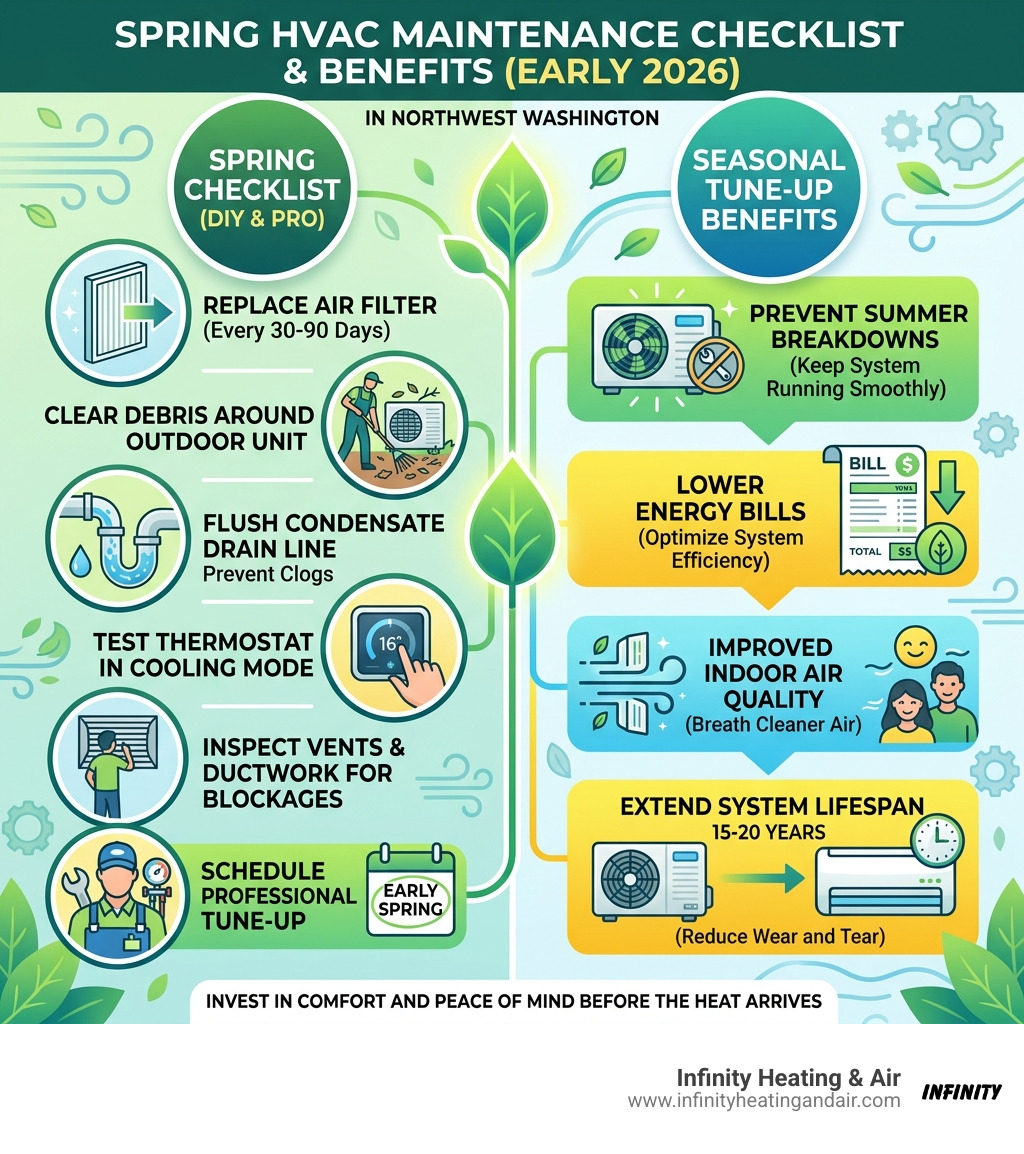
Spring AC and HVAC maintenance is the single most effective thing you can do to keep your home cool and your energy bills low all summer long.
Here's a quick summary of what it involves:
- Replace your air filter every 30–90 days (or monthly during heavy use)
- Clear debris from around the outdoor condenser unit and rinse the coils
- Flush the condensate drain line to prevent clogs and water damage
- Test your thermostat in cooling mode before the heat arrives
- Inspect vents and ductwork for blockages or leaks
- Schedule a professional tune-up in early spring — before the summer rush
These steps take just a few hours. Skipping them, though, can cost far more than the time you saved.
Heating and cooling already account for around 50% of your home's electricity bill. When your system is dirty, clogged, or out of tune, it works harder — and costs more — just to keep up. Worse, most AC failures don't happen on a mild Tuesday. They happen on the hottest day of the year, when every HVAC technician in the area is already booked solid.
In Northwest Washington, spring brings pollen, fluctuating temperatures, and stretches of surprisingly humid air. That combination puts real stress on systems that sat dormant all winter. A little attention now prevents a lot of misery in July.
Why spring ac and hvac maintenance is Essential Before Summer
As we move through April 2026, the transition from heating to cooling is officially underway. Many homeowners in places like Puyallup, Tacoma, and Olympia assume their air conditioner will simply "fire up" when the first heatwave hits. However, after sitting dormant for months, an HVAC system is often caked in dust, housing hibernating spiders, or suffering from minor electrical wear that can turn into a major failure under stress.
Scheduling spring ac and hvac maintenance is essential because it serves as a "wellness check" for your home’s lungs. By catching a weak capacitor or a small refrigerant leak now, you avoid the sinking feeling of your AC giving out during a 90-degree afternoon in July. Beyond just avoiding a breakdown, regular maintenance preserves your system’s longevity. A well-maintained unit can last 15 to 20 years, while a neglected one might fail a decade early, leading to a massive replacement bill long before you’re ready for it.
For more details on why timing is everything, check out our Spring HVAC Checklist: Preparing for Summer.
Maximizing Efficiency with spring ac and hvac maintenance
Efficiency isn't just a buzzword; it’s a direct reflection of how much of your hard-earned money is going to the utility company. Since heating and cooling account for roughly 50% of your home's electricity bill, even a slight drop in efficiency can lead to noticeable spikes in your monthly costs.
When dirt accumulates on your evaporator and condenser coils, it acts as insulation. This means your AC has to run longer and work harder to remove heat from your home. By optimizing airflow and ensuring every component is clean, you can reduce cooling costs significantly. In fact, replacing an old, neglected system with a well-maintained, high-efficiency unit could cut your energy costs by 20% to 40%. For a step-by-step guide on what to look for, see our AC Maintenance Checklist.

How do I prepare my Northwest Washington home for summer?
Preparing your home for the summer months in the Pacific Northwest involves a mix of simple DIY tasks and knowing when to call in the experts. Whether you are in Lacey or Gig Harbor, the damp winters can leave behind a mess of pine needles, moss, and debris that interfere with your HVAC system's performance.
To get started with your DIY maintenance, you’ll need a few basic tools:
- A screwdriver (to open access panels if necessary)
- A garden hose (not a pressure washer!)
- New high-quality air filters
- White vinegar or an anti-algae solution
- A soft brush or vacuum with a brush attachment
A common mistake homeowners make is using a pressure washer on their outdoor unit. The high pressure can easily bend the delicate aluminum fins, restricting airflow and causing the system to overheat. Always use a gentle stream from a standard garden hose. For local advice specific to our region, explore our page on AC Maintenance Puyallup.
Air Filter Care and Thermostat Testing
The air filter is arguably the most critical component of your HVAC system that you can manage yourself. Filters should generally be replaced every 30 to 90 days. However, in Northwest Washington, spring pollen can clog filters much faster. If you have pets or suffer from allergies, a monthly check is a must.
When choosing a filter, look at the MERV rating. A MERV 8 to 11 filter is usually the "sweet spot" for residential homes, offering a balance between high-quality air filtration and proper airflow. Be careful with MERV 13+ filters; unless your system was designed for them, they can be so restrictive that they actually damage your blower motor.
While you’re at it, test your thermostat. Switch it to "Cool" and set the temperature five degrees below the current room temp. Listen for the system to kick on and feel for cool air at the vents. If your thermostat uses batteries, spring is the perfect time to replace them to avoid a mid-summer blackout. Neglecting these small steps can lead to big headaches, as explained in The True Cost of Neglecting HVAC Maintenance.
Cleaning the Outdoor Condenser and Drain Lines
Your outdoor condenser unit needs to breathe. Over the winter, leaves, twigs, and overgrown shrubs can choke the unit. We recommend maintaining at least a two-foot clearance around the entire unit. Trim back any rhododendrons or ferns that have crept too close.
Next, focus on the condensate drain line. This line removes the moisture your AC pulls out of the air. In our humid climate, algae and mold love to grow in these lines, creating thick clogs that can cause water to back up into your home, leading to thousands of dollars in water damage. Pouring a cup of diluted white vinegar down the drain line access point every spring can help keep it clear. For more on year-round comfort, read our guide on Seasonal HVAC Preparation: Live in Comfort Year-Round.
What should I expect during a professional tune-up?
While DIY tasks are great for maintenance between visits, a professional tune-up is a deep dive into the "guts" of your system that requires specialized tools and training. Here is how DIY stacks up against what we do during a professional visit:
| Maintenance Task | DIY Capability | Professional Inspection |
|---|---|---|
| Filter Replacement | Yes | Included |
| Clear Debris Around Unit | Yes | Included |
| Rinse Condenser Coils | Yes | Deep Cleaning |
| Check Refrigerant Levels | No | Yes (Critical for Cooling) |
| Test Electrical Connections | No | Yes (Tighten & Inspect) |
| Calibrate Thermostat | Basic | Precision Calibration |
| Inspect Blower Motor/Belts | No | Yes (Lubricate & Test) |
| Ductwork Leakage Test | No | Yes (Visual & Pressure) |
A professional technician will measure the amperage and voltage on your blower motor, check for refrigerant leaks (which are often the silent killers of efficiency), and ensure that all safety controls are functioning. This level of detail is what keeps your system running reliably through the hottest stretches of August. Learn more about our process at HVAC Service Maintenance.
Scheduling Your Professional spring ac and hvac maintenance
The best time to schedule your spring ac and hvac maintenance is in March or April. By late May and June, HVAC companies are often booked two to four weeks out as the first heatwaves trigger emergency calls.
Booking early ensures you get a time slot that works for you and gives you the peace of mind that your system is ready before you actually need it. When our technician arrives, you can help by ensuring the area around both the indoor air handler and the outdoor condenser is clear of storage items or debris. This allows us to work efficiently and get your system back in top shape quickly. Check out our AC Service Maintenance page to see how we serve your specific neighborhood.
What are the warning signs that I need immediate HVAC service?
Sometimes, despite our best efforts, a system will show signs of distress. If you notice any of the following, don't wait for your scheduled maintenance—call for service immediately:
- Warm Air: If the air coming from your vents is lukewarm even when the AC is running, you could have a refrigerant leak or a failing compressor.
- Unusual Noises: Rattling, grinding, or squealing sounds often indicate a loose belt, failing motor bearings, or debris caught in the fan.
- Short Cycling: If your AC turns on and off every few minutes without cooling the house, it’s putting extreme strain on the compressor.
- Ice Formation: If you see ice on the refrigerant lines or the indoor evaporator coil, your system is likely suffering from restricted airflow or low refrigerant.
- Frequent Tripping: If your AC causes the circuit breaker to trip repeatedly, there is an electrical issue that needs professional attention.
Ignoring these signs can turn a simple fix into a total system replacement. Our Maintenance Plan is designed to catch these issues before they escalate.
Frequently Asked Questions about Spring HVAC Care
How often should air filters be replaced?
In Northwest Washington, we recommend checking your air filters once a month. While some high-capacity filters are rated for six months, the high pollen counts in spring and the dust from summer can clog them much faster. A clean filter is the easiest way to ensure healthy airflow and reduce wear on your blower motor.
What role does ductwork play in HVAC performance?
Your ductwork is the delivery system for your comfort. According to the Department of Energy, the average forced-air system loses 20 to 30 percent of conditioned air to duct leakage. This means you are paying to cool your attic or crawlspace! During a spring visit, we can inspect for gaps and suggest sealing options to ensure that the air you pay for actually reaches your living room. Discover more about our HVAC Service Plan and how it covers these vital inspections.
Is a year-round maintenance plan worth the investment?
Absolutely. A year-round plan, including both spring and fall tune-ups, is the cheapest insurance you can buy for your home. Not only does it keep your system efficient, but many manufacturer warranties actually require proof of annual professional maintenance to remain valid. Furthermore, a Maintenance Plan often provides priority scheduling, so if you do have an emergency, you’re at the front of the line.
Conclusion
At Infinity Heating & Air, we understand that your home is your sanctuary. Whether you are in Tacoma, Puyallup, or any of our surrounding Northwest Washington communities, we are committed to crafting endless comfort through reliable, expert service. Don't let the summer heat catch you off guard. By taking a few proactive steps now with spring ac and hvac maintenance, you can enjoy a cool, worry-free summer.
Ready to prepare your home for the season? Explore our Maintenance Plan today and let our experts ensure your HVAC system is ready for whatever the Pacific Northwest weather throws our way.
Written & reviewed by the Infinity Heating & Air team — licensed WA HVAC contractor (INFINHA841B8). Family-owned in Graham, answering 24/7 across the South Sound.
Choose Infinity & enjoy endless comfort.
Your perfect home environment awaits — call (253) 740-5135 or schedule service online and our team will take it from there.
Open 24/7 · 100% Satisfaction Guaranteed · Graham, WA