The Ultimate Guide to Knowing When Your HVAC System Is Officially Ancient
Discover how old is too old for an HVAC system. Learn lifespans, signs to replace, repair vs. replace, and boost efficiency now!
How Old Is Too Old for an HVAC System — and What That Means for Your Home
How old is too old for an HVAC system is one of the most common questions homeowners ask — and the answer depends on what type of equipment you have.
Here's a quick-reference breakdown:
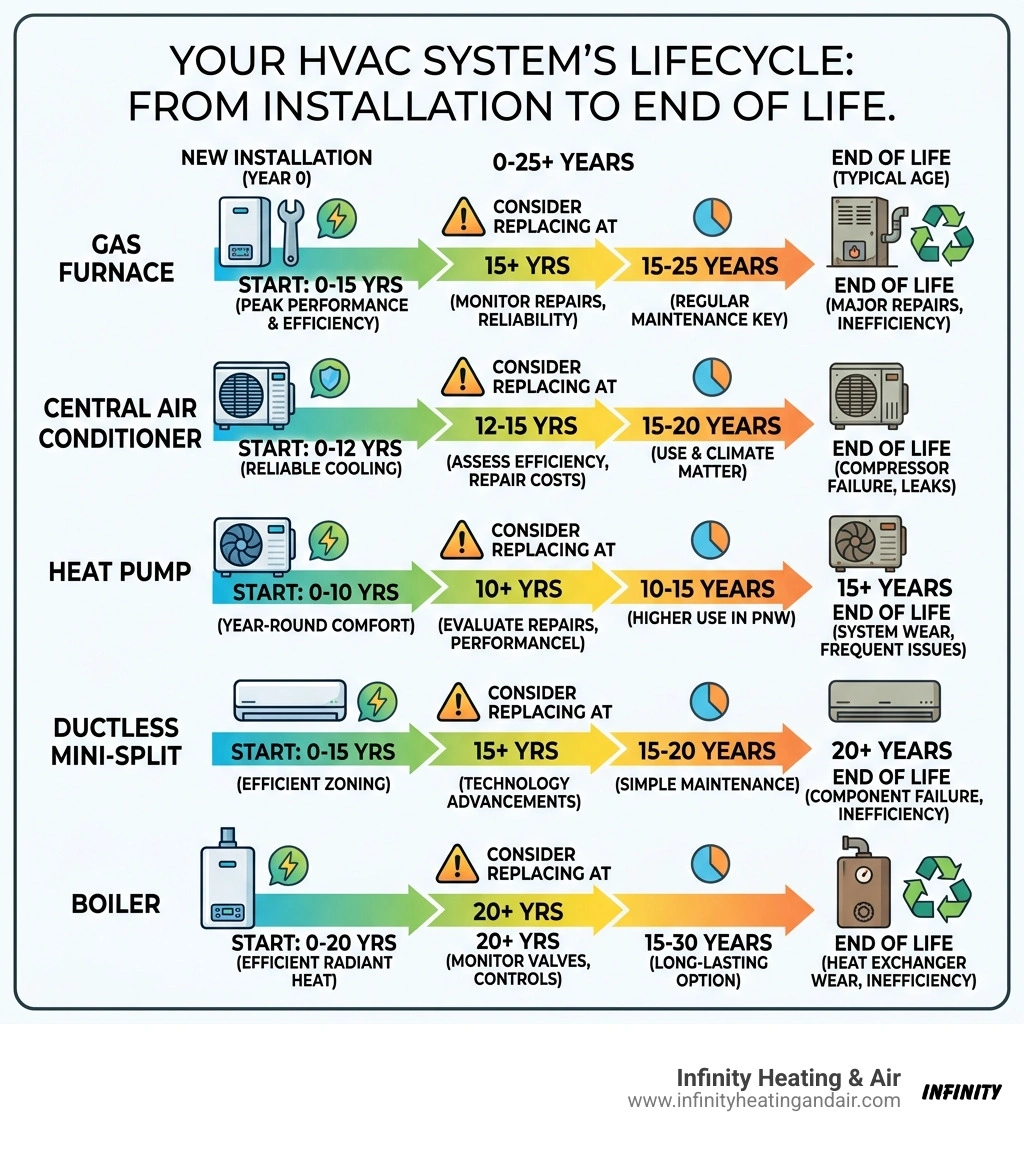
| System Type | Typical Lifespan | Consider Replacing At |
|---|---|---|
| Central Air Conditioner | 15-20 years | 12-15 years with issues |
| Gas Furnace | 15-25 years | 15+ years with breakdowns |
| Heat Pump | 10-15 years | 10+ years with problems |
| Ductless Mini-Split | 15-20 years | 15+ years |
| Boiler | 15-30 years | 20+ years |
The short answer: Most HVAC systems become "too old" somewhere between 12 and 20 years — but age alone isn't the whole story. A system that's been neglected at 12 years can be in worse shape than a well-maintained 18-year-old unit.
Here in Northwest Washington, our cold winters and humid summers put extra strain on heating and cooling equipment. That accelerates wear — sometimes significantly. Nearly one in three homeowners faces a major HVAC breakdown before their system ever reaches its expected lifespan. And when that breakdown hits on the coldest night of the year, you don't want to be making a rushed decision.
This guide will help you understand exactly where your system stands, what warning signs to watch for, and how to make a smart, confident decision about repair versus replacement.
Understanding the Average Lifespan of Your Home Comfort Equipment
When we talk about the lifespan of heating and cooling equipment, we are generally looking at "design life." This is the period during which the manufacturer expects the unit to operate reliably before the mechanical components simply wear out from friction, heat, and usage. In our service areas—from Tacoma and Puyallup down to Olympia and Yelm—the equipment we see follows a fairly predictable timeline.
Central Air Conditioners
The average central air conditioner is designed to last between 15 and 20 years. However, in humid or coastal regions, that lifespan can drop to as little as 8 to 14 years due to corrosion on the outdoor coils. Even if the unit is still spinning, by the time it reaches year 12, it has likely lost 20% to 30% of its original efficiency.
Gas Furnaces
Furnaces are the workhorses of Northwest Washington. Because we rely on them so heavily during our long, damp winters, they usually last between 15 and 25 years. A well-maintained furnace can sometimes push toward the 30-year mark, but the risk of a cracked heat exchanger increases significantly after year 20. It is vital to recognize the Signs That Your Furnace Needs to Be Repaired Before Winter to avoid a total system failure when you need heat the most.
Heat Pumps
Heat pumps work year-round, providing both heating and cooling. Because they are essentially "on" for most of the year, their mechanical components wear out faster than a furnace that only runs in the winter. You can typically expect 10 to 15 years from a standard air-source heat pump. In milder climates, or with meticulous maintenance, some may reach 20 years, but 12-15 is the "danger zone" where major component failures, like the reversing valve or compressor, become common.
Ductless Mini-Splits
These systems are becoming incredibly popular in places like Federal Way and Gig Harbor. They generally offer a lifespan of 15 to 20 years. Because they don't rely on ductwork, they don't face the same static pressure issues that can burn out motors in central systems, but the indoor blowers and outdoor inverter compressors still have a finite number of cycles in them.
Determining How Old Is Too Old for an HVAC System
If your system was installed during the Obama administration or before smartphones had facial recognition, it’s officially entering its "senior years." But at what point does "old" become "too old"?
The 10-Year Inflection Point
By year 10, most central air systems are operating at only 80% to 85% of their original efficiency. This is also when most manufacturer parts warranties expire. If a major component like the compressor or the evaporator coil fails after year 10, you are looking at significant out-of-pocket expenses. This is often the point where we suggest homeowners start a "replacement fund" so they aren't caught off guard.
The 15-Year Threshold
For almost any system—AC, furnace, or heat pump—15 years is a major milestone. At this age, the technology is often two or three generations behind. Modern systems are significantly quieter and more efficient. If your 15-year-old system needs a repair that costs more than a few hundred dollars, it is almost always more economical to invest that money into a new unit. You can read more about this transition in our guide on When to Replace Your HVAC System.
Efficiency Degradation
Think of your HVAC system like an old car. Even if it still gets you from point A to point B, it’s likely burning more fuel and requiring more oil than it did a decade ago. Internal components like fan motors and compressors draw more "amps" as they age, meaning they use more electricity to do the same amount of work.
Key Indicators Your System Is Nearing Retirement
Age is just a number, but performance doesn't lie. If you aren't sure how old is too old for an HVAC system in your specific home, look for these physical "symptoms" of a system in decline.
1. Uneven Temperatures
Have you noticed that the living room is a meat locker while the upstairs bedrooms are sweltering? Or perhaps your guest room in your Lacey home stays chilly no matter how high you crank the heat? As systems age, they lose their "capacity"—their ability to move the required amount of heat or cold air. This often results in uneven comfort throughout the house.
2. Frequent Breakdowns
One repair every few years is normal maintenance. However, if you find yourself calling us for a "quick fix" every single season, your system is trying to tell you something. Nearly one in three homeowners faces a major breakdown before the end of the system's life, and these frequent, smaller repairs can quickly add up to the cost of a new system without providing any of the long-term reliability.
3. Rising Utility Bills
Compare your energy bills from this year to those from three or four years ago. If your usage habits haven't changed but your bills have spiked by 20% or more (adjusting for utility rate hikes), your system is likely struggling. An aging AC can lose 20-30% efficiency by year 12, forcing it to run longer cycles to reach the temperature set on your thermostat.
4. Unusual Noises
Your HVAC system should be a background hum, not a heavy metal concert. Banging, whistling, or screeching noises often indicate that the motor bearings are failing or the compressor is on its last legs. If your unit sounds like a "Summer Disaster Waiting to Happen," it's time to Replace Air Conditioner components or the entire unit.
Aging Signs vs. Normal Operation
| Symptom | Normal Operation | Sign of Aging/Failure |
|---|---|---|
| Sound | Steady hum or click at start | Grinding, squealing, or loud thumping |
| Airflow | Strong, consistent breeze | Weak airflow or "hot spots" |
| Cycle Length | 10-15 minutes, 2-3 times an hour | Running constantly or "short cycling" |
| Smell | Dusty smell at first start of season | Burning plastic, sulfur, or moldy odors |
| Bills | Slight fluctuations with weather | Steady increase year-over-year |
The Role of Refrigerants and Efficiency in Replacement Decisions
The technology inside HVAC units has changed more in the last 15 years than in the 50 years prior. When deciding if a system is too old, we have to look at what's inside the machine—specifically the refrigerant and the efficiency ratings.
SEER2 and AFUE Standards
Efficiency is measured by SEER2 (for cooling) and AFUE (for heating).
- SEER2 (Seasonal Energy Efficiency Ratio): Older systems might be SEER 10 or 13. Modern units start at SEER2 14 or 15 and can go well above 20. Moving from a SEER 10 to a SEER2 17 can reduce your cooling energy use by nearly 40%.
- AFUE (Annual Fuel Utilization Efficiency): This measures how much gas is actually turned into heat. An old furnace might be 80% AFUE, meaning 20 cents of every dollar goes up the chimney. Modern high-efficiency furnaces reach 96% to 98% AFUE.
Upgrading to ENERGY STAR certified units can save you up to 20% on heating and cooling costs compared to units more than 10 years old. However, these savings only materialize if the system is properly maintained. You can learn about the risks of skipping service in our post on The True Cost of Neglecting HVAC Maintenance.
Is a 12-year-old system using R-22 how old is too old for an HVAC system?
If your air conditioner was manufactured before 2010, there is a high chance it uses R-22 refrigerant (often called Freon). The EPA officially banned the production and import of R-22 on January 1, 2020.
Why this matters: If your R-22 system develops a leak, the cost to "recharge" it is astronomical because we are relying on dwindling recycled stockpiles. A simple leak repair that used to be affordable can now cost as much as a significant down payment on a new system. If your unit uses R-22 and has a major mechanical failure, it is officially "too old" because the parts and refrigerant are becoming obsolete. This is a primary factor when considering When Should You Replace Your Furnace or AC combo.
How energy efficiency determines how old is too old for an HVAC system
Modern systems often feature variable-speed compressors. Unlike older "single-stage" systems that are either 100% on or 100% off, variable-speed units can ramp up or down to meet the exact needs of your home. This prevents the "blast of cold air" followed by "stale warmth" cycle, providing much better humidity control—which is a blessing during our humid Northwest Washington summers.
Repair vs. Replace: Making the Final Call in Northwest Washington
Deciding whether to sink more money into an old unit or start fresh is a big financial decision. In our experience serving communities like Auburn, Bonny Lake, and University Place, we recommend using two simple "math rules."
The 50% Rule
If the cost of a single repair is 50% or more of the cost of a new system, you should almost always replace it. Why? Because a major repair on an old unit doesn't reset the "clock" for the rest of the components. You might fix the compressor today only to have the fan motor die next month.
The $5,000 Rule (The Rule of 5,000)
This is a favorite among HVAC professionals. Multiply the age of the system by the cost of the repair. If the number is more than $5,000, it’s time to replace.
- Example A: A 10-year-old system needs a $300 repair. (10 x 300 = 3,000). Repair it.
- Example B: A 15-year-old system needs an $800 repair. (15 x 800 = 12,000). Replace it.
Safety Risks and Carbon Monoxide
This is the most critical factor. As gas furnaces age, the heat exchanger—the part that keeps combustion gases separate from the air you breathe—can develop stress cracks. A cracked heat exchanger can leak carbon monoxide (CO) into your home. Under safety codes, if a technician finds a cracked heat exchanger, they are often required to shut the system down immediately. In this scenario, the system is "too old" for safety reasons, regardless of how well it was heating the home.
Proactive Planning
The worst time to replace an HVAC system is in the middle of a heatwave in July or a snowstorm in January. When you are in an emergency, you don't have time to research efficiency ratings or wait for the specific model you want. By being proactive and replacing a system that is showing signs of age during the "shoulder seasons" (Spring and Fall), you can take advantage of better scheduling and ensure your home stays comfortable year-round. We highly recommend looking into an HVAC Service Plan to keep a professional eye on your system's health.
Frequently Asked Questions about HVAC Longevity
Can a well-maintained furnace last 30 years?
While rare, it is possible. We occasionally see "vintage" furnaces in older homes in Tacoma or Olympia that are still chugging along. However, even if they are "running," they are usually incredibly inefficient (often 60-70% AFUE) and lack modern safety features. Reliability engineering follows a "bathtub curve"—failures are common at the very beginning (infant mortality) and at the very end (wear-out phase). A 30-year-old furnace is deep in the wear-out phase, and a catastrophic failure is a matter of "when," not "if."
Does the Northwest Washington climate affect system life?
Yes, absolutely. Our climate is unique. While we don't have the extreme 115-degree heat of Arizona, our high humidity can lead to "pitting corrosion" on outdoor coils. Furthermore, homes near the Puget Sound (like Steilacoom or Gig Harbor) deal with salt air, which can accelerate the breakdown of aluminum and copper components. Our long heating seasons also mean our furnaces and heat pumps log many more "run hours" than systems in the southern U.S.
Is it better to replace the AC and furnace together?
In most cases, yes. Your furnace and AC (or heat pump) share the same blower motor and ductwork. When you replace them together, you ensure that the components are "matched." A brand-new, high-efficiency AC coil won't perform at its rated SEER2 if it's sitting on top of a 20-year-old furnace with a weak, outdated blower motor. Plus, you save significantly on labor costs by having the team perform both installations at once.
Conclusion
Knowing how old is too old for an HVAC system is about more than just checking the manufacture date. It’s about balancing comfort, safety, and your monthly budget. While a system might "still be running," the hidden costs of inefficiency, frequent repairs, and the looming threat of a mid-winter breakdown often make replacement the smarter financial move.
At Infinity Heating & Air, we are proud to be the Northwest Washington experts in crafting endless comfort. Whether you are in Puyallup, Spanaway, or Sumner, our team is dedicated to providing reliable, expert service that takes the guesswork out of home maintenance. We don't just install boxes; we design systems that fit the unique needs of your home and our local climate.
Don't wait for your system to fail on the coldest night of the year. If your system is pushing 12, 15, or 20 years, let's take a proactive look at your options together. Schedule your Northwest Washington HVAC consultation today and experience the peace of mind that comes with a truly reliable home comfort system.
Written & reviewed by the Infinity Heating & Air team — licensed WA HVAC contractor (INFINHA841B8). Family-owned in Graham, answering 24/7 across the South Sound.
Choose Infinity & enjoy endless comfort.
Your perfect home environment awaits — call (253) 740-5135 or schedule service online and our team will take it from there.
Open 24/7 · 100% Satisfaction Guaranteed · Graham, WA