Filter Your Way to Happiness: The Best Home Options
Discover the best air filter for your home: Compare MERV, FPR, MPR ratings, tackle pets, allergies, VOCs & protect your HVAC. Expert tips!
Clean Air Starts Here: Finding the Best Air Filter for Your Home
The best air filter for your home depends on your specific needs — but here's a quick breakdown to get you started:
Top air filter choices by need:
| Need | Recommended Filter | MERV Rating |
|---|---|---|
| General dust and pollen | Pleated filter | MERV 8 |
| Allergies and pet dander | High-efficiency pleated | MERV 11-13 |
| Odors and VOCs | Activated carbon filter | MERV 8-13 |
| Bacteria and fine particles | Media filter or whole-home HEPA | MERV 13-16 |
| Viruses and ultra-fine particles | HEPA system (standalone or bypass) | MERV 15+ |
Most homes do well with a MERV 8 to MERV 13 filter. It's the sweet spot between effective filtration and keeping your HVAC system healthy.
Here's why this matters more than you might think. Over one-third of Americans live in areas with unhealthy air quality. And indoor air? It can actually be two to five times more polluted than the air outside, according to the EPA.
For homeowners in Northwest Washington — where seasonal pollen, moisture, and wildfire smoke are real concerns — choosing the right air filter isn't just a comfort decision. It's a health one.
The tricky part is that the filter market is full of competing rating systems, confusing specs, and options that range from basic fiberglass to hospital-grade HEPA. It's easy to grab the wrong one.
This guide cuts through the noise and helps you find the filter that actually fits your home, your HVAC system, and your air quality goals.

I’m looking for the best air filter for your home. How do MERV, FPR, and MPR ratings compare?
When you walk into a hardware store in Puyallup or Tacoma, you’ll see numbers everywhere. These are rating systems designed to tell you how "tight" the filter weave is. The tighter the weave, the smaller the particles it can catch.
Understanding MERV (Minimum Efficiency Reporting Value)
MERV is the industry standard developed by ASHRAE. It ranges from 1 to 20. For residential use, MERV 8 is the baseline, while hospitals typically use MERV 14 to 20. A MERV 13 filter is a powerhouse for residential homes, capturing more than 90% of contaminants as small as 3 microns.
Deciphering FPR and MPR
If you shop at big-box retailers, you’ll encounter proprietary scales:
- FPR (Filter Performance Rating): This is a 1–12 scale. It weights large particle capture at 60%, small particles at 30%, and "weight gain" (how much it can hold before failing) at 10%.
- MPR (Microparticle Performance Rating): This focuses on the filter's ability to trap particles between 0.3 and 1 micron.
Why Particle Microns Matter
To give you some perspective, a human hair is about 45 microns wide. HEPA filters are designed to trap particles as small as 0.3 microns. That includes things you can’t see but definitely feel, like bacteria, smoke, and even some viruses.
Comparison Table: Rating Systems at a Glance
| MERV (Industry) | FPR (Retail A) | MPR (Retail B) | What it Captures |
|---|---|---|---|
| 6-8 | 4-5 | 300-600 | Dust, lint, pollen |
| 11 | 7-8 | 1000-1200 | Pet dander, dust mites, mold spores |
| 13 | 9-10 | 1500-1900 | Bacteria, smoke, microscopic allergens |
| 14-16 | 10+ | 2200-2800 | Viruses, ultra-fine particles |
Which filter types are most effective for Northwest Washington households?

In the May 2026 climate of Northwest Washington, we deal with a unique mix of dampness (hello, mold spores!) and beautiful but pollen-heavy springs. Choosing the best air filter for your home means picking a material that handles our local air.
Fiberglass Filters
These are the "spun glass" filters you often see for a few dollars. Truthfully? They are designed to protect your HVAC equipment from large "bunnies" of dust, but they do almost nothing for your lungs. We generally recommend moving past these if you care about indoor air quality.
Pleated Media Filters
These are the most common choice. The "pleats" create more surface area, allowing the filter to catch more debris without instantly choking off your airflow. For most of our neighbors in Lacey or Olympia, a high-quality pleated filter is the gold standard. Check out our Spring Air Filter Replacement Guide for more on seasonal timing.
HEPA Systems
True HEPA filters are so dense that a standard residential furnace fan often can’t push air through them. They usually require a "bypass" system with its own motor. These are incredible for households with severe respiratory issues, as they trap 99.97% of particles.
Electrostatic Fibers
Some filters use self-charging paper or cotton fibers that act like a magnet for dust. These are excellent for smaller particles but need to be replaced regularly to maintain that "magnetic" charge.
Best air filter for your home with pets and allergies
If you share your home in Gig Harbor with a Golden Retriever or a fluffy cat, you know pet dander is a constant battle. For these homes, we recommend a MERV 11 to MERV 13 filter. This level of filtration is specifically designed to snag microscopic dander and pollen spores before they settle on your furniture.
Best air filter for your home to combat VOCs and odors
Standard filters don't stop smells. If you’re dealing with "old house smell," cooking odors, or VOCs (Volatile Organic Compounds) from new carpets or paint, you need an activated carbon layer. These filters use a process called adsorption to trap gas molecules and odors. Some even include baking soda or antimicrobial layers to suppress mold and bacteria growth.
How can I balance high-efficiency filtration with HVAC system health?
Here is where many homeowners make a costly mistake. They buy the "highest" MERV rating possible, thinking more is better. However, a filter that is too thick or dense acts like a wall.
Your HVAC system is designed to "breathe" a certain amount of air. If the filter is too restrictive, it increases static pressure. This forces your blower motor to work twice as hard, leading to:
- Energy Inefficiency: Your bills go up because the system runs longer.
- Blower Motor Strain: The motor can overheat and eventually fail.
- Reduced Comfort: You might notice certain rooms aren't getting as cold or warm as they used to.
The secret is finding the balance. Most residential systems in areas like Federal Way or Auburn can handle up to a MERV 13 filter if it is a high-quality pleated version. If you want to go higher, you should consider a 4-inch or 5-inch "media cabinet" upgrade, which provides a massive surface area to keep airflow high while catching tiny particles. Learn more about the mechanics in our guide on Furnace Filter Replacement.
What are the most common mistakes when measuring and replacing filters?
It sounds simple, but getting the wrong size is the #1 reason filters fail to work.
Nominal vs. Actual Size
Look at the side of your filter. You’ll see numbers like "20x25x1." This is the nominal size (the rounded-up version). If you take a tape measure to it, the actual size might be "19.5 x 24.5 x 0.75." Always buy based on the nominal size printed on the frame, but ensure it fits snugly. If there’s a gap, air will simply "bypass" the filter, carrying dust straight into your lungs and your furnace.
Airflow Direction
Every filter has an arrow printed on the side. That arrow must point toward the furnace/air handler. If you install it backward, the structural mesh that holds the filter together won't be able to support the pressure, and the filter could collapse into your machinery.
Replacement Frequency
In May 2026, we recommend checking your filter every 30 days. While some media filters claim to last a year, most 1-inch pleated filters should be swapped every 60 to 90 days. If you have pets or live near a construction site in a growing area like Tehaleh, you might need to change it every month.
Standard Filter Maintenance Steps:
- Turn off your HVAC system at the thermostat.
- Locate the filter slot (usually in the return air duct or the furnace cabinet).
- Slide out the old filter and check for heavy gray dust buildup.
- Slide in the new filter with the arrow pointing toward the unit.
- Secure the door or cover to prevent air leaks.
- Set a calendar reminder for 60 days from now!
Frequently Asked Questions about Home Air Filtration
How often should I replace my air filter in 2026?
For most Northwest Washington homes, replacing your filter four to six times a year is the sweet spot. If you have a 4-inch media filter, you can often go 6 to 9 months. However, if you have heavy allergies or pets, stick to every 2 months for 1-inch filters.
Can a high-MERV filter damage my furnace?
Yes, if it’s a 1-inch filter with a very high MERV rating (like MERV 14+), it can restrict airflow enough to cause the system to "limit out" or overheat. If you want high-level filtration, we recommend upgrading to a deeper media cabinet (4–5 inches) which allows for high MERV without the airflow restriction.
What is the difference between nominal and actual filter sizes?
Nominal size is the name of the filter (e.g., 16x20x1), which is what you look for on the store shelf. Actual size is the exact measurement of the filter. Manufacturers make filters slightly smaller than the slot so they slide in easily.
Conclusion
Finding the best air filter for your home doesn't have to be a guessing game. By understanding MERV ratings and respecting your HVAC system's need for airflow, you can create a sanctuary of clean air for your family. Whether you are in Tacoma, Olympia, or anywhere in between, the right filtration is the foundation of a healthy home.
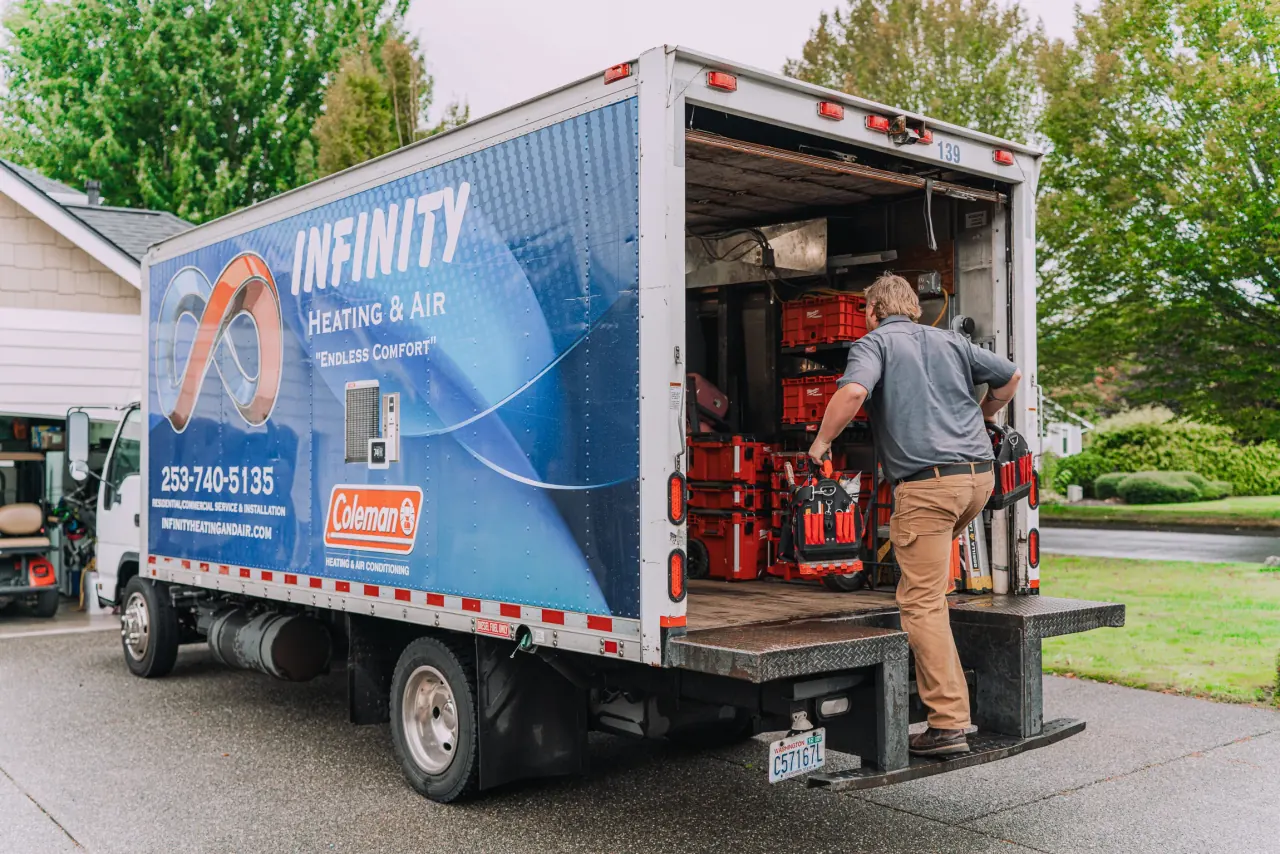
At Infinity Heating & Air, we are your Northwest Washington experts in indoor air quality. We don't just fix heaters; we craft endless comfort by ensuring the air you breathe is as pure as possible. If you're tired of guessing which filter is right for your specific system, or if you're interested in upgrading to a whole-home HEPA or media system, we are here to help.
Ready to breathe easier? Ensure your system is running at peak performance and your air is crystal clear with endless comfort with a reliable maintenance plan. Reach out to our team today for a professional consultation!
Written & reviewed by the Infinity Heating & Air team — licensed WA HVAC contractor (INFINHA841B8). Family-owned in Graham, answering 24/7 across the South Sound.
Choose Infinity & enjoy endless comfort.
Your perfect home environment awaits — call (253) 740-5135 or schedule service online and our team will take it from there.
Open 24/7 · 100% Satisfaction Guaranteed · Graham, WA