Step-by-Step Guide to Signs Your HVAC Needs Replacing, Not Just Fixing
Learn the signs your hvac needs replacing not just fixing with this step-by-step guide for Northwest Washington homeowners.
.webp)

How to Tell If Your HVAC Needs Replacing, Not Just Fixing
Knowing the signs your HVAC needs replacing not just fixing can save you from wasting money on repairs that only delay the inevitable. Most homeowners wait until their system completely stops working — and that reactive approach almost always costs more.
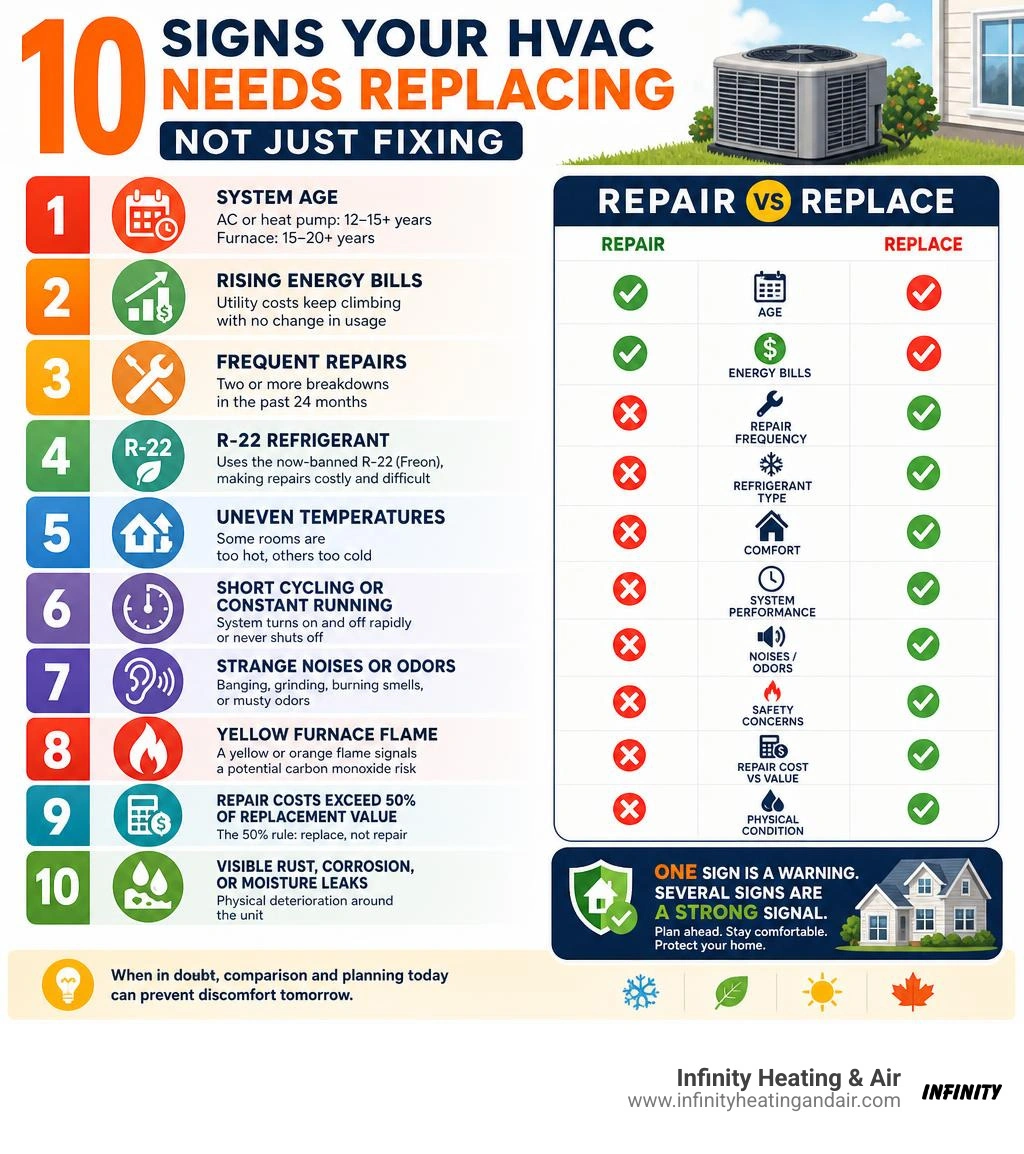
Here are the clearest signs your HVAC system needs replacement, not another repair call:
- System age — Your AC or heat pump is 12–15+ years old, or your furnace is 15–20+ years old
- Rising energy bills — Utility costs keep climbing with no change in usage
- Frequent repairs — You've had two or more breakdowns in the past 24 months
- R-22 refrigerant — Your system uses the now-banned R-22 (Freon), making repairs costly and difficult
- Uneven temperatures — Some rooms are too hot, others too cold
- Short cycling or constant running — The system turns on and off rapidly or never shuts off
- Strange noises or odors — Banging, grinding, burning smells, or musty odors
- Yellow furnace flame — A yellow or orange flame signals a potential carbon monoxide risk
- Repair costs exceed 50% of replacement value — The 50% rule says replace, not repair
- Visible rust, corrosion, or moisture leaks — Physical deterioration around the unit
Any one of these signs deserves attention. Several of them together? That's a strong signal it's time to replace.
For homeowners in Northwest Washington — where winters are cold and wet and summers can bring unexpected heat events — a failing HVAC system isn't just uncomfortable. It can be a real safety concern. The good news: recognizing these warning signs early gives you time to plan, rather than scramble during a breakdown.
The sections below walk through each sign in detail so you can make a confident, informed decision.
Important signs your hvac needs replacing not just fixing terms:
The Lifespan Factor: How System Age Influences Your Decision
One of the most objective baselines we use to evaluate any heating or cooling system is its age. While routine maintenance can help push equipment to the upper limits of its lifespan, mechanical parts naturally degrade over time. In Northwest Washington, our systems work hard to combat bone-chilling winter humidity and increasingly warm summer afternoons.
If you are trying to determine how old is too old for an hvac system, the Department of Energy recommends starting the replacement conversation once a system crosses the 10-to-15-year threshold. Beyond this point, the likelihood of major component failure rises sharply, and overall operating efficiency drops.
When is an Air Conditioner or Heat Pump Past Its Prime?
Most modern residential air conditioners and heat pumps have a service life expectancy of 10 to 12 years, though some well-maintained units can stretch to 15 years.
As a cooling system ages, the compressor—the "heart" of the system—experiences significant wear. When the compressor begins to fail, the system must work much harder to cool your home, leading to severe efficiency degradation. An older system rated at 14 SEER when first installed may only operate at an 8 or 10 SEER level after a decade of continuous service. If you notice your home is taking longer to cool down or you are constantly searching for signs your ac needs repair, age is likely the underlying driver.
Furnace and Boiler Lifespans in Northwest Washington
Heating systems generally enjoy a slightly longer operational lifespan than cooling units, but they are not immortal.
- Gas Furnaces: Typically last 15 to 20 years.
- Boilers: Can operate reliably for 15 to 25 years with pristine maintenance.
Our wet, damp winters in Puget Sound communities like Tacoma, Puyallup, and Olympia place heavy demands on heating equipment. Over 15 to 20 years, the constant expansion and contraction of a furnace’s metal heat exchanger can lead to structural fatigue. If your heating system is approaching its second decade, keeping it on life support with frequent repairs is often a losing financial battle.
Financial Formulas: The 50% Rule and the $5,000 Rule
When your heating or cooling system breaks down, it can be tough to make an objective decision under pressure. To take the emotion out of the equation, we recommend utilizing two industry-standard financial formulas. These guidelines help determine if a repair is a smart investment or if you are simply throwing good money after bad. You can explore a detailed breakdown of these scenarios in our HVAC repair vs replace complete guide.
Applying the 50% Rule to Major Component Failures
The 50% rule is straightforward: If the cost of a single repair exceeds 50% of the value of a brand-new replacement system, you should replace the unit.
This rule is particularly relevant when dealing with critical component failures. For instance, if your heat pump’s compressor fails or your furnace’s heat exchanger cracks, the cost to source and install these parts is incredibly high. Opting for a major repair on a system that is already out of warranty rarely makes financial sense, as other aging components within the unit are likely to fail shortly thereafter.
How the $5,000 Rule Helps Identify Signs Your HVAC Needs Replacing Not Just Fixing
The $5,000 rule is another excellent mathematical framework for homeowners. To apply it, you multiply the age of your HVAC system by the estimated cost of the repair. If the total number is greater than $5,000, replacement is almost always the more economical long-term decision.
Let's look at how this math plays out in real-world scenarios:
- Scenario A: You have a 6-year-old system that requires a minor blower motor repair. The repair estimate is reasonable. Multiplying 6 (years) by the repair cost yields a number well under the 5,000 threshold. In this case, repairing the system is highly logical.
- Scenario B: You have a 14-year-old system facing a moderate repair. Multiplying 14 (years) by that repair estimate easily clears the 5,000 limit. Even though the individual repair isn't as expensive as a new system, the unit's advanced age makes replacement the smarter financial move.
For a deeper dive into managing these scenarios, check out our HVAC repair vs replacement ultimate guide.
Performance Red Flags: Comfort, Efficiency, and Air Quality

A functional HVAC system should run quietly in the background while keeping your indoor climate perfectly balanced. When a system is on its last legs, it will begin to show performance red flags that directly impact your daily comfort, indoor air quality, and monthly budget. Ignoring these issues often leads to the true cost of neglecting hvac maintenance, which can result in sudden, catastrophic system failure.
Rising Energy Bills and Declining System Efficiency
Have you noticed your gas or electric bills creeping upward, even though your local utility rates have remained relatively stable? This is a classic indicator of declining system efficiency.
As internal components wear out, the system must run longer and work harder to achieve the temperature set on your thermostat. According to the Department of Energy, poor maintenance and system degradation can drive home energy use up by 5% to 20% each year. Furthermore, aging systems running at a degraded 8 to 10 SEER instead of their original, higher ratings can add hundreds of dollars per year in wasted energy costs. Upgrading to a modern system with updated SEER2 (Seasonal Energy Efficiency Ratio) and AFUE (Annual Fuel Utilization Efficiency) standards immediately plugs this financial leak.
Short Cycling, Constant Running, and Uneven Temperatures
As equipment degrades, you will likely notice a significant drop in consistent indoor comfort:
- Short Cycling: This occurs when your air conditioner or furnace turns on, runs for a brief couple of minutes, and abruptly shuts off before completing a full heating or cooling cycle. This rapid starting and stopping places immense electrical and mechanical strain on the system.
- Constant Running: Conversely, a system that runs non-stop without ever reaching your thermostat’s set point is struggling to produce enough conditioned air. This is common during extreme winter cold snaps or summer heatwaves.
- Uneven Temperatures: If your living room feels like an icebox while your upstairs bedroom is a sauna, your system may no longer have the airflow velocity required to push air through your ductwork. This comfort mismatch is a strong indicator that the system is failing to meet your home's load demands.
Critical Technical Indicators and Safety Hazards
While high utility bills and uneven temperatures are frustrating, some signs your hvac needs replacing not just fixing are outright safety hazards. Protecting your family from electrical fires, gas leaks, and carbon monoxide poisoning should always be your top priority. Keeping up with annual hvac maintenance: is it worth it? is the best way to catch these severe hazards before they threaten your household.
Why R-22 Refrigerant is a Clear Sign Your HVAC Needs Replacing Not Just Fixing in 2026
If your air conditioner or heat pump was manufactured before 2010, there is a very high probability that it operates on R-22 refrigerant (commonly known as Freon). Due to its ozone-depleting properties, the EPA completely banned the production and import of R-22.
In 2026, the available supply of recycled R-22 is incredibly scarce. If an older system develops a refrigerant leak, recharging the unit is extremely expensive. Furthermore, patching leaks on an outdated copper coil is often a temporary fix. Investing in a modern system that utilizes environmentally friendly, readily available refrigerants is the only practical path forward.
Cracked Heat Exchangers and Yellow Burner Flames
For homeowners utilizing gas furnaces, physical damage to the combustion assembly is a critical safety hazard:
The heat exchanger is the metal chamber that keeps toxic combustion byproducts (like carbon monoxide) separate from the clean air circulating through your home. If a heat exchanger cracks due to age or overheating, carbon monoxide can escape directly into your living spaces.
A primary indicator of incomplete combustion or a cracked heat exchanger is a yellow or orange burner flame instead of a crisp, steady blue flame. If you notice a yellow furnace flame, shut your system down immediately and contact a professional technician to evaluate the unit.
Sensory Warning Signs: Noises, Odors, and Visible Wear
Your senses are highly effective diagnostic tools. If you can see, hear, or smell that something is wrong with your heating and cooling equipment, it is usually a sign that internal components are undergoing severe stress.
Rattling, Clanking, and Screeching Sounds
While no HVAC system is completely silent, it should produce a predictable, gentle hum when operating. Loud, erratic noises are a clear cry for help:
- Rattling or Clanking: Often points to loose components, failing fan blades, or a dying compressor motor.
- Screeching or Squealing: Typically indicates a failing blower motor belt or worn-out bearings.
- Grinding: Suggests metal-on-metal contact, which can rapidly destroy expensive internal machinery.
If turning on your heater or air conditioner sounds like a construction site, the system is likely nearing a total mechanical breakdown.
Musty Smells, Burning Odors, and Moisture Leaks
Strange odors and excess moisture around your indoor or outdoor units should never be ignored:
- Musty, Dusty Smells: Often indicate mold or mildew growth inside your ductwork or evaporator coil, which can severely compromise indoor air quality.
- Burning Metal or Plastic Odors: Suggest electrical overheating, failing wiring, or a burning blower motor. If you smell electrical burning, shut down the system at the breaker panel immediately.
- Moisture Leaks: While minor condensation is normal, heavy puddling around your indoor furnace or outdoor heat pump indicates a blocked condensate line, a frozen evaporator coil, or a serious refrigerant leak. Over time, standing water can cause extensive structural rot and mold growth in your home.
Frequently Asked Questions About Signs Your HVAC Needs Replacing, Not Just Fixing
How do I know if my system uses R-22 refrigerant?
To determine what type of refrigerant your air conditioner or heat pump uses, locate the manufacturer's nameplate label on the side of your outdoor condenser unit. This label lists key technical specifications, including the model number, serial number, and the specific chemical refrigerant type.
If the label lists R-22 or HCFC-22, your system uses the phased-out refrigerant. Additionally, if the unit was manufactured before 2010, it almost certainly relies on R-22.
Should I replace my furnace and air conditioner at the same time?
Yes, in the vast majority of cases, we highly recommend replacing both systems simultaneously. Your furnace and air conditioner share the same blower motor and ductwork system. When you pair a brand-new, high-efficiency outdoor cooling unit with an old, inefficient indoor furnace, you create a mismatched system.
Replacing both units at once ensures maximum energy efficiency, maintains valid manufacturer warranties, and saves you significant money on labor costs compared to scheduling two separate installations. You can read more about this in our guide on when to replace your HVAC system.
How much energy can I save by upgrading to a modern SEER2 system?
Upgrading to a modern, high-efficiency SEER2 system can dramatically lower your home's energy consumption. For example, replacing an older 10-SEER system with a new, high-efficiency 16-SEER unit reduces cooling energy consumption by roughly 37%.
Depending on your household's usage patterns, a new, properly sized system can cut your overall heating and cooling bills by as much as 20% to 40%. To learn more about how installation variables and system types impact your long-term efficiency, read our article on how much does HVAC installation cost: a breakdown.
Conclusion
Recognizing the signs your HVAC needs replacing not just fixing empowers you to take control of your home's comfort, safety, and energy efficiency. Rather than waiting for a complete system failure during a freezing winter night or a humid summer afternoon, being proactive allows you to choose the perfect system for your home without the pressure of an emergency.
At Infinity Heating & Air, we specialize in helping homeowners throughout Northwest Washington navigate these decisions with honest, professional advice. Whether you are located in Puyallup, Tacoma, Olympia, Federal Way, Gig Harbor, or any of our other surrounding service areas, our expert team is here to craft endless comfort for your home.
If your aging system is exhibiting any of these warning signs, don't wait for a total breakdown. Schedule an HVAC consultation with Infinity Heating & Air today, and let us help you find the most reliable, energy-efficient solution for your home.
Endless Comfort
Starts Here
Our expert technicians are ready to serve you and your home.