The Definitive Guide to Federal Tax Credits for Heat Pump Upgrades
Claim federal tax credits for heat pump upgrades before the 2025 deadline and maximize your energy savings.
.webp)

What You Need to Know About Federal Tax Credits for Heat Pump Upgrades
Federal tax credits for heat pump upgrades were one of the most valuable energy incentives available to American homeowners — and if you installed a qualifying system by December 31, 2025, you may still be able to claim yours.
Here's the quick answer:
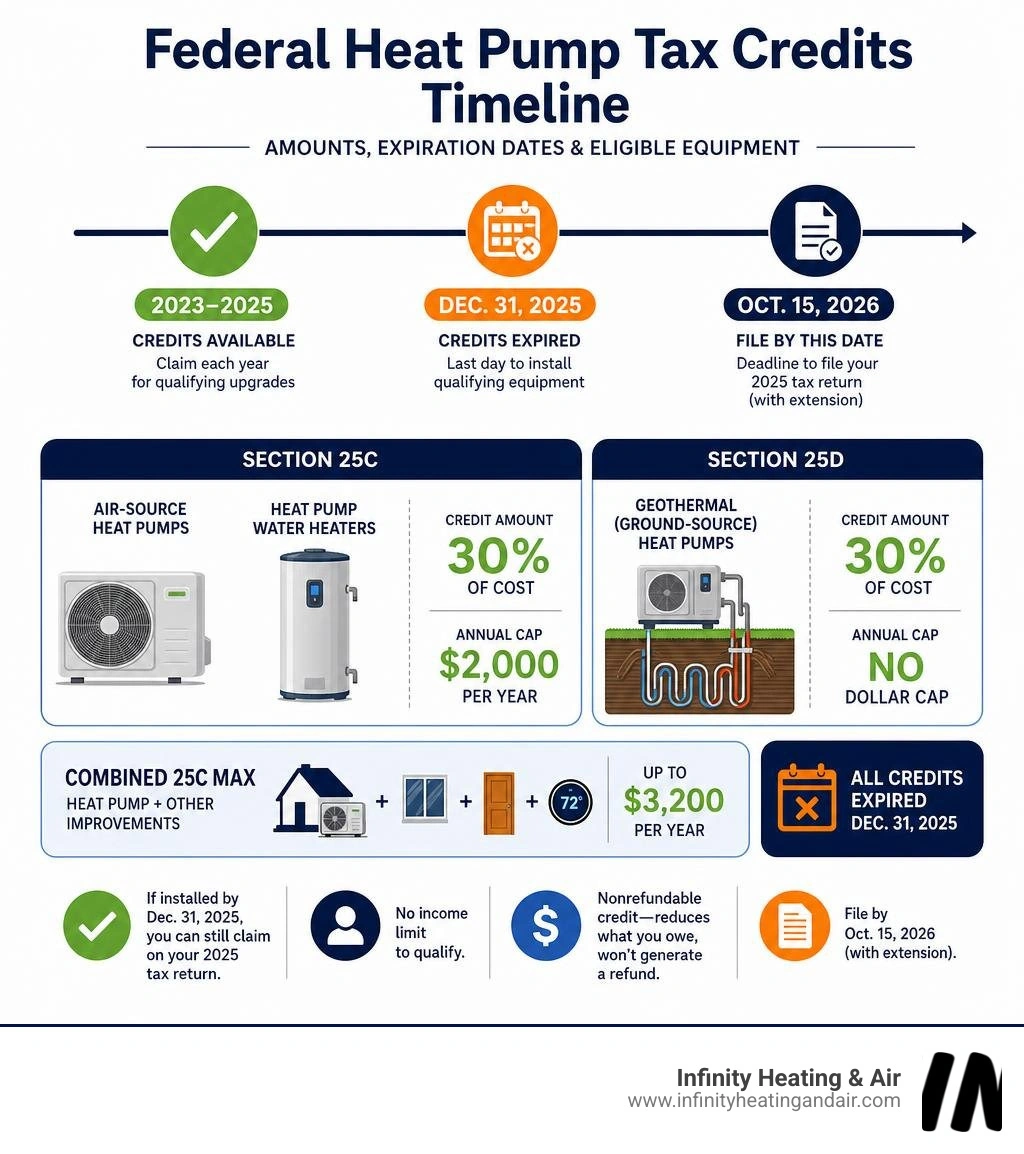
| Credit Type | Equipment | Credit Amount | Annual Cap | Status |
|---|---|---|---|---|
| Section 25C | Air-source heat pumps, heat pump water heaters | 30% of cost | $2,000 | Expired Dec. 31, 2025 |
| Section 25D | Geothermal (ground-source) heat pumps | 30% of cost | No dollar cap | Expired Dec. 31, 2025 |
| Combined 25C max | Heat pump + other improvements | Up to $3,200 | Per year | Expired Dec. 31, 2025 |
The most important facts:
- The credits expired after December 31, 2025, under the One Big Beautiful Bill Act (Public Law 119-21)
- If your system was installed by that date, you can still claim the credit on your 2025 tax return
- The deadline to file (with extension) is October 15, 2026
- There is no income limit to qualify
- The credit is nonrefundable — it reduces what you owe, but won't generate a refund
For Northwest Washington homeowners, these credits made heat pump upgrades significantly more affordable. The Inflation Reduction Act had expanded them starting in 2023, giving households a fresh annual limit each year with no lifetime cap.
This guide covers everything — how the credits worked, what qualified, what changed, and what to do right now if you installed in 2025.
How Federal Tax Credits for Heat Pump Upgrades Worked Through 2025
The federal government structured incentives for energy-efficient upgrades under two distinct pathways: the Energy Efficient Home Improvement Credit (Section 25C) and the Residential Clean Energy Credit (Section 25D). For most homeowners upgrading to standard ducted or ductless air-source heat pumps, Section 25C was the primary vehicle.
Under Section 25C, homeowners could claim a tax credit equal to 30% of the qualified purchase and installation expenses. This credit had a dedicated annual cap of $2,000 specifically for qualified heat pumps, heat pump water heaters, and biomass stoves or boilers.
What made this incentive structure particularly attractive was its lack of a lifetime dollar limit. Prior to the Inflation Reduction Act, homeowners were constrained by a lifetime cap of $500 for energy-efficient home improvements. From 2023 through December 31, 2025, that lifetime limit was completely eliminated. Homeowners could strategically plan their upgrades, claiming up to the annual limit year after year.
For instance, a homeowner could claim a credit for a home energy audit and insulation upgrades in one tax year, and then claim a separate credit for installing an air-source heat pump the following year.
To maximize the program, the IRS allowed a maximum combined annual credit of $3,200. This was calculated by combining:
- Up to $1,200 per year for general energy efficiency improvements (such as $150 for home energy audits, $500 for exterior doors, and $600 for energy-efficient windows or skylights).
- Up to $2,000 per year for qualified heat pumps, heat pump water heaters, or biomass equipment.
Understanding how these limits interacted allowed families to significantly offset their tax liabilities while upgrading their home's thermal envelope and mechanical systems. To learn more about how these systems perform in our regional climate, check out our guide on Heat Pump Benefits for Pacific Northwest Homeowners.

Key Differences Between Section 25C and Section 25D
While both sections aimed to reduce residential carbon footprints, their rules, caps, and eligible technologies differed substantially. Section 25C targeted standard energy-efficient improvements on existing homes, whereas Section 25D targeted residential clean energy generation, including geothermal (ground-source) heat pumps, solar panels, and wind energy systems.
| Feature | Section 25C (Energy Efficient Home Improvement Credit) | Section 25D (Residential Clean Energy Credit) |
|---|---|---|
| Primary Equipment | Air-source heat pumps, heat pump water heaters | Geothermal heat pumps, solar, wind, battery storage |
| Credit Percentage | 30% of total cost (including labor) | 30% of total cost (including labor) |
| Annual Limit | Capped at $2,000 for heat pumps (max $3,200 combined) | No annual dollar limit |
| Carryforward Rules | Nonrefundable; cannot carry forward unused credit | Nonrefundable; can carry forward unused credit |
| Home Eligibility | Existing homes only; must be principal residence for some items | Existing homes and new construction; primary or secondary homes |
| Labor Cost Eligibility | Labor costs for installing HVAC equipment qualify | Labor costs for system installation qualify |
Because Section 25C was nonrefundable and lacked carryforward provisions, if your calculated tax credit exceeded your total federal income tax liability for the year of installation, you forfeited the excess. You could not get the difference back as a refund check, nor could you apply the leftover credit to the following year's taxes.
Conversely, Section 25D allowed taxpayers to carry forward any unused portion of the 30% credit to subsequent tax years. This made geothermal installations highly attractive for homeowners with lower annual tax liabilities but significant long-term clean energy goals.
Qualifying Equipment, Efficiency Standards, and Homeowner Eligibility
To claim federal tax credits for heat pump upgrades, both the taxpayer and the installed equipment had to meet strict federal guidelines.
Homeowner Eligibility
- Primary vs. Secondary Residences: For Section 25C, the upgraded home had to be located in the United States and used as an existing residence by the taxpayer. While some building envelope components (like insulation) strictly required the home to be the taxpayer's principal residence, residential energy property—including air-source heat pumps—could be installed in secondary homes used as residences, provided the taxpayer did not rent out the property.
- Renters: Renters were eligible to claim the Section 25C credit for installing qualifying heating and cooling equipment, such as ductless mini-splits, provided they paid for the equipment and installation themselves. Renters could not, however, claim credits for building envelope components like landlord-owned windows or exterior doors.
- New Construction: Section 25C credits were strictly limited to existing homes. If you were building a brand-new home, you could not claim Section 25C credits for the heat pump installed during construction. However, Section 25D (geothermal) remained fully applicable to new construction.
- Business Use Rules: If your home was used partially for business purposes (such as a home office), the credit calculation had to be adjusted. If the business use of the home was 20% or less, you could claim the full credit. If business use exceeded 20%, the credit had to be allocated proportionally based on the residential share of the expenses.
For a comprehensive look at choosing the right system for your home, take a look at our Best Heat Pump Installation Tacoma Guide.
Efficiency Standards and Federal Tax Credits for Heat Pump Upgrades
Not just any heat pump off the shelf qualified for these tax savings. The IRS required systems to meet specific performance and efficiency criteria.
- CEE Highest Efficiency Tier: To qualify for the Section 25C credit, residential energy property had to meet or exceed the highest non-advanced efficiency tier established by the Consortium for Energy Efficiency (CEE) in effect at the beginning of the calendar year in which the equipment was placed in service.
- ENERGY STAR Most Efficient: Starting in January 2025, the certification standards became even more stringent. Qualifying systems had to meet the ENERGY STAR Most Efficient criteria for the year of installation. This ensured that only top-performing, highly efficient systems qualified for federal taxpayer subsidies.
- IECC Standards: For supporting building envelope components, such as insulation and air sealing, the materials had to meet the prescriptive criteria of the International Energy Conservation Code (IECC) in effect two years prior to installation. For installations in 2024 and 2025, the 2021 IECC standards applied.
- Split System Requirements: For split-system air-source heat pumps (which feature both an outdoor condenser and one or more indoor air handlers), the IRS mandated that both the indoor and outdoor components be installed together as a matched system certified by the Air-Conditioning, Heating, and Refrigeration Institute (AHRI). You could not simply replace an outdoor unit and pair it with an outdated, mismatched indoor coil to claim the credit.
Navigating these efficiency tiers can be complex, which is why working with an experienced local contractor is essential. For detailed installation requirements in our area, consult our Heat Pump Installation Tacoma WA Guide.
The One Big Beautiful Bill Act and Claiming Your Credit
A major shift in the federal energy policy landscape occurred with the passage of the One Big Beautiful Bill Act (Public Law 119-21). This legislation brought an early end to several green energy tax incentives, officially expiring the residential federal heat pump tax credits under Section 25C and Section 25D for any systems placed in service after December 31, 2025.
Because of this legislative change, no federal tax credits are available for new heat pump installations completed in 2026. However, if your qualifying system was installed and fully operational by December 31, 2025, you are legally entitled to claim the credit on your federal tax return filed in 2026.
The "Placed-in-Service" Rule
The IRS is very strict about timing: the key metric for eligibility is the date the system was officially "placed in service." This means the system must have been fully installed, connected, and ready for use in your home. Signing a contract, paying a deposit, or having the equipment delivered to your garage in 2025 does not qualify if the actual installation and startup did not occur until 2026.
The 2025 Manufacturer PIN/QM Code Requirement
To combat fraudulent claims, the IRS instituted a strict verification system for the 2025 tax year. For any qualifying equipment installed in 2025, you cannot claim the Section 25C credit unless:
- The equipment was produced by a "Qualified Manufacturer" who entered into a formal agreement with the IRS.
- You report the unique Qualified Manufacturer Identification Number (QMID) or four-digit Qualified Manufacturer (QM) code directly on your tax return.
This code is typically provided on the manufacturer's certification statement or the product packaging. When planning a system replacement, ensuring your contractor provides this documentation is critical. Learn more about professional system transitions in our Professional Heat Pump Replacement Guide Tacoma WA.
How to Claim Federal Tax Credits for Heat Pump Upgrades on Your Tax Return
If you completed your qualifying upgrade in 2025, claiming your tax credit requires filing specific forms alongside your standard federal tax return.
- Use IRS Form 5695: To calculate and claim your credit, you must complete IRS Form 5695 (Residential Energy Credits).
- Use Part II of Form 5695 to calculate the Energy Efficient Home Improvement Credit (Section 25C) for air-source heat pumps and heat pump water heaters.
- Use Part I of Form 5695 if you installed a geothermal heat pump under Section 25D.
- Transfer to Form 1040: Once calculated, the final credit amount is transferred to Schedule 3 (Form 1040) and applied directly against your tax liability. You can claim this credit whether you choose to take the standard deduction or itemize your deductions.
- Filing Deadlines:
- If you filed your 2025 taxes by the standard April 15, 2026 deadline, your credit should already be processed.
- If you filed for an automatic six-month tax extension, you have until October 15, 2026 to submit your completed return and Form 5695 to claim your 2025 installation credit.
- Required Documentation Checklist: Do not mail your documentation to the IRS, but keep these records in your personal files for at least three to five years:
- The itemized contractor invoice showing the equipment make, model, and serial numbers.
- A breakdown of labor versus equipment costs.
- The manufacturer's Certification Statement confirming the model meets CEE/ENERGY STAR efficiency criteria.
- The four-digit QM code or QMID.
- Proof of payment (receipt, cleared check, or financing approval).
For homeowners seeking cost-effective replacement options, our Affordable Heat Pump Replacement Guide Tacoma WA provides excellent strategies for managing project documentation and system selection.
Post-2025 Alternatives: State Incentives and Utility Rebates
While the federal tax credits expired at the end of 2025, homeowners in Northwest Washington are far from out of options. State-level programs and local utility incentives continue to provide robust support for heat pump installations in 2026.
State-Level Programs
Many states have maintained independent tax credits or point-of-sale discounts to support building decarbonization. For example, the Colorado Heat Pump Tax Credits program continues to offer substantial discounts directly through registered contractors, who must pass along a portion of the tax credit as an upfront discount on the customer's invoice.
Here in Washington, our state-level initiatives and local utility programs are designed to keep energy-efficient upgrades accessible and affordable.
Local Utility Rebates
Local utilities across Pierce, King, Thurston, and Snohomish counties offer generous incentives that can be claimed directly for qualifying heat pump installations in 2026.
- Puget Sound Energy (PSE): PSE offers significant rebates for customers transitioning from electric resistance heating, baseboards, or natural gas furnaces to high-efficiency electric air-source heat pumps.
- Tacoma Power & Seattle City Light: These municipal utilities provide substantial rebates and low-interest financing options for qualified heat pump installations.
HEEHRA Rebates
The High-Efficiency Electric Home Rebate Act (HEEHRA), funded by the federal government but administered individually by each state, provides point-of-sale rebates for low- and moderate-income households. Qualifying families can receive up to $8,000 for space-heating heat pumps and up to $1,750 for heat pump water heaters, depending on state program rollouts and funding availability in 2026.
By working with an experienced local contractor, you can stack state programs, utility rebates, and manufacturer promotions to maximize your total savings. For professional installation services in Puyallup and the surrounding communities, visit our page on Heat Pump Installation Puyallup WA.
Frequently Asked Questions About Heat Pump Tax Credits
Can I still claim the credit in 2026 for a 2025 installation?
Yes. If your qualifying heat pump was fully installed and "placed in service" on or before December 31, 2025, you are eligible to claim the credit on your 2025 federal tax return. If you requested a tax filing extension, you have until October 15, 2026 to file your return with IRS Form 5695 and claim the credit. Any systems installed on or after January 1, 2026, are not eligible for the federal tax credit due to the expiration under the One Big Beautiful Bill Act. For assistance with upgrading older systems, see our Heat Pump Replacement Puyallup Guide.
How do rebates and subsidies affect my tax credit calculation?
Under IRS rules, any utility rebate, state incentive, or manufacturer discount received at the time of purchase is considered a "purchase price adjustment." You must subtract these subsidies from your total project cost before calculating your 30% federal tax credit.
For example, if your total heat pump installation cost was $8,000 and you received a $1,000 rebate from Puget Sound Energy, your net qualified expense for the tax credit calculation is $7,000. Your 30% tax credit would be calculated based on $7,000 ($2,100), which is then capped at the maximum allowable limit of $2,000. Keeping your system well-maintained is also key to long-term savings; check out our guide on Heat Pump Service Maintenance Tacoma WA to keep your system running efficiently.
Do renters qualify for the heat pump tax credit?
Yes, renters are eligible to claim the Section 25C tax credit for residential energy property, including air-source heat pumps and heat pump water heaters, provided they paid for the equipment and installation costs out of their own pocket and the system was installed in their primary residence. However, renters cannot claim credits for structural building envelope components, such as insulation, windows, or exterior doors, as these are considered permanent landlord property. To explore affordable installation options, view our Affordable Heat Pump Installation Guide Tacoma WA.
Conclusion
Navigating the transition away from federal tax credits doesn't mean you have to miss out on energy savings. While the federal tax credits expired at the end of 2025, local utility rebates, state incentives, and long-term utility savings continue to make heat pump upgrades an exceptionally smart investment for Northwest Washington homeowners.
At Infinity Heating & Air, we specialize in designing, installing, and servicing high-efficiency heating and cooling systems tailored to our unique Pacific Northwest climate. We proudly serve homeowners across Pierce, King, Thurston, and Snohomish counties, including Tacoma, Puyallup, Auburn, Lacey, Lakewood, Olympia, and surrounding areas. Our expert team is dedicated to crafting endless comfort with reliable, professional service and helping you navigate every available local rebate and financing option.
Ready to upgrade your home comfort and lower your energy bills? Schedule your heat pump installation or replacement today and let our team design the perfect system for your home!
Endless Comfort
Starts Here
Our expert technicians are ready to serve you and your home.