How Wildfire Smoke Affects Your Indoor Air Quality 101
Learn how wildfire smoke affects your indoor air quality and discover practical steps to protect your home during smoke events.
.webp)

Why Wildfire Smoke Is a Serious Indoor Air Quality Threat
Understanding how wildfire smoke affects your indoor air quality is more urgent than ever — especially for homeowners in Northwest Washington, where smoke from regional wildfires can blanket communities for days at a time.
Here's the short answer:
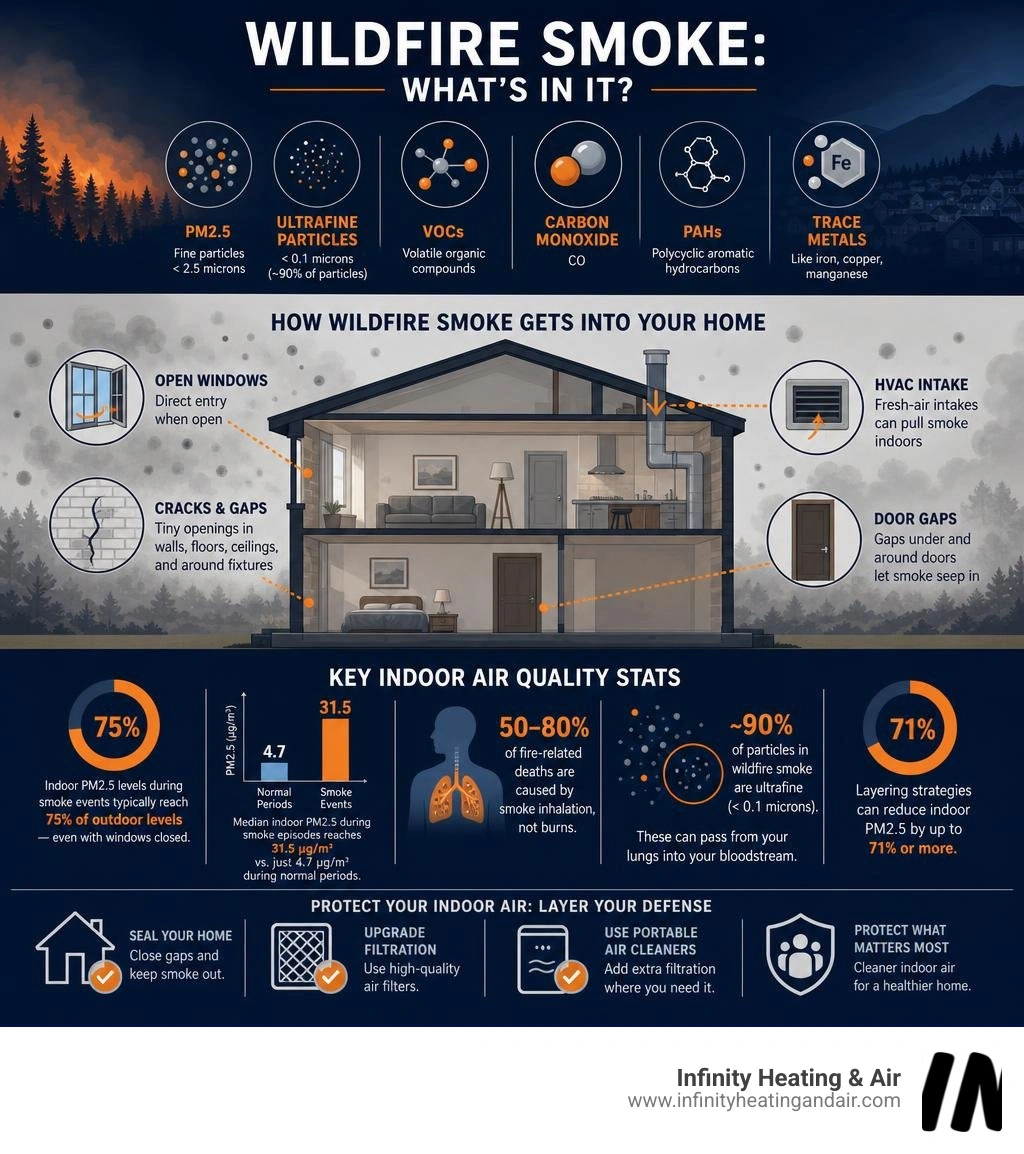
- Wildfire smoke carries fine particles (PM2.5), ultrafine particles, VOCs, carbon monoxide, PAHs, and trace metals
- These pollutants enter your home through open windows, HVAC fresh-air intakes, and even tiny cracks and gaps in your building envelope
- Indoor PM2.5 levels during smoke events typically reach 75% of outdoor levels — even with windows closed
- Staying indoors does help, but it is not enough on its own
- Layering strategies — sealing your home, upgrading filtration, and using portable air cleaners — can reduce indoor PM2.5 by up to 71% or more
Most people assume their home is a safe refuge during a smoke event. The reality is more complicated.
Research shows that median indoor PM2.5 during smoke episodes reaches 31.5 µg/m³ — compared to just 4.7 µg/m³ during normal periods. That's a dramatic increase, and it happens whether your windows are open or not.
Even more concerning: 50–80% of fire-related deaths are caused by smoke inhalation, not burns. And the most dangerous particles — ultrafine particles smaller than 0.1 microns — make up roughly 90% of all particles in wildfire smoke. They're small enough to pass from your lungs directly into your bloodstream.
This guide walks you through exactly what's in wildfire smoke, how it gets inside your home, which homes are most vulnerable, and what you can do before, during, and after a smoke event to protect your family.
Understanding How Wildfire Smoke Affects Your Indoor Air Quality
When smoke plumes drift across the Pacific Northwest, they don't stop at your front door. Wildfire smoke is a complex, chaotic mixture of gases and fine particles. Because these pollutants are incredibly small, they easily penetrate the average home, transforming an outdoor environmental crisis into an indoor health hazard.
To understand how this happens, we have to look at the microscopic scale of the smoke itself. While most people can see the thick, acrid haze hanging over the Puget Sound, the real danger is completely invisible. The primary culprit in smoke-related health issues is particulate matter, specifically PM2.5 (particles smaller than 2.5 micrometers) and ultrafine particles (smaller than 0.1 micrometers).
These tiny invaders behave less like solid dust and more like a gas, easily riding indoor air currents. When you inhale them, they bypass your body's natural respiratory filters (like your nasal passages) and settle deep into your lungs. From there, ultrafine particles can pass directly into your bloodstream, triggering systemic inflammation, cardiovascular stress, and respiratory distress.
Beyond particulate matter, wildfire smoke carries a toxic cocktail of gaseous pollutants, including carbon monoxide (CO), nitrogen oxides (NOx), volatile organic compounds (VOCs), and polycyclic aromatic hydrocarbons (PAHs). To keep your family safe, it is essential to understand the seasonal patterns of Air Quality Washington and how these outdoor threats migrate indoors.
The Chemical Makeup of Wildfire Smoke
Wildfire smoke is not just wood ash. While a forest fire starts with burning timber and brush, it quickly consumes everything in its path. In modern fires, this includes residential structures, vehicles, chemical storage units, plastics, and building materials. Consequently, the chemical profile of wildfire smoke is incredibly complex and dangerous.
The smoke contains thousands of compounds, but the most hazardous components include:
- Acrolein and Formaldehyde: Highly reactive VOCs that irritate the eyes, nose, and throat, even at low concentrations. Long-term exposure to formaldehyde is also linked to chronic health complications.
- Benzene: A known carcinogen released during the combustion of both natural wood and synthetic materials.
- Polycyclic Aromatic Hydrocarbons (PAHs): Highly toxic compounds that bind to fine soot particles. Studies show that indoor PAH concentrations can increase up to 10-fold during active wildfire smoke episodes.
- Trace Metals and Ions: Smoke carries elevated levels of heavy metals and chemical ions. Research indicates that during regional haze episodes, indoor ion concentrations jump from an average of 8.77 µg/m³ to 14.98 µg/m³, while trace metals double from 0.75 µg/m³ to 1.53 µg/m³.
- Soot and Ash: The larger, visible components of smoke that deposit on surfaces, leaving behind persistent odors and chemical residues.
How Wildfire Smoke Affects Your Indoor Air Quality via Infiltration
Many homeowners believe that simply keeping their doors and windows shut will completely block out the smoke. Unfortunately, buildings are not airtight boxes. Air is constantly moving between the inside and outside of your home through a process called infiltration.
The scientific measure of this movement is the infiltration factor ($F_{in}$), which represents the fraction of outdoor pollution that penetrates indoors and remains suspended. During wildfire events, the median indoor/outdoor (I/O) ratio for PM2.5 is 0.75 (with a range of 0.31 to 1.3). This means that without active air cleaning, 75% of the outdoor smoke pollution will successfully make its way inside your living space.
Outdoor smoke enters your home through three primary pathways:
- Natural Ventilation: Airflow through open windows and doors.
- Mechanical Ventilation: HVAC systems, bathroom exhaust fans, and kitchen hoods that draw outdoor air inside.
- Infiltration: Air leaking through microscopic cracks in the building envelope, electrical outlets, window frames, and floorboards.
If you are trying to manage these pathways in Western Washington, understanding localized building dynamics is key. For instance, managing air exchange rates is a critical step in maintaining healthy Indoor Air Quality in Tacoma WA, where older housing stocks often permit higher infiltration rates than newer constructions.
How Building Characteristics Influence Smoke Infiltration
How much smoke enters your home depends heavily on your building's unique characteristics. Not all homes are created equal when it comes to defending against outdoor air pollution.
The primary factors influencing smoke infiltration include:
- Envelope Tightness: The physical seal of your home. Tighter building envelopes can reduce PM2.5 infiltration to 31%, whereas leakier, older homes permit up to 68% infiltration.
- Building Age: Homes built after 1975 generally feature tighter construction standards. Research shows that post-1975 homes have a median infiltration factor of 0.27, compared to 0.41 for older homes.
- HVAC Type and Design: Whether your system recirculates indoor air or continuously pulls in fresh (but smoky) outdoor air plays a massive role in your indoor safety.
For residents living in scenic, breezy areas, local weather and construction styles dictate how smoke behaves. If you are looking to protect your household, optimizing these physical barriers is a great way to improve your Indoor Air Quality in Lake Tapps WA, where lakeside humidity and wind patterns can push smoke through neglected structural gaps.
The Role of HVAC Systems and Ductwork
Your heating, ventilation, and air conditioning (HVAC) system can either be your greatest ally or your worst enemy during a wildfire smoke event.
In normal weather, many HVAC systems utilize a "fresh-air intake" to pull outdoor air inside, keeping indoor air from becoming stale. However, during a wildfire, this intake acts as a direct highway for toxic smoke. If your system is running on its default settings, it will continuously pump PM2.5 and VOCs directly into your bedrooms and living spaces.
Additionally, ductwork integrity is crucial. Leaky ducts running through unconditioned spaces like crawlspaces or attics can pull smoky air into the system via negative pressure, bypassing your air filter entirely. To prevent this, homeowners must understand How Air Quality, Ductwork and Zoning Work Together to create a sealed, pressurized, and highly filtered indoor environment.
Practical Steps to Protect Your Home During a Smoke Event
When the Air Quality Index (AQI) spikes into the "Unhealthy" or "Hazardous" range, you need to take immediate action. Waiting until you can smell smoke inside your living room means you have already been exposed to millions of harmful particles.
Here is a checklist of immediate home-sealing steps to protect your indoor environment:
- Seal the Windows and Doors: Close all exterior doors and windows tightly. If you have older, single-pane windows, apply temporary painter's tape or weatherstripping around the edges to block drafts.
- Install Door Sweeps: Slide draft stoppers or rolled-up damp towels under exterior doors to block ground-level infiltration.
- Close Fireplace Throat Dampers: An open chimney is a massive pathway for outdoor air. Ensure your fireplace damper is fully closed, and avoid using the fireplace entirely.
- Manage Negative Pressure: Avoid running kitchen exhaust hoods, bathroom fans, or central vacuum systems unless absolutely necessary. These fans vent indoor air outside, which creates negative pressure that actively sucks smoky outdoor air into your home through any available crack.
- Switch HVAC to Recirculate: Adjust your thermostat settings to "Recirculate" and turn the fan setting to "ON" (instead of "AUTO") to keep air continuously moving through your home's filter.
How Wildfire Smoke Affects Your Indoor Air Quality and How Filtration Helps
Once you have sealed your home's physical envelope, the next step is active filtration. Simply closing your windows reduces the indoor/outdoor PM2.5 ratio from 0.76 to 0.62. While that is a step in the right direction, it still leaves your lungs vulnerable to a substantial amount of pollution.
To achieve true safety, you must filter the air. This is where high-efficiency filtration comes into play:
- MERV 13 Filters: Minimum Efficiency Reporting Value (MERV) 13 filters are the gold standard for residential HVAC systems during smoke events. They are rated to capture at least 50% of particles in the 0.3–1.0 µm range and over 85% of PM2.5. Upgrading to a MERV 13 filter can reduce indoor PM2.5 concentrations by 40% to 95% depending on system run-time and building tightness.
- HEPA Filters: High-Efficiency Particulate Air (HEPA) filters capture 99.97% of particles down to 0.3 microns, including ultrafine smoke particles. Portable air cleaners (PACs) equipped with true HEPA filters can reduce indoor PM2.5 by 71% (lowering median levels from 29.2 µg/m³ to a safe 8.5 µg/m³) when windows are kept closed.
- DIY Box Fan Filters (Corsi-Rosenthal Boxes): If commercial air purifiers are sold out or unavailable, you can assemble a low-cost DIY filter using a standard 20-inch box fan and MERV 13 filters. Studies show these DIY units are incredibly effective, achieving up to a 99% reduction in PM2.5 in smaller rooms within 60 minutes.
For comprehensive protection, combining your central system with localized filtration is highly recommended. If you need assistance setting up these defensive systems, you can look into professional Indoor Air Quality Services & Solutions Graham WA to ensure your equipment is properly rated and safely installed.
Post-Smoke Cleanup and Restoring Your Indoor Air
Once the winds shift and the outdoor air clears, your job isn't quite finished. Wildfire smoke leaves behind a heavy physical legacy in the form of soot, ash, and chemical residues that settle on your carpets, furniture, and countertops. If left unaddressed, these settled particles will continuously kick back up into the air every time you walk across the room.
Furthermore, materials like drywall, upholstery, and wood can absorb gaseous pollutants during a smoke event and gradually release them back into your home over the following weeks — a process known as chemical off-gassing.
To safely clean your home after a smoke event, follow these guidelines:
- Wear Respiratory Protection: Always wear a well-fitted, NIOSH-certified N95 or P100 respirator mask during cleanup. Surgical and cloth masks do not block fine ash or soot.
- Avoid Dry Sweeping: Never use a broom or dry duster, as this will launch settled particles back into your breathing zone. Instead, lightly mist hard surfaces with water before wiping them down with a damp cloth.
- Use a HEPA Vacuum: Standard vacuum cleaners will blow fine soot particles straight out of their exhaust. Use only vacuums equipped with true HEPA filters, or opt for professional steam cleaning on carpets and drapes.
- Clean with Soap and Water: Avoid harsh chemical cleaners or vinegar, which can react with the highly alkaline compounds found in wood ash. Plain soap and water are highly effective and safe.
For deep-seated soot and lingering chemical odors, professional intervention is often the safest path. You can restore your home's freshness by scheduling comprehensive Indoor Air Quality Services & Solutions to address stubborn residues and verify your air is truly clean.
Maintaining Your HVAC System After a Fire
Your HVAC system worked overtime to protect you during the smoke event, which means its filters are likely packed with highly toxic soot and ash. Leaving a dirty filter in your system will degrade your air conditioner’s efficiency, strain the blower motor, and can even cause the system to release burnt, smoky odors into your home.
Post-smoke HVAC maintenance should include:
- Immediate Filter Replacement: Swap out your HVAC filter as soon as the smoke clears. If you live in an area prone to extended smoke seasons, you may need to replace your filters monthly for up to a year.
- Coil and Intake Cleaning: Rinse off your outdoor air conditioning condenser coils and fresh-air intakes, which can become caked in ash.
- Ductwork Inspection: If your system was run extensively during heavy smoke, consider professional duct inspection and cleaning to prevent lingering ash from recirculating.
Proper maintenance also protects your system from other regional air hazards. For example, keeping your filters clean and system dry is essential for Combating Mold and Mildew in Your HVAC Unit, especially when considering How Pacific Northwest Rain and Humidity Affect Your HVAC throughout the changing seasons.
Frequently Asked Questions about Wildfire Smoke and IAQ
Who is most at risk from indoor wildfire smoke exposure?
While wildfire smoke is unhealthy for everyone, certain populations are highly vulnerable to serious, immediate health complications. These include:
- Children: Kids breathe more air per pound of body weight than adults, and their respiratory systems are still developing.
- Pregnant People: Exposure to PM2.5 during pregnancy is linked to low birth weight and pre-term labor.
- Older Adults: Seniors are more likely to have pre-existing, undiagnosed heart or lung conditions.
- Individuals with Heart or Lung Disease: People with asthma, COPD, chronic bronchitis, or congestive heart failure can experience severe flare-ups, sometimes requiring hospitalization.
If you have vulnerable family members living in high-risk zones, taking extra precautions with your home's air systems is vital. This is especially true for families maintaining Indoor Air Quality in Frederickson WA, where seasonal smoke can pool in low-lying residential areas.
How long do smoke pollutants persist indoors after the air clears?
Smoke pollutants can linger indoors for days or even weeks after the outdoor air returns to a healthy "green" AQI. Fine particulate matter can remain suspended in stagnant indoor air for hours, while heavier soot and ash settle onto carpets, walls, and furniture.
Furthermore, VOCs and semi-volatile organic compounds (like PAHs) absorb into porous materials and slowly off-gas over time, keeping indoor chemical levels elevated. To safely clear these persistent pollutants, wait until the outdoor AQI drops below 50, then open your windows and doors to flush out your home while running your air purifiers on high.
Managing this transition carefully is a priority for coastal and inlet communities, such as those looking to stabilize Indoor Air Quality in Steilacoom WA, where marine breezes can be used to naturally ventilate homes once the smoke clears.
What tools should I use to monitor indoor air quality during a fire?
To make informed decisions about when to seal your home, run your purifiers, or evacuate, you need reliable data.
We recommend using the following tools:
- Air Quality Apps: Use the EPA’s AirNow.gov app or website to track real-time regulatory AQI data in your ZIP code.
- Crowdsourced Sensor Networks: Websites like PurpleAir.com display real-time readings from thousands of low-cost laser particle sensors installed in residential neighborhoods. This provides highly localized, street-by-street smoke data.
- Indoor Air Quality Monitors: Consider purchasing a dedicated indoor PM2.5 monitor. Having an indoor sensor allows you to see exactly how well your HVAC filtration and portable air cleaners are performing, helping you keep your indoor PM2.5 levels below the recommended target of 12 µg/m³.
Conclusion
When wildfire smoke rolls into Northwest Washington, your home should be a safe, healthy sanctuary for your family. However, keeping the smoke out requires a proactive, layered defense strategy. By sealing structural gaps, configuring your HVAC system to recirculate, upgrading to MERV 13 or HEPA filtration, and cleaning up properly after the haze clears, you can dramatically reduce your exposure to dangerous PM2.5, VOCs, and toxic gases.
At Infinity Heating & Air, we are dedicated to crafting endless comfort with reliable, expert service. Our team of home air quality specialists serves communities across Pierce, King, and Thurston counties — from Auburn and Tacoma to Puyallup, Lacey, and beyond. Whether you need to upgrade your home's filtration system, seal leaky ductwork, or install a whole-house air purifier before the next smoke season hits, we are here to help.
Don't wait for the next smoky summer to protect your family's health. Schedule professional HVAC maintenance with Infinity Heating & Air today, and let us help you breathe easier all year round.
Endless Comfort
Starts Here
Our expert technicians are ready to serve you and your home.