Why Correct System Sizing Matters for Your Home
Discover why correct HVAC system sizing matters for comfort, efficiency, and equipment lifespan — and the top dangers of an oversized or undersized unit.
Understanding the Basics of HVAC Sizing and Capacity
's Comfort and Efficiency
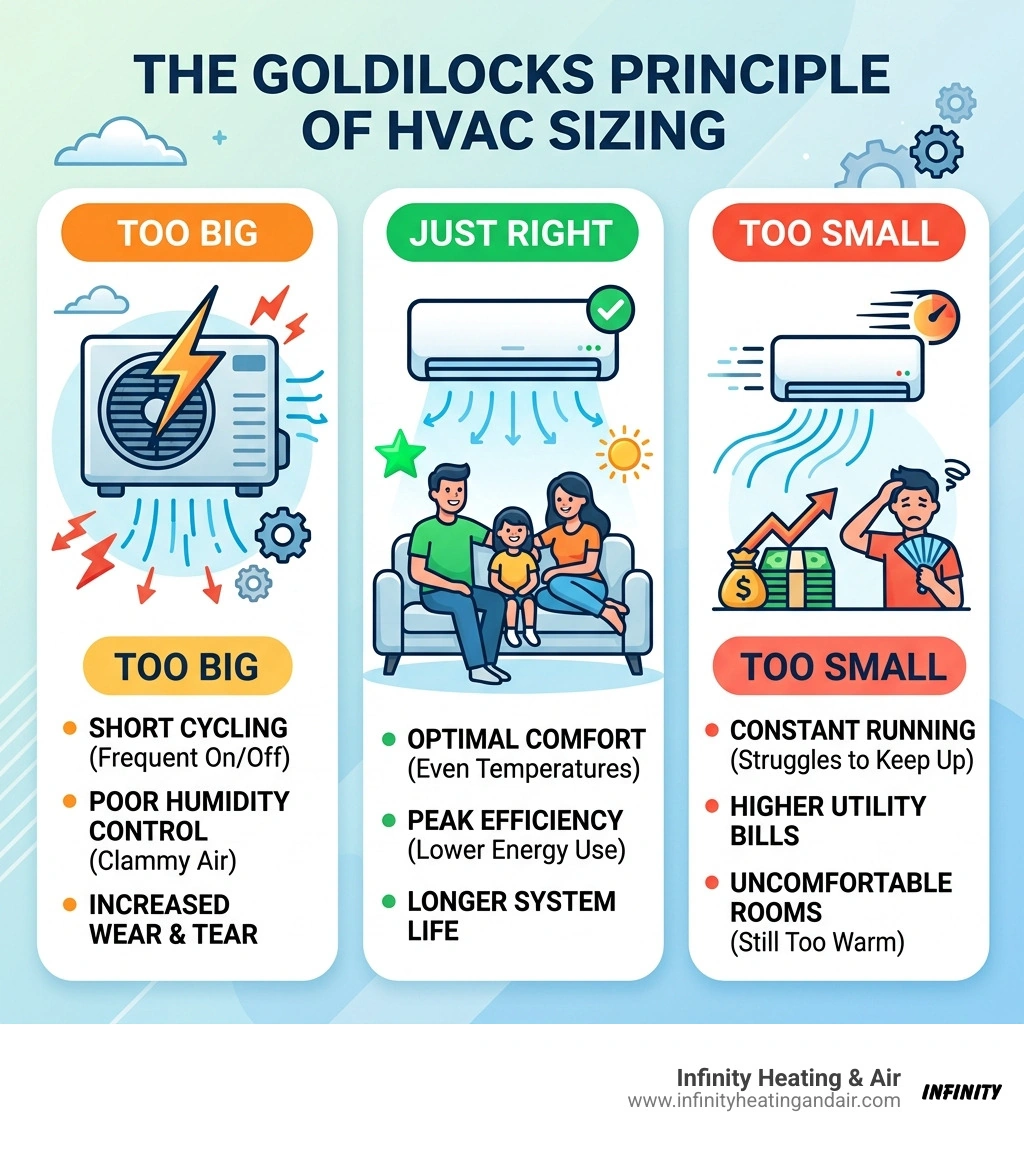
Why correct system sizing matters for your home comes down to one simple idea: a system that's the wrong size — too big or too small — will cost you more money, wear out faster, and leave your home uncomfortable no matter how premium the equipment is.
Here's a quick summary of why it matters:
- Comfort: A properly sized system maintains even temperatures and controls humidity throughout your home
- Energy efficiency: Incorrectly sized systems can increase energy use by up to 30%
- System lifespan: Wrong sizing causes extra wear and tear, shortening equipment life significantly
- Air quality: Only a correctly sized system runs long enough to filter air and remove moisture properly
- Reliability: A right-sized system handles Northwest Washington's cold winters and warm summers without struggling
Most homeowners assume bigger is safer. It isn't. And smaller isn't a budget win either — it just means your system runs constantly trying to catch up.
The surprising reality? Studies estimate that up to 90% of HVAC systems are improperly sized or installed, and the majority of those mistakes trend toward oversizing. This isn't a rare edge case. It's the norm.
Getting the size right from the start is one of the most important decisions you'll make about your home's heating and cooling system.
When we talk about HVAC "sizing," we aren't referring to the physical dimensions of the outdoor unit or the furnace in your garage. Instead, sizing refers to the system’s capacity to move heat. In HVAC, heat is measured in BTUs (British Thermal Units). One BTU is roughly the amount of energy required to raise the temperature of one pound of water by one degree Fahrenheit.
In larger residential applications, you will often hear the term "tonnage." One ton of cooling capacity is equal to 12,000 BTUs per hour. This terminology dates back to the days when ice was used for cooling; one ton of cooling is the amount of heat required to melt one ton of ice over a 24-hour period. Most residential systems in Northwest Washington range from 2 to 5 tons.
Understanding HVAC Unit Types and Which One Works for You is the first step in the sizing journey. Whether you are installing a central heat pump in Tacoma or a furnace in Puyallup, the capacity must match the "load" of your home.
As of May 2026, modern standards also distinguish between two types of heat:
- Sensible Heat: This is the heat you can feel and measure with a thermometer. It’s what changes the air temperature.
- Latent Heat: This is the energy held in water vapor (humidity). A system must run long enough to remove this moisture, especially during our humid Puget Sound springs and autumns.
Why correct system sizing matters for your home and energy efficiency
Energy efficiency isn't just about the SEER2 (Seasonal Energy Efficiency Ratio) or HSPF2 (Heating Seasonal Performance Factor) rating on the box. A high-efficiency unit that is improperly sized will never reach its advertised efficiency.
Research shows that improperly sized HVAC systems can increase energy usage by up to 30%. This happens because the system never reaches its steady-state operating mode. An oversized system cycles on and off too quickly, while an undersized system runs forever. Both scenarios waste electricity and fuel. By ensuring the capacity matches the home, we help homeowners in areas like Federal Way and Lacey achieve the operational balance necessary for lower utility bills and a longer system lifespan. To learn more about how local conditions affect these choices, see our guide on HVAC in Washington.
The Hidden Dangers of an Oversized HVAC System

Many homeowners think, "If a 3-ton unit is good, a 4-ton unit must be better." This is a common misconception that often leads to a phenomenon called "short cycling." Short cycling occurs when a powerful system blasts the home with conditioned air, reaching the thermostat's set point in just a few minutes, and then shuts down.
This rapid on-off pattern is disastrous for several reasons:
- Humidity Control: In our maritime climate, air conditioners and heat pumps act as dehumidifiers. However, they need to run for at least 10 to 15 minutes for the evaporator coil to get cold enough to pull moisture out of the air. An oversized unit shuts off before this happens, leaving the air feeling "clammy" or "sticky."
- Microbial Growth: When humidity remains above 60% because the system isn't running long enough to dehumidify, it creates a breeding ground for mold and bacteria.
- Component Wear: The most stressful part of an HVAC system’s life is the startup. Short cycling puts immense strain on the compressor and relays, leading to premature failure.
When looking at a Central AC vs Ductless Mini-Split Comparison, sizing becomes even more critical. Ductless systems are often better at avoiding these issues because they use inverter technology to "throttle down" their capacity, but even they have limits if the initial sizing is wildly off.
How an oversized unit impacts indoor air quality
Your HVAC system is your home's primary air filtration tool. Every time the blower motor runs, air is pulled through your filters, removing dust, pollen, and pet dander. If your system is oversized and only runs for five minutes every hour, your air is only being filtered for five minutes. This leads to increased dust accumulation and poor indoor air quality (IAQ).
Furthermore, because the moisture isn't being removed properly, the evaporator coils inside your air handler can stay damp without the benefit of the "wash" that occurs during a full dehumidification cycle. This can lead to "dirty sock syndrome," where the coils develop a musty odor that is blown through the house. For homeowners in Puyallup, following an HVAC Installation Puyallup WA Complete Guide ensures that these IAQ factors are handled during the design phase.
Why Correct System Sizing Matters for Your Home During Extreme Weather
While oversizing is the most common mistake, undersizing creates its own set of headaches, particularly during Northwest Washington’s extreme weather events. Whether it’s a record-breaking heatwave in July or a freezing cold snap in January, an undersized system simply cannot keep up with the heat gain (in summer) or heat loss (in winter).
If you live in a colder area like Enumclaw or Yelm, you need the Best HVAC Systems for Cold Climates sized exactly for your home's thermal envelope. An undersized system will run 24/7 without ever reaching the desired temperature. This leads to:
- Massive Utility Bills: Constant operation, especially if the system has to rely on expensive electric backup "heat strips," will skyrocket your costs.
- Inconsistent Temperatures: You might find the living room is "okay," but the bedrooms upstairs are freezing or sweltering.
- Total System Failure: Running a mechanical system at 100% capacity for days on end significantly increases the risk of a component failure right when you need the system most.
How Professionals Determine the Perfect Size for Your Space
At Infinity Heating & Air, we don't guess. We use science. The industry standard for determining the correct size of an HVAC system is the Manual J Load Calculation, published by the Air Conditioning Contractors of America (ACCA).
A Manual J calculation takes into account dozens of variables to determine exactly how many BTUs your home loses in the winter and gains in the summer. We also use Manual S for equipment selection (matching the unit to the load) and Manual D for duct design (ensuring the "veins" of your home can handle the "heart's" output).
Manual J vs. Square Footage Rules of Thumb
| Factor | Square Footage "Rule of Thumb" | Manual J Load Calculation |
|---|---|---|
| Accuracy | Very Low (often results in oversizing) | High (Scientific Precision) |
| Insulation | Ignored | Detailed (R-values of walls/attic) |
| Windows | Ignored | Counts number, size, and orientation |
| Home Orientation | Ignored | Accounts for sun exposure (South vs. North) |
| Ceiling Height | Ignored | Calculates total volume of air |
| Occupancy | Ignored | Factors in heat generated by people |
Moving beyond square footage: Why correct system sizing matters for your home's unique layout
Square footage is just one piece of the puzzle. Two homes in University Place might both be 2,000 square feet, but if one has 20-foot vaulted ceilings and the other has standard 8-foot ceilings, the home with vaulted ceilings has significantly more air to condition.
We also look at:
- The Building Envelope: How well is the home sealed? Are there air leaks around the doors and windows?
- Sun Exposure: A home with massive west-facing windows in Gig Harbor will have a much higher cooling load than a shaded home in the woods of Graham.
- Appliances: Modern kitchens with high-end ranges and refrigerators add to the heat load.
- Ductwork Integrity: Even a perfectly sized unit will fail if the ductwork is leaky or undersized. Average duct systems leak 30-40% of their air, which is why we evaluate the whole system when deciding When to Replace Your HVAC System.
Frequently Asked Questions about HVAC Sizing
Can I estimate my HVAC size using square footage?
While you can find "rules of thumb" online (like 1 ton per 500 square feet), we strongly advise against using them. Modern homes with high-performance insulation might require 1 ton per 1,000 square feet, while an older, drafty home in Tacoma might need much more. Using a rule of thumb is how 90% of systems end up improperly sized.
What is a Manual J load calculation?
It is the scientific standard for HVAC design. Using professional software like Wrightsoft or Diamond System Builder, we input your home's specific data—insulation levels, window types, floor plan, and local climate data—to calculate the exact BTU requirements. It is the only way to ensure your system is "just right."
Why is my new HVAC system making the house feel clammy?
This is almost always a sign of an oversized system. If the unit is too powerful, it cools the air so quickly that the thermostat shuts it off before it can complete a dehumidification cycle. The temperature is "reached," but the latent heat (moisture) remains in the air, creating that uncomfortable, clammy feeling.
Conclusion
At Infinity Heating & Air, we believe in "endless comfort," and that comfort begins with precision. Whether you are in Auburn, Bonney Lake, or Tumwater, why correct system sizing matters for your home is a question of long-term value. A system that is sized correctly will run more efficiently, provide better air quality, and last years longer than one that was chosen based on a guess.
Don't let a "rule of thumb" dictate your family's comfort for the next 20 years. If you are curious about the process or wondering How Much Does HVAC Installation Cost? A Breakdown, we are here to provide clear, expert answers.
From Gig Harbor to Olympia and everywhere in between, our team is ready to design a system that fits your home like a glove. Schedule your professional sizing assessment today and experience the difference that expert engineering makes.
Written & reviewed by the Infinity Heating & Air team — licensed WA HVAC contractor (INFINHA841B8). Family-owned in Graham, answering 24/7 across the South Sound.
Choose Infinity & enjoy endless comfort.
Your perfect home environment awaits — call (253) 740-5135 or schedule service online and our team will take it from there.
Open 24/7 · 100% Satisfaction Guaranteed · Graham, WA