What Temperature Should I Set My Thermostat: 5 Practical Ways
Learn what temperature to set your thermostat in every season, plus 5 practical ways to balance comfort and energy savings in your Washington home.
What Temperature Should I Set My Thermostat? Quick Answer First
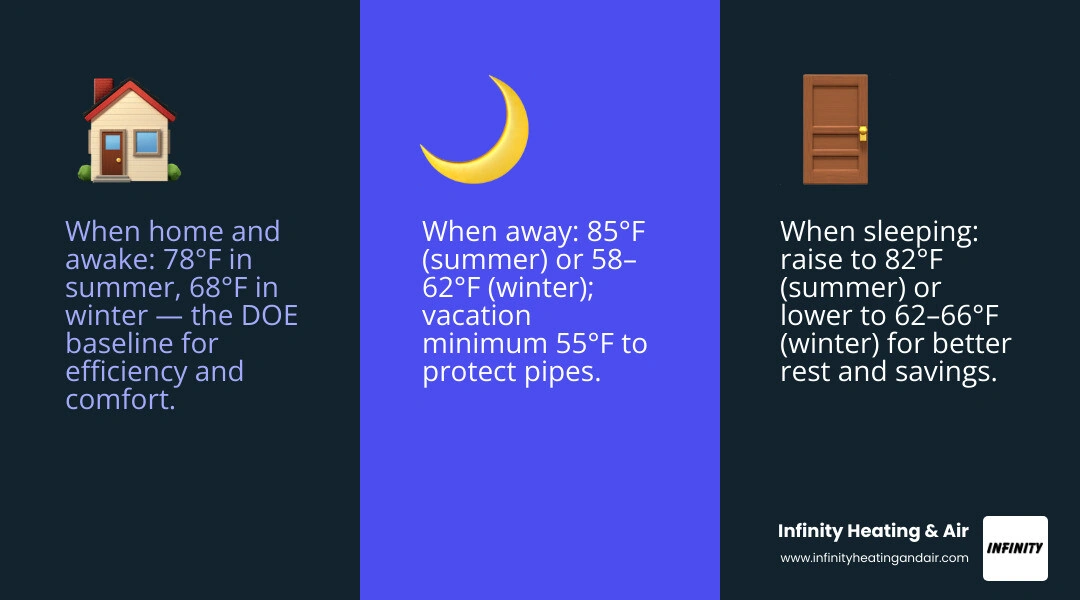
If you're wondering what temperature should I set my thermostat to, here's the short answer recommended by the U.S. Department of Energy:
| Situation | Summer (Cooling) | Winter (Heating) |
|---|---|---|
| Home & awake | 78°F | 68°F |
| Sleeping | 82°F | 62-66°F |
| Away from home | 85°F | 58-62°F |
| Extended vacation | - | 55°F |
These settings balance comfort with energy efficiency for most households.
Your thermostat setting affects your energy bills more than almost any other factor in your home. A small change — even a single degree — can add up to real savings over a full heating or cooling season.
But the "right" temperature isn't the same for everyone. Your comfort depends on humidity levels, who lives in your home, your local climate, and how your HVAC system is performing.
For homeowners in Northwest Washington, this gets even more interesting. The region's mild but wet winters and unpredictable seasonal swings mean your thermostat strategy may look a little different than what works in drier or warmer climates.
This guide walks you through five practical ways to dial in your settings — so you stay comfortable and keep your energy bills under control.
1. The Golden Standard: What Temperature Should I Set My Thermostat for Seasonal Efficiency?

Finding the perfect balance between personal comfort and energy conservation can feel like an ongoing household debate. However, the U.S. Department of Energy has established clear baselines designed to protect your wallet while keeping your home comfortable.
By aligning your home with these seasonal standards, you can maximize the benefits of an Energy Efficient HVAC system. Let's break down the golden standards for both the heating and cooling seasons.
Finding Comfort in the Winter: What Temperature Should I Set My Thermostat to When Awake?
During the chilly winter months in Western Washington, the recommended baseline temperature when you are home and awake is 68°F (20°C).
While 68°F might sound slightly brisk to some, there is a fascinating scientific reason behind it: heat loss physics. The rate at which your home loses heat to the outdoors is directly related to the temperature difference between inside and outside. The warmer you keep your home, the faster heat escapes into the cold air of Tacoma or Puyallup, forcing your heating system to work overtime. Keeping the indoor temperature at 68°F slows down this heat loss, saving you energy.
If 68°F feels a bit chilly at first, try these simple ways to adapt:
- Layer up: Throwing on a cozy sweater, thick socks, or using a warm throw blanket can easily make 68°F feel like 72°F.
- Leverage natural sunlight: Keep your south-facing window coverings open during the day to let natural solar heat warm your rooms, and close them at night to lock the warmth inside.
- Upgrade your heating equipment: If your home struggles to maintain a consistent temperature even at 68°F, it might be time to look into a High Efficiency Furnace to deliver steady, even heating.
Staying Cool in the Summer: What Temperature Should I Set My Thermostat to When Home?
When summer arrives in Northwest Washington, the golden rule for cooling is 78°F (26°C) when you are home and active.
We know what you might be thinking: 78 degrees? That sounds like a sauna! However, keeping your thermostat set to 78°F is highly effective at keeping cooling costs manageable. Every degree you lower your thermostat below 78°F increases your energy consumption by approximately 3 to 4 percent.
To put that into perspective:
- Setting your thermostat to 72°F instead of 78°F can increase your summer cooling costs by 18 to 24 percent!
- Conversely, setting your thermostat to 72°F instead of 68°F in the winter can increase your heating costs by 12 percent or more.
To make 78°F feel incredibly comfortable in the summer, utilize ceiling fans. Running your fans counter-clockwise creates a wind-chill effect that makes the air feel 4 degrees cooler than it actually is. Just remember to turn fans off when you leave the room—fans cool people, not rooms!
Additionally, keep in mind that standard residential air conditioners are designed to cool indoor spaces to a maximum of 20 degrees lower than the outdoor temperature. On a rare 98°F summer day in Lacey or Olympia, expecting your home to reach 68°F will only run your system nonstop, risking a breakdown.
2. The Power of the Setback: Adjusting Temperatures for Sleep and Away Periods
One of the easiest ways to slash your utility bills is by embracing the "setback." A setback is simply the practice of lowering (in winter) or raising (in summer) your thermostat when you don't need active climate control—specifically when you are asleep or away from home.
According to the Department of Energy, setting your thermostat back 7 to 10 degrees Fahrenheit for 8 hours a day can save you up to 10% a year on your heating and cooling bills. You can save roughly 1% to 3% on energy costs for each degree of change over an 8-hour period.
Here is how to manage these setbacks for maximum savings:
Nighttime Sleep Settings
For optimal sleep, the National Sleep Foundation recommends keeping your bedroom cool. Our bodies naturally drop in temperature as we prepare for sleep, and a cooler room facilitates this transition.
- In the winter: Aim for a sleeping temperature of 62°F to 66°F. This simple setback can save you 5% to 10% on your heating costs overnight.
- In the summer: Aim for a sleep setting of 82°F (or slightly lower if you use a ceiling fan to keep air moving).
Away Settings
There is no reason to pay to heat or cool an empty house while you are at work or running errands in Federal Way.
- In the winter: Lower your thermostat to 58°F to 62°F when you leave for 8 hours or more.
- In the summer: Raise your thermostat to 85°F (or turn the cooling system off entirely if you do not have pets or heat-sensitive plants).
Pipe Freeze Protection
While winter setbacks are fantastic for saving money, you must never set your thermostat below 55°F during cold weather. Keeping your home at a minimum of 55°F ensures that the ambient temperature inside your walls remains warm enough to prevent your water pipes from freezing and bursting.
| Season | Awake & Home | Sleeping (8 Hours) | Away (8+ Hours) |
|---|---|---|---|
| Winter (Heating) | 68°F | 62°F – 66°F | 58°F – 62°F (Never below 55°F) |
| Summer (Cooling) | 78°F | 82°F | 85°F |
3. Beyond the Numbers: How Humidity and Climate Impact Your Comfort
Have you ever noticed that 70°F can feel perfectly comfortable on one day, but sticky and warm on another? That is because humidity affects your perceived temperature far more than the actual reading on your thermostat.
Our bodies cool down through sweat evaporation. When the air is highly humid, sweat cannot evaporate efficiently, making us feel much hotter and stickier. In the winter, low humidity makes the air feel much colder than it actually is, which often prompts homeowners to crank up the thermostat unnecessarily.
To maintain a healthy, comfortable, and energy-efficient indoor environment, experts recommend keeping your home's relative humidity between 30% and 50%:
- In the summer: Keep humidity levels below 50%. This prevents mold, dust mites, and mildew growth while allowing your air conditioner to cool you more effectively.
- In the winter: Aim for the lower end of the spectrum (around 30% to 40%). This prevents dry skin and static electricity without causing condensation to pool on your windows.
In our unique Pacific Northwest climate—characterized by mild, wet winters and humid shoulder seasons—managing moisture is a major part of indoor comfort. Excess moisture in the air can strain your heating and cooling systems. To ensure your system is properly dehumidifying and circulating air, look into the Benefits of Regular HVAC Maintenance in Pacific Northwest Mild Wet climates.
4. Household Considerations: Tailoring Settings for Infants, Pets, and the Elderly
While the general 68°F and 78°F standards work incredibly well for healthy adults, your household might include members who require a little extra warmth or cooling.
Infants and Toddlers
Babies cannot regulate their body temperatures as easily as adults. For a nursery or a home with an infant, the ideal temperature range is slightly warmer in the winter—typically between 68°F and 72°F. Avoid letting the nursery drop below 64.4°F (18°C), which is the absolute minimum indoor housing temperature recommended by the World Health Organization (WHO) to protect residents from the harmful health effects of cold.
The Elderly and Health-Compromised Individuals
As we age, our circulation can slow down, and our bodies become more sensitive to temperature extremes. For elderly family members, maintaining a winter baseline of 70°F to 72°F is often much safer and more comfortable.
Pets and Houseplants
Don't forget about your furry friends and indoor greenery!
- Dogs and Cats: Most domestic pets have built-in fur coats and can easily tolerate winter setbacks down to 60°F or summer settings up to 80°F. However, short-haired breeds, elderly pets, or sick animals may need a more moderate environment.
- Houseplants: Most common tropical houseplants thrive in temperatures between 60°F and 75°F. If you are lowering your thermostat to 55°F for a winter vacation, move your sensitive houseplants away from drafty windows.
5. Smart Solutions: Upgrading to Programmable and Smart Thermostats
If adjusting your thermostat multiple times a day sounds exhausting, you are not alone. It is easy to forget to lower the temperature before heading out to work in Gig Harbor or going to sleep in Lakewood. That is where modern technology comes to the rescue.
Upgrading to a programmable or smart thermostat removes human error from the equation, ensuring you always hit your efficiency targets automatically.
Programmable Thermostats
A programmable thermostat allows you to pre-set schedules based on your routine. You can program a "Wake" temperature of 68°F at 6:00 AM, an "Away" temperature of 60°F at 8:00 AM, and a "Sleep" temperature of 62°F at 10:00 PM.
Note for Heat Pump Owners: If you have a traditional heat pump system, be cautious with deep manual setbacks in the winter. Standard programmable thermostats can cause heat pumps to activate inefficient backup electric resistance heat to rapidly warm the home. Ensure your thermostat is specifically designed for heat pumps to avoid this issue.
Smart Thermostats
Smart thermostats take automation a step further. Featuring Wi-Fi connectivity, these devices allow you to control your home's climate from your smartphone, tablet, or computer. Many models can:
- Learn your habits: They track when you leave and return, automatically adjusting the temperature to optimize savings.
- Monitor humidity: They work in tandem with your HVAC system to manage indoor moisture levels.
- Provide energy reports: They show you exactly how much energy you are saving and offer tips to reduce your utility bills further.
Investing in a smart thermostat is one of the smartest upgrades you can make to boost your HVAC system's overall efficiency. Regular upkeep of your system is equally critical; find out more by reading Annual HVAC Maintenance: Is It Worth It? to see how professional care keeps your smart system running flawlessly.
Frequently Asked Questions About Thermostat Settings
Will turning my thermostat way down cool my house faster?
No, this is one of the most common heating and cooling myths! Your air conditioner or furnace pumps conditioned air into your home at the exact same speed regardless of how low or high you set the temperature.
Setting your thermostat to 60°F when it is 80°F inside will not cool your house any faster than setting it to 78°F. It simply keeps the system running much longer, wasting massive amounts of energy and causing unnecessary wear and tear on your equipment.
Is 65 degrees too cold for a house in the winter?
For a healthy adult, 65°F is perfectly safe and can lead to excellent energy savings. However, the World Health Organization recommends keeping indoor temperatures at or above 64.4°F (18°C) to protect vulnerable populations—such as infants, the elderly, or those with chronic illnesses—from respiratory and cardiovascular strain. If everyone in your home is healthy, 65°F is a great target, especially when paired with warm clothing layers.
When should I call a professional for thermostat or HVAC issues?
You should reach out to a professional HVAC technician if you notice any of the following warning signs:
- The system runs nonstop without ever reaching your set temperature.
- Lukewarm air blows from your vents when the heating or cooling is active.
- Your thermostat is out of calibration. (You can test this by taping a reliable thermometer next to your thermostat. If the readings differ by more than 1–2 degrees after 15 minutes, your thermostat needs calibration or replacement).
To keep your system running at peak performance year-round, check out our guide on How Often Should You Service Your HVAC.
Conclusion
Finding the perfect answer to what temperature should I set my thermostat is all about balancing daily comfort with smart energy habits. By utilizing seasonal baselines (68°F in winter and 78°F in summer), taking advantage of sleeping and away setbacks, and keeping your home's humidity in check, you can enjoy a comfortable home while keeping your energy bills low.
At Infinity Heating & Air, we are proud to serve communities across Northwest Washington—including Puyallup, Tacoma, Olympia, Lacey, and Federal Way. We are dedicated to crafting endless comfort with reliable, expert service.
Whether you need to upgrade to a smart thermostat, schedule a routine tune-up, or explore a comprehensive HVAC Service Plan, our team is here to help.
Ready to optimize your home's comfort and efficiency? Schedule professional HVAC service and maintenance today!
Written & reviewed by the Infinity Heating & Air team — licensed WA HVAC contractor (INFINHA841B8). Family-owned in Graham, answering 24/7 across the South Sound.
Choose Infinity & enjoy endless comfort.
Your perfect home environment awaits — call (253) 740-5135 or schedule service online and our team will take it from there.
Open 24/7 · 100% Satisfaction Guaranteed · Graham, WA