Step-by-Step Guide to Why HVAC Replacement Is a Smart Investment
Discover why HVAC replacement is a smart investment for energy savings, home value, and long-term comfort with modern high-efficiency systems.
.webp)

Why HVAC Replacement Is a Smart Investment for Northwest Washington Homeowners
Why HVAC replacement is a smart investment comes down to a simple reality: at some point, the money you keep spending on an aging system would be better spent on a new one that pays you back every month.
Here's the quick answer if you're evaluating whether to replace your HVAC system:
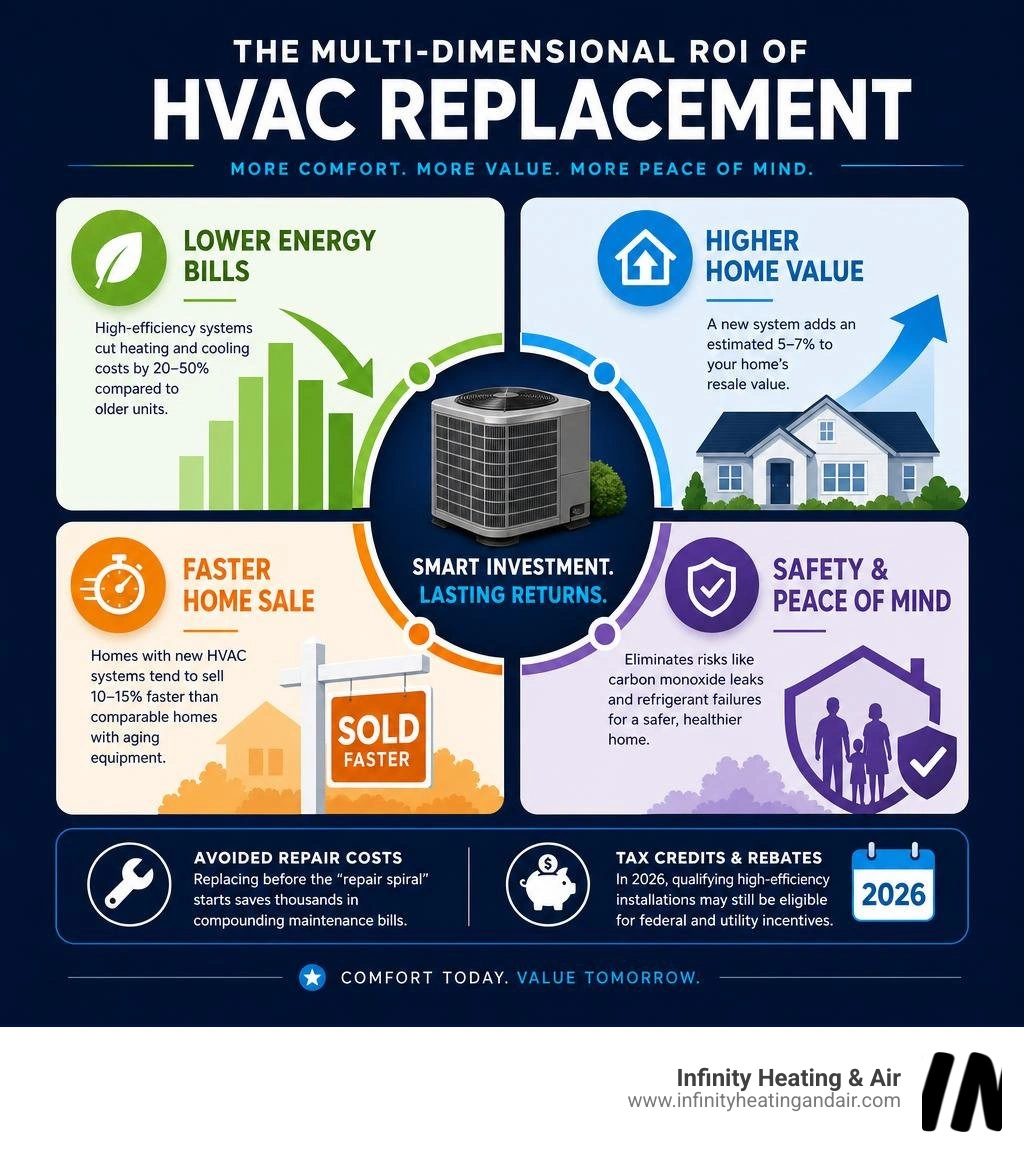
HVAC replacement is a smart investment because it delivers value in multiple ways simultaneously:
- Lower energy bills — High-efficiency systems cut heating and cooling costs by 20–50% compared to older units
- Higher home value — A new system adds an estimated 5–7% to your home's resale value
- Faster home sale — Homes with new HVAC systems tend to sell 10–15% faster than comparable homes with aging equipment
- Avoided repair costs — Replacing before the "repair spiral" starts saves thousands in compounding maintenance bills
- Safety — Eliminates risks like carbon monoxide leaks from cracked heat exchangers or expensive R-22 refrigerant failures
- Tax credits and rebates — In 2026, qualifying high-efficiency installations may still be eligible for federal and utility incentives
For most homeowners, especially in Northwest Washington where winters are cold and damp and summers can push systems hard, the question isn't whether replacement pays off — it's when the math tips in its favor.
This guide walks you through every dimension of that decision: the financial frameworks, the home value impact, the safety factors, the right system types, and the incentives available right now.
Quick look at why hvac replacement is a smart investment:
The Financial Framework: Why HVAC Replacement Is a Smart Investment

When evaluating a major home upgrade, it is easy to view it strictly as an expense. However, a modern heating and cooling system functions more like a financial vehicle that pays monthly dividends. Continuing to pour money into a system that is past its prime is often a sunk cost on a terminal machine.
By looking at the complete picture of return on investment (ROI), you can see how a proactive replacement protects your household budget. The financial return is built on three distinct pillars:
- Immediate Utility Reductions: Cutting waste from day one.
- Resale Value Recovery: Recouping a massive portion of the installation cost when selling your property.
- Avoided Repair Costs: Ending the constant cycle of service calls.
To help manage this transition smoothly, flexible Financing options are available to align the upfront investment with your ongoing monthly energy savings.
Long-Term Savings and Payback Period
Heating and cooling account for up to 50% of a typical home's energy bill. In our damp, chilly Northwest Washington winters and increasingly warm summers, your heating and cooling system is the single largest energy consumer in your household.
If your current system is more than a decade old, it likely relies on single-stage technology. Older units operate like a light switch: they are either 100% on or completely off. This constant cycling on and off uses a massive amount of electricity and fuel.
Modern systems utilize advanced variable-speed technology. Think of this like a smooth accelerator pedal on a car rather than going zero-to-sixty over and over. By making tiny, incremental adjustments, a variable-speed system maintains a perfectly consistent temperature while using significantly less power.
Upgrading to an Energy Efficient HVAC system can cut your heating and cooling costs by 20% to 50%. For most homeowners, this dramatic drop in utility bills allows the system to pay for itself over time, typically reaching a complete payback within 5 to 8 years. Over a 15- to 20-year equipment lifespan, that translates to nearly a decade of pure financial savings.
How a New System Boosts Home Value and Marketability
If you are planning to list your home in the near future, upgrading your heating and cooling system is one of the most strategic moves you can make. In competitive real estate markets across Pierce, Thurston, and King Counties, a brand-new climate control system acts as a powerful differentiator.
According to data from the National Association of Realtors, homeowners recover approximately 71% of their HVAC upgrade costs during a home resale. Furthermore, 72% of modern homebuyers prioritize energy-efficient features when searching for a property. A new system provides buyers with a form of insurance for their bank accounts, assuring them they won't face an emergency system failure immediately after moving in.
Understanding Why HVAC Replacement Is a Smart Investment Before Selling
From a buyer's perspective, an outdated heating and cooling system is a massive red flag. Buyers who are already stretching their budgets to cover a down payment and moving costs do not want to inherit the risk of a failing furnace or heat pump.
Replacing your system before listing your home gives you complete control over the narrative. It removes a major bargaining chip from the negotiation table, preventing buyers from demanding steep price concessions during the inspection phase.
Additionally, a new system dramatically accelerates your transaction. Homes with updated systems tend to sell 10% to 15% faster than comparable properties with aging equipment. When appraisers evaluate your home, a new system prevents "functional obsolescence" and secures positive value adjustments. You can read more about this in our guide on How HVAC Condition Affects Home Appraisals.
System Types and Their Impact on Property Value
Different heating and cooling configurations influence your home's market appeal and appraisal in unique ways:
- Ducted Heat Pumps: These systems are surging in popularity across Northwest Washington. Because they provide both highly efficient heating in the winter and crisp air conditioning in the summer, they represent the gold standard for regional homebuyers. Learn more about upgrading with a Heat Pump Installation Replacement.
- Ductless Mini-Splits: Perfect for homes with baseboard heating or historic properties without existing ductwork. They allow you to add conditioned square footage to bonus rooms, converted garages, or home offices, directly boosting your home's usable footprint. Explore options with a Mini Split Installation Replacement.
- Central Air and Furnaces: A reliable, classic pairing. Upgrading to a high-efficiency condensing gas furnace and matching AC ensures consistent, quiet comfort across all seasons.
- Zoned Systems: By dividing your home into distinct thermal zones, these systems eliminate hot and cold spots, appealing heavily to buyers looking at multi-story properties.
Deciding Between Repair and Replacement: The Strategic Rules
When your heating or cooling system acts up, you face a critical decision: do you pay to fix it again, or is it time to replace it? To remove the guesswork, the HVAC industry relies on two primary financial frameworks: the 50% Rule and the $5,000 Rule.
- The 50% Rule: If a single repair estimate exceeds 50% of the cost of a brand-new system, replacement is always the smarter long-term decision.
- The $5,000 Rule: Multiply the exact age of your system by the repair quote. If the result is over $5,000, replacement is the more financially sound choice.
For example, if an 11-year-old system requires a repair:
- An minor repair: 11 years × minor repair = well under the threshold. Verdict: Repair.
- A major component failure: 11 years × major repair = significantly exceeds the threshold. Verdict: Replace.
To help you visualize the best path forward, review our decision comparison below:
| Decision Factor | Choose Repair | Choose Replacement |
|---|---|---|
| Equipment Age | Under 10 years old | Over 12–15 years old |
| Refrigerant Type | Eco-friendly R-410A or newer | Phased-out R-22 (Freon) |
| Repair Frequency | Rare, isolated incident | Multiple repairs in the last 24 months |
| Utility Bills | Stable and predictable | Climbing steadily year-over-year |
| Safety Status | Completely safe | Cracked heat exchanger or electrical hazard |
| Comfort Levels | Consistent temperatures | Constant hot and cold spots |
For a deeper dive into these strategies, read our guides on Should I Repair or Replace My HVAC System and the HVAC Repair vs Replacement Ultimate Guide.
Why HVAC Replacement Is a Smart Investment for Long-Term Safety
While financial calculations are incredibly helpful, safety is non-negotiable. There are several critical system failures that make immediate replacement the only viable option:
- Cracked Heat Exchangers: In a gas furnace, the heat exchanger keeps toxic combustion gases separated from the air circulating through your home. If this metal chamber cracks, it can leak deadly carbon monoxide (CO) into your living spaces. Because a cracked heat exchanger cannot be safely patched, it requires an immediate system shutdown and replacement.
- Phased-Out R-22 Refrigerant: If your air conditioner or heat pump was installed before 2010, it likely uses R-22 (Freon). The EPA has completely banned the production and import of R-22 due to its ozone-depleting properties. Consequently, servicing these systems has become incredibly scarce and expensive. Investing in a repair on an R-22 system is essentially throwing money at an obsolete machine.
- Compromised Electrical Systems: Aging wiring, failing contactors, and worn-out compressors can create severe electrical fire hazards within your home.
If you suspect your system is reaching its limit, learn more about the warning signs by reading When Should You Replace Your Furnace and How Old Is Too Old for an HVAC System.
Evaluating the Repair Spiral
Continuing to repair an aging system often triggers a "repair spiral." Because mechanical components wear out at a similar rate, replacing one failing part frequently puts extra strain on other aging components, leading to cascading failures.
To break this cycle, homeowners should keep a dedicated "Home Health Folder." Track every service call, repair bill, and seasonal tune-up. If you notice you've called for service multiple times over the last two years, your system is signaling that it is ready for retirement.
Proactive replacement allows you to plan your installation calmly during the mild spring or autumn months, rather than facing an emergency replacement in the middle of a freezing winter storm or a summer heatwave.
To explore how ongoing maintenance impacts this timeline, refer to our HVAC Repair vs Replace Complete Guide, The True Cost of Neglecting HVAC Maintenance, and learn about the unique regional factors in our article on the Benefits of Regular HVAC Maintenance in Pacific Northwest Mild Wet.
Energy Efficiency Gains and Modern Technology Upgrades
Modern heating and cooling technology has advanced leaps and bounds over systems built just a decade ago. Today's equipment is strictly rated under more rigorous testing standards known as SEER2 (Seasonal Energy Efficiency Ratio 2) for cooling and AFUE (Annual Fuel Utilization Efficiency) for heating.
Upgrading from an older furnace with an 80% AFUE rating to a modern condensing model boasting 95% to 98% AFUE means that nearly every dollar you spend on fuel is directly converted into heat for your home, reducing waste to almost zero.
Additionally, pairing your new system with a smart thermostat can boost your home's overall value by up to 5% while unlocking automated, zone-specific energy savings. You can see how these modern ratings stack up by checking out our Standard Efficiency vs High Efficiency HVAC Comparison.
Leveraging 2026 Tax Credits and Rebates
In June 2026, homeowners looking to upgrade can still take advantage of significant financial incentives. The Inflation Reduction Act continues to support clean energy initiatives by offering federal tax credits for qualifying high-efficiency heat pump installations.
Furthermore, local utility providers across Washington State offer robust rebates for homeowners who transition to ENERGY STAR-certified heating and cooling systems. By combining these federal tax credits with local utility rebates, you can offset a substantial portion of your upfront installation costs.
Be sure to explore the current opportunities listed in our guide on Washington Energy Rebates for HVAC Upgrades.
Frequently Asked Questions about HVAC Upgrades
Does a new HVAC system increase the appraised value of a home?
Yes. Licensed real estate appraisers view a new, professionally installed HVAC system as a major capital improvement that extends the functional life of the property. When comparing your home to recently sold properties (comparables) in your local neighborhood, the appraiser will make positive adjustments for a new system, helping ensure your home appraises at or above your target asking price.
Should I replace my furnace and air conditioner at the same time?
In almost all cases, yes. Replacing both units together as a matched system ensures they are designed to work in perfect harmony, maximizing your overall SEER2 and AFUE efficiency ratings.
Additionally, replacing them at the same time saves you a significant amount on labor costs compared to scheduling two separate installations years apart. It also aligns your manufacturer and contractor warranties, giving you complete peace of mind.
Explore our specialized services for Heating Installation Replacement and Air Conditioning AC Installation Replacement.
How long does a typical HVAC system last?
In our Northwest Washington climate, a well-maintained gas furnace typically lasts 15 to 20 years, while central air conditioners and heat pumps average 10 to 15 years.
The single most influential factor in extending your system's lifespan is consistent, professional preventative maintenance. To learn more about protecting your investment, read our detailed analysis: Annual HVAC Maintenance Is It Worth It.
Conclusion
At Infinity Heating & Air, we understand that upgrading your heating and cooling system is a significant decision. As Northwest Washington's trusted home comfort and air quality experts, we are dedicated to crafting endless comfort with reliable, expert service.
Whether you are looking to lower your monthly utility bills, resolve persistent hot and cold spots, protect your family from safety hazards, or maximize your home's resale value before listing it on the market, a modern system is one of the smartest investments you can make.
We proudly serve homeowners across Pierce, Thurston, and South King Counties, including Puyallup, Tacoma, Olympia, Lacey, Lakewood, Federal Way, Gig Harbor, Auburn, and surrounding areas.
If you are ready to explore your options, we invite you to learn more about our professional HVAC Installation Replacement services, or secure long-term reliability with our comprehensive Maintenance Plan. Contact our friendly, experienced team today to design the perfect, high-efficiency comfort solution for your home!
Endless Comfort
Starts Here
Our expert technicians are ready to serve you and your home.