A Comprehensive Guide to Heat Pumps in Mild Wet Climates
Discover if heat pumps are efficient in mild wet climates with expert tips for Pacific Northwest homes.
.webp)

Are Heat Pumps Efficient in Mild Wet Climates? Here's What Northwest Homeowners Should Know
Are heat pumps efficient in mild wet climates? Yes — and they often perform better here than almost anywhere else in the country.
Here's a quick summary of why:
| Factor | How It Helps Heat Pumps |
|---|---|
| Mild winters (rarely below 20°F) | Heat pumps run at peak efficiency most of the season |
| Moist, dense air | More ambient heat energy available to extract |
| Moderate summers | Less strain on the cooling side compared to hot-dry regions |
| Clean electrical grid (PNW) | Lower carbon footprint per unit of energy used |
The Pacific Northwest gets a lot of attention for its grey skies and steady drizzle. But that same damp, mild maritime climate is one of the best environments on earth for heat pump technology to thrive.
Unlike a gas furnace that burns fuel to create heat, a heat pump moves heat that already exists in the outdoor air — even when that air feels cold and wet. The mild temperatures common across Northwest Washington mean the system rarely has to work at its limits. And when it does run hard during a cold snap, modern cold-climate models are built to handle it.
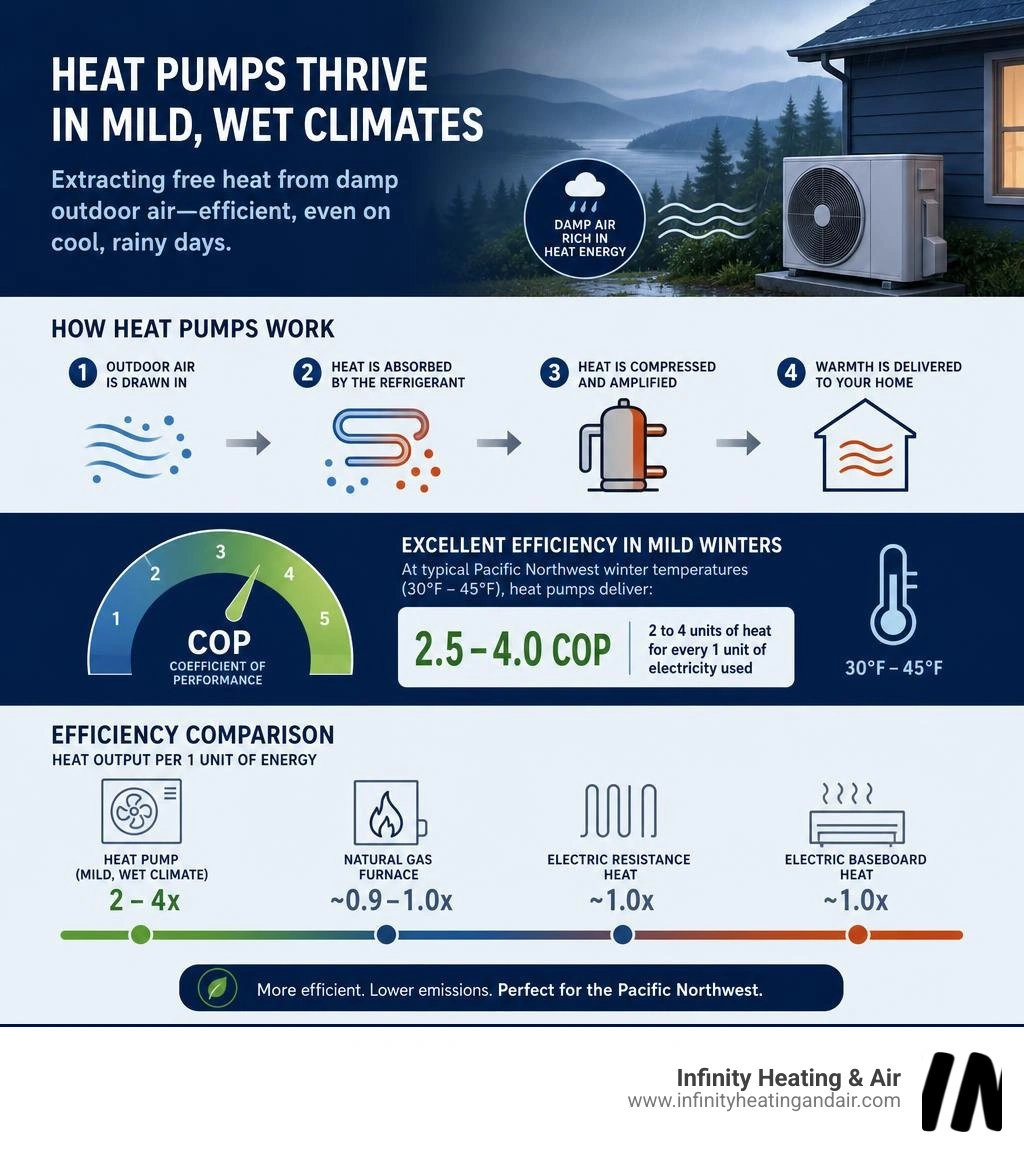
Data backs this up. Heat pumps deliver 2 to 4 units of heat for every 1 unit of electricity they consume. At typical Pacific Northwest winter temperatures — hovering between 30°F and 45°F — a quality heat pump can maintain a Coefficient of Performance (COP) well above 2.5. That's a level of efficiency no gas furnace or electric baseboard system can match.
For homeowners in Bellingham, Ferndale, Blaine, and across Northwest Washington who are still relying on electric resistance heat or an aging gas furnace, the case for switching is hard to ignore.
Related content about are heat pumps efficient in mild wet climates:
Why Are Heat Pumps Efficient in Mild Wet Climates?
To understand why are heat pumps efficient in mild wet climates, we have to look at the basic physics of how these systems operate. Traditional heating systems like gas furnaces or electric baseboard heaters rely on creating thermal energy from scratch. A furnace burns natural gas, while a baseboard heater forces electrical current through a high-resistance metal coil. In both cases, you can never achieve more than 100% efficiency. In fact, even a premium, high-efficiency gas furnace maxes out at around 95% to 98% efficiency due to energy lost through the exhaust flue.
Heat pumps, on the other hand, do not generate heat. They act as thermal transporters. Using a closed refrigeration loop, they absorb ambient heat energy from the outdoor air, compress the refrigerant to raise its temperature, and release that heat inside your home. In the summer, they simply reverse this cycle, extracting heat from your indoor air and dumping it outside.

This process of heat transfer is incredibly elegant and highly efficient. When the outdoor temperature is mild — say, between 40°F and 50°F, which is typical for winters in South Puget Sound communities like Tacoma, Puyallup, and Olympia — the outdoor air is packed with accessible thermal energy.
Furthermore, our infamous maritime humidity actually plays a surprising role in this process. Moist air is physically denser than dry air. Because water vapor holds more thermal energy than dry air at the same temperature (a concept known as latent heat), the damp winter air in Western Washington acts as an excellent medium for heat transfer. When this dense, moisture-laden air passes over the outdoor evaporator coils, the heat pump can easily harvest that abundant ambient heat.
This high concentration of accessible outdoor heat allows the system to achieve an outstanding Coefficient of Performance (COP). In our mild climate, a standard air-source heat pump can easily achieve a COP of 3.0 or higher. This means that for every single dollar of electricity you put into the system, you get three dollars' worth of heat delivered into your home. This is why understanding Heat Pump Benefits for Pacific Northwest Homeowners is so critical when planning a home comfort upgrade in 2026.
Real-World Performance: Are Heat Pumps Efficient in Mild Wet Climates Compared to Furnaces?
When we compare a heat pump to a gas furnace or electric resistance heating in the Puget Sound region, the efficiency gap becomes even more dramatic. In colder, drier regions of the country (like the Midwest or Northeast, spanning climate zones 5 through 7), fossil fuel furnaces remain the dominant heating choice, heating roughly 63% of homes while heat pumps represent only about 3%. In those sub-zero climates, standard air-source heat pumps can struggle to find enough outdoor heat without relying heavily on expensive backup heat strips.
But Western Washington lies in a unique climatological sweet spot. Our winters are incredibly mild compared to the rest of the northern United States. Because our temperatures rarely stay below freezing for long stretches, a heat pump operates in its peak efficiency zone for nearly 95% of the heating season.
| Heating System Type | Typical Operating Efficiency | Average Winter COP | Source of Heat |
|---|---|---|---|
| Air-Source Heat Pump | 200% – 400% | 2.5 – 3.8 | Ambient outdoor air |
| Electric Resistance (Baseboards) | 100% | 1.0 | Electrical resistance |
| Standard Gas Furnace | 80% – 95% | N/A (Combustion) | Fossil fuel combustion |
As shown in the table above, switching from a standard gas furnace to an air-source heat pump can cut a household's carbon dioxide emissions by about 40%. In areas like Thurston and Pierce counties, where local electrical grids are increasingly powered by clean, renewable hydro and wind energy, transitioning to an electric heat pump can virtually eliminate your home’s operational heating carbon footprint.
From a purely financial perspective, the operating cost savings are equally impressive. When you replace electric baseboards or wall heaters with a heat pump, you can trim your heating-related electricity consumption by up to 50% to 75%. To learn more about how these systems stack up against older technology, take a look at our detailed breakdown of Heat Pump Advantages Over Traditional Heating.
Humidity and Frost: Are Heat Pumps Efficient in Mild Wet Climates During Winter?
While high humidity provides a dense medium for heat transfer, it does introduce one specific engineering challenge: coil frosting.
When the outdoor temperature drops close to freezing (typically between 32°F and 40°F) and the relative humidity is high, the moisture in the air can condense and freeze onto the cold outdoor evaporator coils of the heat pump. If ice is allowed to build up unchecked, it acts as an insulating blanket, blocking airflow and reducing the system’s ability to absorb heat.
Fortunately, modern heat pumps are designed with automated defrost cycles to handle this exact scenario. When the system detects ice buildup on the coils, it temporarily reverses its operation into cooling mode for a few minutes. This sends warm refrigerant back through the outdoor coils, quickly melting the frost. During this brief cycle, the indoor blower typically pauses or uses a tiny amount of auxiliary heat to ensure you don’t feel a cold draft inside.
While the defrost cycle does consume a small amount of energy, modern variable-speed systems have optimized this process so well that it has a negligible impact on overall seasonal efficiency. In our maritime climate, the temporary energy used for defrosting is vastly offset by the massive efficiency gains achieved during the rest of the day. To explore how our unique weather patterns interact with your heating and cooling equipment, read our guide on How Pacific Northwest Rain and Humidity Affect Your HVAC.
Selecting the Right System for Maritime Weather
Choosing the best heat pump system for your home depends heavily on your property’s layout, existing infrastructure, and your specific comfort goals. In Western Washington, we generally install three primary types of heat pump systems: ducted air-source, ductless mini-splits, and geothermal (ground-source) systems.
- Central Ducted Heat Pumps: If your home in Federal Way, Gig Harbor, or Lakewood already has a network of air ducts from an old furnace, a central ducted heat pump is a fantastic drop-in replacement. The outdoor unit connects directly to your existing ductwork via an indoor air handler, distributing consistent, filtered air to every room.
- Ductless Mini-Split Heat Pumps: For homes without existing ductwork—such as classic mid-century homes or properties utilizing electric baseboards—ductless systems are incredibly popular. They use compact indoor air handlers mounted directly on the wall or ceiling, connected to an outdoor compressor by a small refrigerant line.
- Geothermal Heat Pumps: Geothermal systems tap into the stable temperatures of the earth rather than the outdoor air. While they require a higher upfront investment for ground loop installation, they offer unmatched efficiency (often exceeding 400% to 500% COP) and have incredibly long lifespans, with indoor components lasting up to 24 years and ground loops lasting over 50 years.
To weigh the differences between ducted and ductless installations for your specific area, check out our comparison of Central Air vs Mini Split for the South Puget Sound Area Homes.
Ductless Mini-Splits for Zoned Comfort
Ductless mini-splits have revolutionized home heating and cooling across the Pacific Northwest. Because they don't rely on a network of ducts, they eliminate the "duct loss" that plagues traditional central systems. In a typical home, leaky or poorly insulated ductwork can lose between 20% and 30% of its heated or cooled air before it ever reaches your living spaces. By delivering conditioned air directly into the room, mini-splits ensure that virtually 100% of the energy you pay for is converted into indoor comfort.
Another massive benefit of ductless technology is zoning. Each indoor head can be controlled independently with its own thermostat. This means you can keep your bedroom cool and comfortable at night while keeping your living room warm, without wasting energy heating empty guest rooms.
For older homes in historical neighborhoods of Tacoma, Olympia, or Steilacoom, ductless mini-splits are a game-changer. They require only a small, three-inch hole through the exterior wall to run the refrigerant and electrical lines, completely preserving the architectural integrity of your home. You can read more about these flexible solutions in our guide to Ductless Heating and Cooling for Pacific Northwest Homes.
Cold-Climate Heat Pumps for Occasional Freezing Snaps
While our winters are generally mild, we do experience occasional Arctic blasts and cold snaps that bring freezing temperatures and snow to Puyallup, Auburn, and surrounding areas. In the past, older heat pumps would struggle during these events, forcing homeowners to rely heavily on expensive backup electric resistance heat strips.
Today's modern "cold-climate" heat pumps have completely solved this problem. Equipped with advanced variable-speed inverter compressors and vapor injection technology, these systems can modulate their output dynamically. Instead of operating like a traditional single-speed system that is either 100% "on" or 100% "off," a variable-speed compressor acts like a dimmer switch, scaling its output from 25% up to 110% to match the exact heating demand of your home.
This advanced engineering allows modern cold-climate heat pumps to maintain 100% of their heating capacity at temperatures as low as 5°F, and continue operating efficiently well below zero. If you ever run into issues during a sudden freeze, our team is always ready to help. You can read our troubleshooting tips at Heat Pump Not Heating Diagnosis Puyallup WA.
Maximizing Efficiency and Indoor Air Quality in Damp Environments
Our damp maritime climate requires a proactive approach to home maintenance to prevent moisture-related issues like mold, mildew, and indoor air pollution. Fortunately, a properly installed heat pump is one of the best tools available for managing indoor air quality and humidity.
During the summer cooling season, your heat pump naturally acts as a powerful dehumidifier. As warm, humid indoor air passes over the cold indoor coils, moisture condenses on the metal surfaces and is safely drained away outside. This process keeps your indoor relative humidity within the ideal 30% to 50% range, preventing mold growth and keeping your home feeling crisp and comfortable.
To maximize your system's efficiency and maintain pristine indoor air, we always recommend pairing your heat pump with targeted home weatherization upgrades, such as attic insulation and air sealing. Sealing up drafts ensures that your heat pump doesn't have to work overtime to replace lost air, keeping your utility bills low.
Additionally, because heat pumps circulate air continuously to maintain stable temperatures, high-quality air filtration is essential. Our damp winters can cause airborne mold spores and allergens to thrive, making regular filter changes incredibly important. Learn more about how our local weather impacts your system's maintenance needs in our article on How Pacific Northwest Mild Wet Affects Filter Replacement Frequency.
The Importance of Regular Maintenance
Regular professional maintenance is the single most important factor in ensuring your heat pump operates at peak efficiency for its entire 15-to-20-year lifespan. Because heat pumps run year-round—providing gentle heating in the winter and cooling in the summer—they experience more operational wear and tear than a standard furnace.
In our wet, humid climate, outdoor coils can easily become blanketed in damp organic debris, pine needles, and dust. This buildup restricts airflow and forces your compressor to work harder, which can drop your system's efficiency by 15% to 30% and lead to premature wear.
A standard professional maintenance visit includes:
- Deep cleaning the outdoor condenser and indoor evaporator coils.
- Checking refrigerant levels and inspecting lines for leaks.
- Verifying proper condensate drainage to prevent indoor water leaks.
- Testing electrical connections and measuring motor currents.
- Calibrating your thermostat for optimal comfort and performance.
By scheduling annual or bi-annual tune-ups, you protect your investment, maintain your manufacturer's warranty, and ensure your system is ready to handle whatever weather Western Washington throws our way. For a deeper look at why keeping your system clean is so vital, read about the Benefits of Regular HVAC Maintenance in Pacific Northwest Mild Wet and explore our comprehensive Heat Pump Maintenance Tacoma WA Guide.
Financial Incentives and Rebates for 2026 Upgrades
Making the switch to an energy-efficient heat pump is more accessible than ever in 2026, thanks to an array of federal, state, and local utility incentives designed to promote home electrification.
Under the federal Energy Efficient Home Improvement Credit (Section 25C), homeowners can claim a tax credit of up to 30% of the total installation cost, up to $2,000 annually, for qualifying ENERGY STAR certified heat pumps. Because this is a non-refundable tax credit, it directly reduces the amount of federal income tax you owe.
In addition to federal support, our local utility providers across Pierce, Thurston, and King counties offer substantial rebates to help offset installation costs:
- Tacoma Power: Offers generous rebates and zero-interest financing options for customers upgrading from electric resistance heat or older, inefficient systems to high-efficiency heat pumps.
- Puget Sound Energy (PSE): Provides significant cash-back rebates for qualifying ducted and ductless heat pump installations, helping to make the transition seamless.
- Local Municipal Utilities: Many municipal electric departments in towns like Eatonville, Milton, and Sumas offer targeted incentives for energy-efficiency upgrades.
When you stack these utility rebates with federal tax credits, the upfront cost of upgrading your home's comfort system becomes incredibly manageable. For a complete breakdown of how to navigate these savings in our area, consult our Heat Pump Installation Tacoma WA Guide.
Frequently Asked Questions about Heat Pumps in Wet Climates
Do heat pumps work during freezing Pacific Northwest cold snaps?
Yes, absolutely. While older models occasionally struggled when temperatures dipped below freezing, modern cold-climate heat pumps are engineered specifically for sub-freezing performance. Utilizing advanced variable-speed inverter compressors, these systems can extract ambient heat from outdoor air even when temperatures drop below 0°F. If a rare, extreme winter storm pushes the system past its limits, the heat pump can seamlessly transition to integrated auxiliary electric heat strips to ensure your home stays perfectly warm.
How does high humidity affect heat pump efficiency?
High humidity actually has a dual effect. On one hand, damp air is physically denser and holds more thermal energy than dry air, making it easier for the heat pump to harvest heat during mild winter days. On the other hand, when temperatures hover near freezing, high humidity can cause frost to accumulate on the outdoor coils. Fortunately, modern heat pumps handle this automatically through engineered defrost cycles that quickly melt away frost with minimal energy consumption, preserving high seasonal efficiency.
What is the typical lifespan of a heat pump in a wet climate?
With regular professional maintenance, a high-quality heat pump in our mild maritime climate typically lasts 15 to 20 years. Because our local temperatures are relatively moderate year-round, the systems rarely experience the extreme thermal shock or constant maximum-load operation common in harsher desert or Midwestern climates. This mild operating environment helps preserve the longevity of major components like the compressor and fan motors.
Conclusion
When you look at the empirical data, the answer to our original question is clear: are heat pumps efficient in mild wet climates? Not only are they highly efficient, but our unique maritime climate is arguably the absolute best environment in the country for maximizing a heat pump's performance and long-term energy savings.
By utilizing advanced heat transfer technology instead of burning expensive fossil fuels, a modern heat pump provides consistent, gentle warmth all winter, crisp dehumidified cooling all summer, and exceptional indoor air filtration year-round—all while dramatically lowering your home’s carbon footprint.
At Infinity Heating & Air, we are proud to be the premier home comfort and air quality experts serving South Puget Sound communities from Tacoma and Puyallup to Gig Harbor and Olympia. Our dedicated team is committed to crafting endless comfort for your family with reliable, expert service, 24/7 emergency support, and flexible financing options tailored to your needs.
Ready to experience the unmatched efficiency and comfort of a modern comfort system? Upgrade to an ENERGY STAR certified heat pump with us today, and take the first step toward a more comfortable, energy-efficient future.
Endless Comfort
Starts Here
Our expert technicians are ready to serve you and your home.