Everything You Need to Know About Heat Dome Cooling Demand
Learn how summer heat domes create unexpected cooling demand and prepare your HVAC system for extreme summer heat.
When the Sky Becomes a Lid: Understanding Heat Dome Cooling Demand
How summer heat domes create unexpected cooling demand is something millions of homeowners discovered in the summer of 2025 — when more than 255 million Americans were exposed to dangerous, life-threatening heat in a single weather event.
Here's the short answer:
How Heat Domes Create Unexpected Cooling Demand
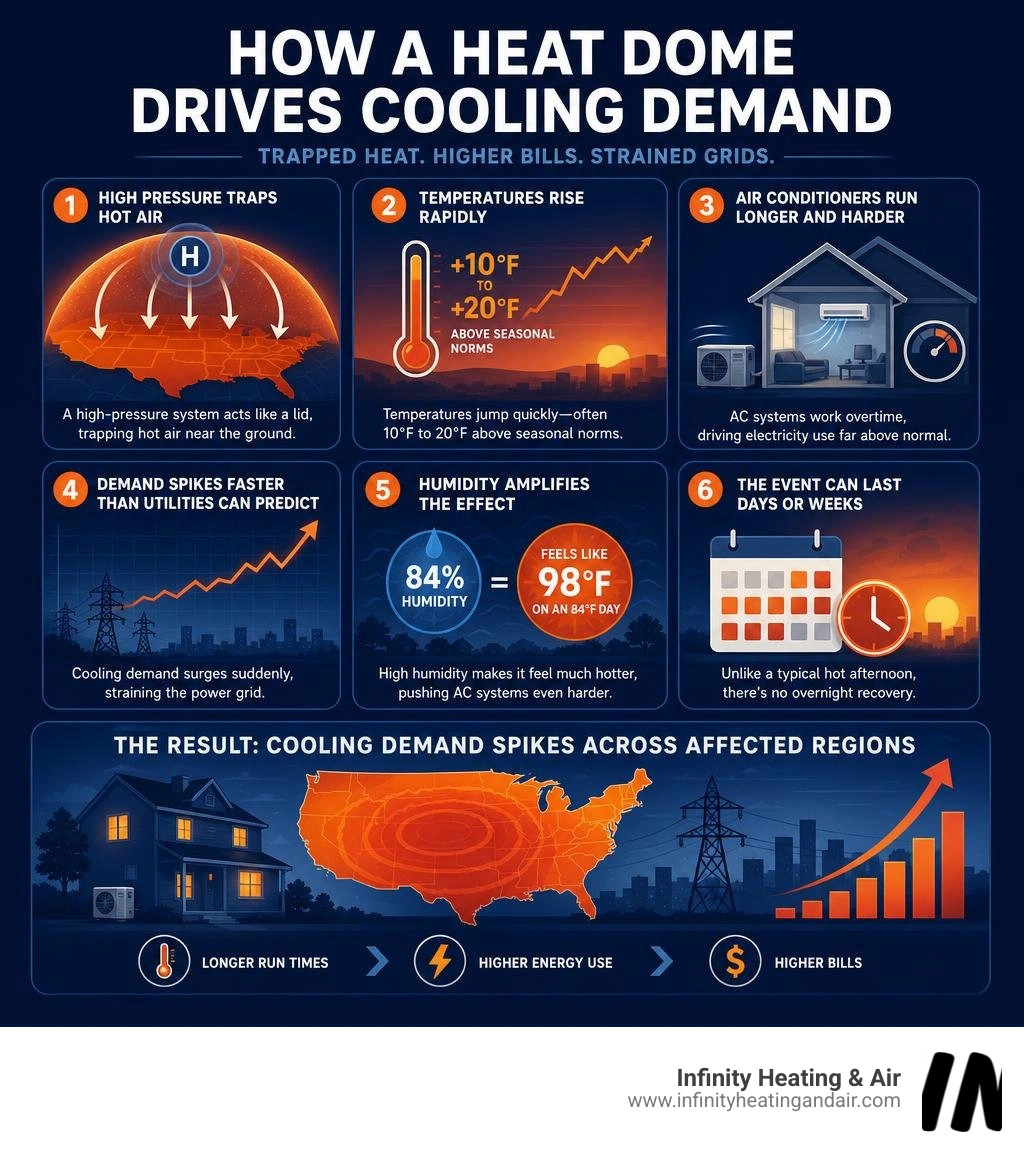
- A high-pressure system traps hot air near the ground, acting like a lid over a region
- Temperatures rise rapidly — often 10°F to 20°F above seasonal norms — within days
- Air conditioners run longer and harder to keep up, driving electricity use far above normal
- Demand spikes faster than utilities can predict, straining the power grid
- Humidity amplifies the effect — at 84% humidity, an 84°F day can feel like 98°F, pushing AC systems even harder
- The event can last days or weeks, unlike a typical hot afternoon, so there's no overnight recovery
This isn't just a comfort issue. Heat wave frequency in the U.S. has nearly tripled since the 1960s, and the heat wave season has more than doubled — from roughly 25 days to 70 days per year. For homeowners in Northwest Washington and across the country, that means HVAC systems are being pushed into territory they were never designed to handle.
The sections below break down exactly what a heat dome is, why it puts so much strain on your cooling system, and what you can do about it.
What Is a Heat Dome and How Does It Form?
To understand why your cooling system suddenly feels like it is running a marathon during a heat wave, we have to look up at the atmosphere. A heat dome is not just a fancy term for a hot week; it is a specific, powerful meteorological phenomenon.
At its core, a heat dome forms when a strong, high-pressure atmospheric system settles over a region. Think of the high pressure as a giant, heavy blanket of air descending from 10,000 to 25,000 feet. As this heavy air sinks toward the earth's surface, it compresses. In physics, when you compress air, you heat it up. This sinking, compressing air acts like a lid on a pot, trapping the heat that is already radiating off the ground.
Normally, hot air rises, cools in the upper atmosphere, and creates convection currents that help ventilate the region. But under a high-pressure dome, those convection currents are blocked. The hot air attempts to rise, hits the high-pressure "lid," and is forced right back down to compress and warm even further.
Compounding this issue are jet stream blocking patterns. Often driven by "Arctic Amplification" — where the Arctic warms faster than the rest of the globe — the jet stream can develop deep, wavy loops. When these loops stall, they create atmospheric "traffic jams." This prevents weather systems from moving, locking a heat dome in place over areas like Western Washington for days or even weeks.
As the sun shines down through cloudless skies, it bakes the ground day after day. Without clouds or wind to disperse the heat, temperatures climb exponentially. This is when having a reliable, highly efficient Air Conditioning system becomes a matter of safety rather than just basic comfort.
How Summer Heat Domes Create Unexpected Cooling Demand
When a heat dome settles over a region, the sudden shift in weather completely disrupts normal energy consumption patterns. Utilities and grid operators measure this shift using a metric called Cooling Degree Days (CDDs).
A cooling degree day measures how much and for how long the outside air temperature remains above a baseline of 65°F (the temperature at which most buildings no longer need mechanical heating and might begin to require cooling). For example, if the average daily temperature in Tacoma or Puyallup is 80°F, that day counts as 15 CDDs.
During a heat dome, CDDs do not just rise; they skyrocket. This causes an immediate, massive surge in peak electricity demand. Because nearly nine in ten U.S. homes rely on some form of air conditioning, millions of systems turn on simultaneously and stay on.
This sudden collective behavior causes wholesale electricity prices to spike. In highly populated or constrained energy markets, grid operators must turn on expensive, less efficient "peaker plants" to keep up with the load. For homeowners, this translates directly to eye-watering utility bill spikes.
Furthermore, because the heat dome prevents nighttime cooling — a phenomenon amplified by the urban heat island effect in paved areas like Seattle, Tacoma, and Everett — your home never has a chance to naturally shed its thermal load. Your air conditioner is forced to work 24/7 without a break. If your system is not in peak condition, you might find your AC Not Cooling Properly: What to Check before the heat wave reaches its peak.
The Science Behind How Summer Heat Domes Create Unexpected Cooling Demand
The relationship between outdoor temperature and electricity demand is highly nonlinear. It resembles a sharp U-shaped curve centered around that 65°F threshold. When temperatures hover between 60°F and 70°F, energy demand is at its lowest. But once the daily average pushes past 80°F, and especially when daytime highs cross 90°F, the demand curve bends sharply upward.
This dramatic shift occurs because your air conditioner has to fight two distinct types of heat loads:
- Sensible Heat Load: This is the actual temperature of the dry air. Lowering the sensible heat load requires your AC to physically cool the air down to your thermostat's setpoint.
- Latent Heat Load: This is the heat held by moisture (humidity) in the air. To cool humid air, your AC must first condense and remove the water vapor.
Humidity acts as a massive thermal sponge. For instance, a temperature of 84.5°F with 84% humidity actually feels like 98°F to the human body — and it places a similar, crushing "felt" load on your cooling equipment. The system must spend a significant portion of its energy simply squeezing water out of the air before it can effectively lower the indoor temperature. Under a heat dome, high humidity levels make the air feel incredibly heavy, forcing your HVAC system to run continuously just to keep indoor spaces dry and tolerable.
Regional Impacts: How Summer Heat Domes Create Unexpected Cooling Demand on the East Coast and Pacific Northwest
While heat domes present challenges nationwide, their regional impacts vary dramatically. On the East Coast, where high humidity is a summer staple, the grid is structurally designed for heavy summer cooling loads, though it still suffers from natural gas pipeline constraints that can drive up energy prices during extreme weather.
In contrast, the Pacific Northwest has historically enjoyed mild, temperate summers. For decades, many homes in the Puget Sound region did not even have air conditioning. However, climate shifts have changed the game. The historic June 2021 Pacific Northwest heat wave — which pushed Seattle to 108°F and Portland to 116°F — rewrote the record books and served as a massive wake-up call.
Since then, we have seen rapid AC adoption across Washington state, with adoption rates in WA homes climbing past 53%. This rapid shift has fundamentally changed how local utilities must plan for the summer.
Data from Seattle City Light reveals how sensitive our local grid has become to temperature changes. In their 2025 forecasting models, a mere 5°F temperature increase in July or August drove over 15 MW and 20 MW of additional load respectively compared to just two years prior. Because our regional infrastructure was historically built around winter heating peaks, these sudden, sharp summer afternoon cooling peaks put unprecedented stress on local substations.
Whether you are in Tacoma, Federal Way, or Olympia, ensuring your system is ready for these sudden shifts is crucial. Scheduling a timely AC Service Puyallup before the summer peak can protect your system from failing when the next dome settles over the Puget Sound.
The Impact of Extreme Heat on HVAC Systems and the Power Grid
Extreme heat waves do not just increase the demand for electricity; they simultaneously degrade the supply and efficiency of our entire energy infrastructure. This creates a dangerous double-whammy for grid reliability.
First, let's look at the power plants themselves. Thermal power plants (including natural gas, coal, and nuclear facilities) rely on cooling water from nearby rivers or reservoirs to operate efficiently. During a heat dome, river temperatures rise. If the water gets too warm, nuclear plants are legally required to ramp down or shut down entirely to prevent ecological damage to local waterways. During a hot spell, gigawatts of power can be forced offline exactly when we need them most.
Second, the physical transmission lines that carry electricity across Washington state become less efficient as they heat up. High temperatures increase electrical resistance in the copper and aluminum wires, meaning more power is lost as waste heat during transmission. The lines can even physically sag under the combined weight of high electrical current and ambient heat, occasionally touching tree branches and triggering localized blackouts.
For your home's air conditioner, this means it is receiving less stable power while trying to operate in a hostile environment. The outdoor condenser coil must disperse the heat extracted from your home into the blistering outdoor air. If the outdoor temperature is 95°F, it is much harder for that coil to shed heat than if it were 75°F. Your compressor has to work twice as hard to compress the refrigerant, leading to rapid wear and tear.
If your system has neglected maintenance issues, these extreme conditions will expose them immediately. Keep an eye out for the Signs Your AC Needs Repair to avoid a complete system breakdown in the middle of a heat wave.
| Operational Metric | Normal Summer Day (72°F - 78°F) | Heat Dome Peak (90°F - 100°F+) | Impact on Homeowner |
|---|---|---|---|
| AC Run Cycle | 15–20 minutes per hour | 50–60 minutes per hour (Continuous) | Higher wear, increased energy bills |
| Grid Power Reserves | High / Stable | Low / Critical | Risk of brownouts or rolling blackouts |
| Compressor Operating Temp | Moderate | Very High | High risk of electrical/mechanical failure |
| Refrigerant Pressure | Standard | Elevated | Leaks and component strain are magnified |
How Homeowners Can Prepare for and Mitigate Heat Dome Effects
While you cannot control the jet stream or prevent a high-pressure system from stalling over Northwest Washington, you can take proactive steps to shield your home and your wallet from the worst of a heat dome's impacts.
Here is a list of highly effective, actionable energy-saving tips to implement before the summer heat arrives:
- Upgrade to a Smart Thermostat: A smart thermostat allows you to program "pre-cooling" schedules. You can cool your home slightly lower than normal during the early morning hours when the outdoor temperature is cool and electricity demand is low. Then, you can let the thermostat rise a few degrees during the peak afternoon heat to reduce grid strain.
- Seal Air Leaks and Improve Insulation: Your home's envelope is its first line of defense. Use caulk and weatherstripping to seal gaps around windows and doors. Ensuring your attic has adequate insulation keeps the baking heat of your roof from radiating down into your living spaces.
- Block Solar Heat Gain: Close your blinds, drapes, or shades on the sunny sides of your house (usually south and west) during the day. Keeping the sun out can reduce indoor heat gain by up to 33%.
- Use Ceiling Fans Wisely: Ceiling fans create a wind-chill effect on your skin, making the room feel up to 4°F cooler than it actually is. Just remember: fans cool people, not rooms. Turn them off when you leave the space to save electricity.
- Avoid Heat-Producing Activities: Delay using heat-generating appliances like ovens, clothes dryers, and dishwashers until late evening or early morning. Fire up the outdoor grill instead of turning on the stove!
Taking these steps is a great start to managing your summer energy use. For a deeper dive into managing your seasonal utility costs, check out our guide on How to Lower AC Bills During Summer.
Most importantly, do not wait until the weather forecast turns purple to check on your cooling system. Performing a quick DIY inspection using our AC Maintenance Checklist can help you spot potential issues early, ensuring your system is ready to go the distance when the heat arrives.
Frequently Asked Questions About Heat Domes and Cooling
When extreme weather hits, our team gets a lot of questions from concerned homeowners across Pierce, King, and Thurston counties. Here are the answers to the most common questions we hear during summer heat waves.
Why does my AC run constantly during a heat dome?
It is incredibly common for homeowners to notice their air conditioner running continuously without shutting off when outdoor temperatures soar into the 90s. In most cases, this is actually how the system is designed to behave under extreme loads.
Standard residential air conditioning systems are typically sized to maintain a 20°F differential between the outdoor temperature and the indoor temperature. If it is a scorching 98°F outside, your system is working at its absolute physical limit to keep your indoor air at a comfortable 78°F.
To maintain this differential, the system must run continuously. However, if your AC is running non-stop and the indoor temperature is still steadily climbing, or if the air coming out of your vents feels lukewarm, your system may be struggling with a dirty air filter, a blocked outdoor condenser, or a refrigerant leak. This is When to Call a Professional for AC Problems to diagnose the issue before the system overheats and shuts down completely.
How does humidity affect my air conditioner's performance?
Humidity plays a massive role in how comfortable your home feels and how hard your air conditioner has to work. As mentioned earlier, your AC does double duty: it lowers the air temperature (sensible cooling) and removes moisture from the air (latent cooling).
When indoor humidity is high, the air holds onto heat. Your AC must work much harder to condense that moisture on its indoor evaporator coil and drain it outside. If your system's airflow is restricted by a dirty filter or blocked vents, this moisture can actually freeze on the coil, turning your air conditioner into a literal block of ice and blocking all cooling.
Furthermore, high indoor humidity combined with a struggling HVAC system can create damp conditions inside your ductwork and around your indoor unit. Understanding How Proper HVAC Maintenance Prevents Mold Growth is essential for keeping your indoor air clean, healthy, and odor-free during the humid summer months.
What should I do if my AC stops cooling during extreme heat?
If your air conditioner suddenly stops blowing cold air or shuts down entirely during a heat wave, try not to panic. Take these immediate troubleshooting steps:
- Check the Thermostat: Ensure it is set to "Cool" and the fan is set to "Auto" or "On." If the screen is blank, try replacing the batteries.
- Check the Air Filter: A heavily clogged filter can restrict airflow so severely that the system shuts down on a safety limit to prevent the compressor from overheating. Replace it if it looks dirty.
- Inspect the Circuit Breaker: Check your home's main electrical panel to see if the breaker for the AC has tripped. If it has, flip it fully off and then back on once. Note: If it trips a second time, do not reset it again — call a professional immediately.
- Clear the Outdoor Unit: Ensure there are no grass clippings, leaves, or shrubs blocking airflow around your outdoor condenser unit.
While you are troubleshooting, pay close attention to how the system sounds. If you hear anything unusual, consult our guide on AC Making Strange Noises: What They Mean to help identify the issue. If these basic steps do not restore cool air, turn the system off at the thermostat to prevent further damage and contact an expert technician right away.
Conclusion
Summer heat domes are no longer rare, once-in-a-generation events. As we navigate the warm summer of 2026, these persistent high-pressure systems have become a regular part of our seasonal reality, driving unexpected cooling demand and putting our homes and power grids to the test.
At Infinity Heating & Air, we believe that preparing your home for extreme heat shouldn't be a source of stress. As Northwest Washington's premier heating, cooling, and indoor air quality experts, we are dedicated to crafting endless comfort for families throughout Auburn, Tacoma, Puyallup, Lacey, and the surrounding Puget Sound communities.
Whether you need a proactive seasonal tune-up, a system upgrade to a high-efficiency heat pump, or emergency repairs in the middle of a blistering afternoon, our highly trained technicians are here to help. Don't wait for the next heat dome to put your home's comfort at risk. Contact us today to schedule your comprehensive HVAC Service and Maintenance and keep your home cool, safe, and efficient all summer long.
Written & reviewed by the Infinity Heating & Air team — licensed WA HVAC contractor (INFINHA841B8). Family-owned in Graham, answering 24/7 across the South Sound.
Choose Infinity & enjoy endless comfort.
Your perfect home environment awaits — call (253) 740-5135 or schedule service online and our team will take it from there.
Open 24/7 · 100% Satisfaction Guaranteed · Graham, WA