How Often to Change Your HVAC Air Filter: A Simple Guide
Learn how often should you change your hvac air filter with this simple guide covering filter types, replacement schedules, and maintenance tips for better air quality.
The Simple Answer to How Often You Should Change Your HVAC Air Filter
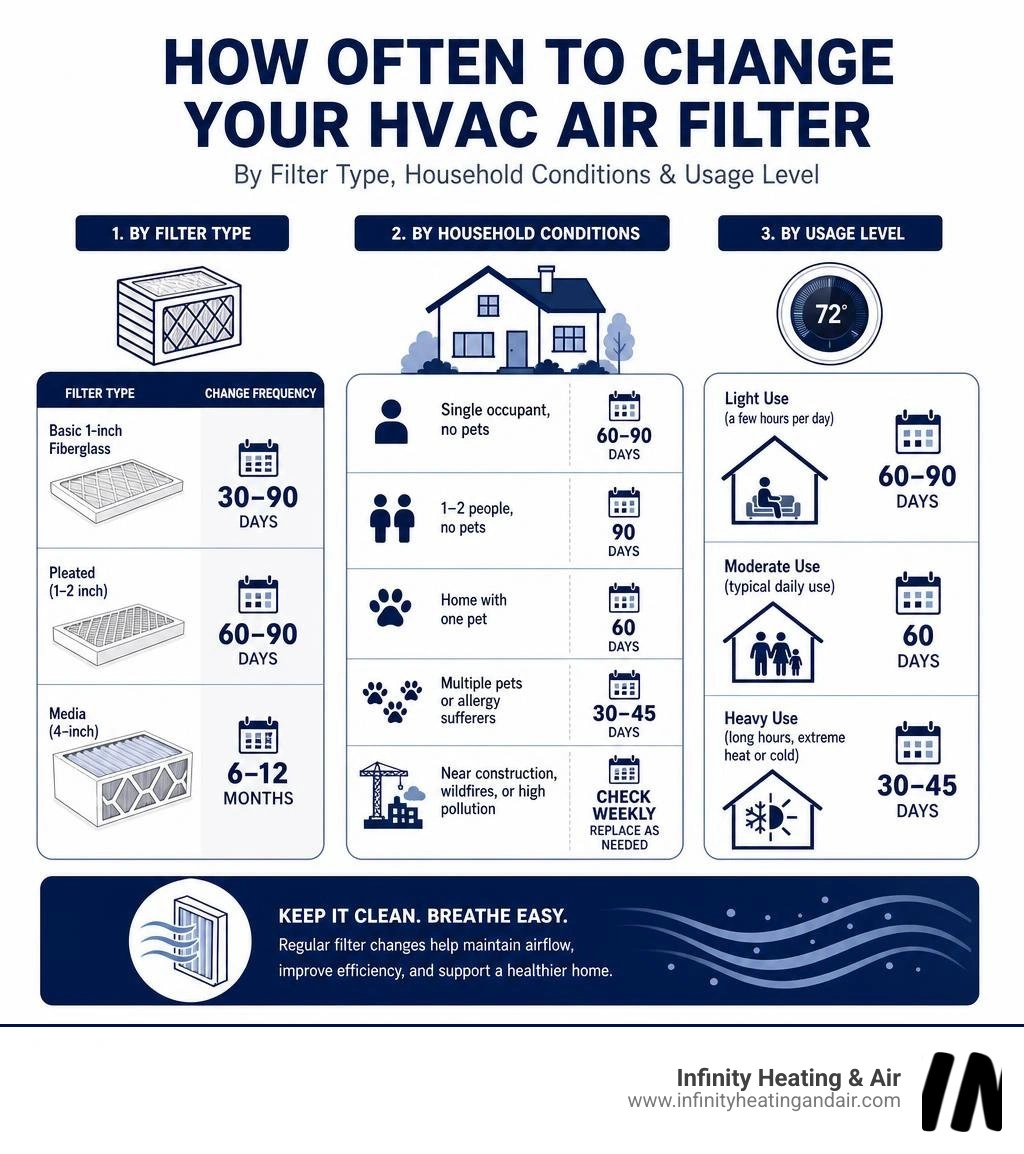
How often should you change your HVAC air filter depends on your filter type, home conditions, and how much you run your system — but here's a quick reference to get you started:
| Household Situation | Recommended Change Frequency |
|---|---|
| Basic 1-inch filter, no pets, single occupant | Every 60-90 days |
| Average home, 1-2 people, no pets | Every 90 days |
| Home with one pet | Every 60 days |
| Home with multiple pets or allergy sufferers | Every 30-45 days |
| 4-inch media filter, average home | Every 6-12 months |
| Near construction, wildfires, or high pollution | Check weekly, replace as needed |
Think of your air filter as your HVAC system's first line of defense. It catches dust, pollen, pet dander, and other airborne particles before they reach your equipment. When it gets clogged, your system works harder — and that means higher energy bills, reduced airflow, and wear that shortens the life of your equipment.
According to the U.S. Department of Energy, replacing a dirty filter can improve your system's efficiency by 5 to 15%. That's a meaningful impact from a simple task most homeowners overlook.
The good news? Once you know what to look for, staying on top of filter changes takes just a few minutes a month.
How Often Should You Change Your HVAC Air Filter?
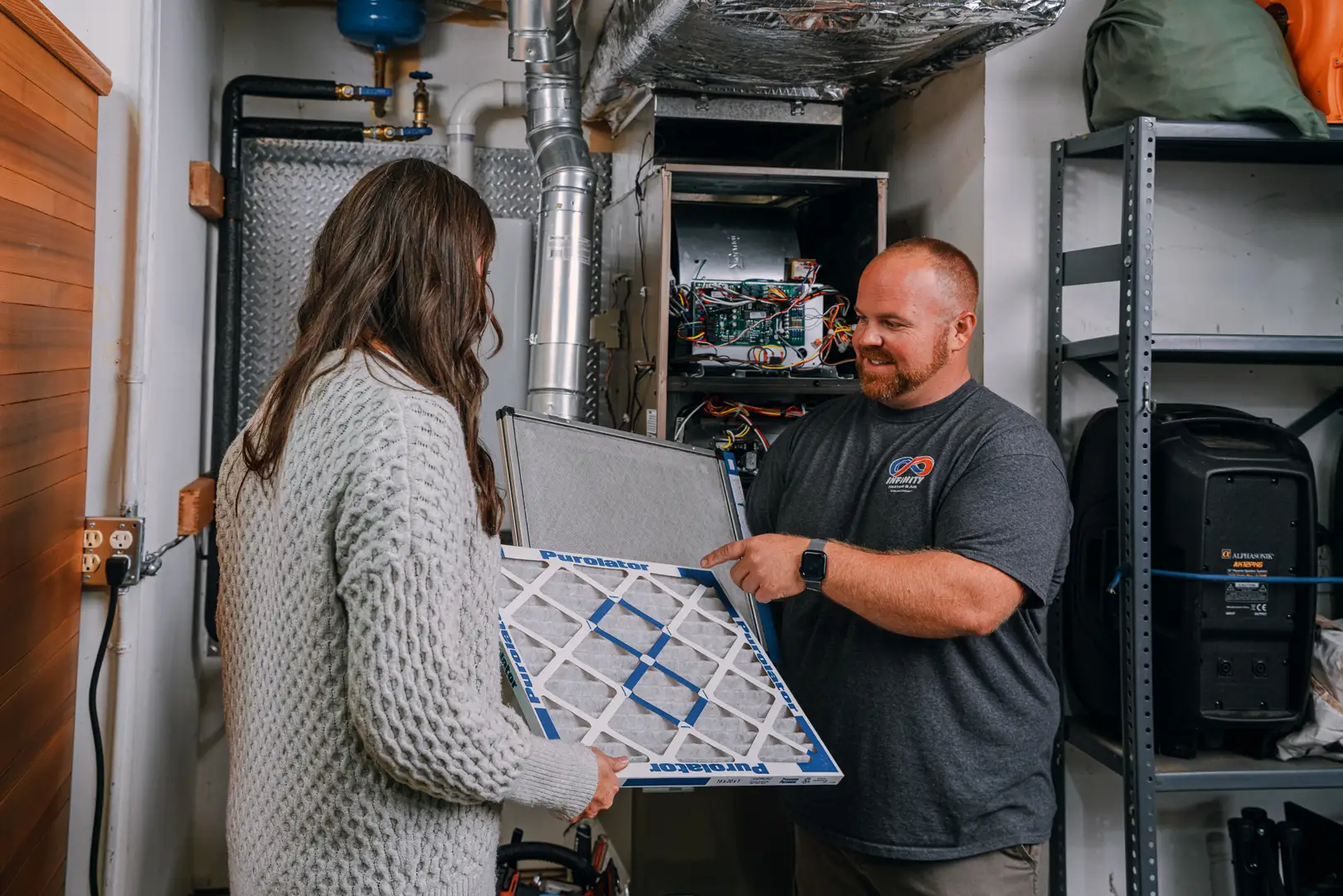
For most homes, the safest general answer is: check your HVAC air filter every month and replace it every 30 to 90 days.
That range is wide because filters are not all built the same. A thin fiberglass filter may be ready for replacement after about 30 days, while a thicker 4-inch media filter may last several months under normal conditions.
Your HVAC system also matters. Some systems are designed for higher-capacity filters, while others need a lower-resistance filter to keep airflow moving properly. That is why we always recommend using your manufacturer’s guidance as the starting point, then adjusting based on your home.
As of June 2026, our practical homeowner rule is simple:
- Inspect monthly.
- Replace when visibly dirty.
- Never go beyond the filter manufacturer’s recommended interval.
- Change sooner during heavy HVAC use, wildfire smoke, remodeling, high pollen, or pet shedding season.
A clean filter helps protect airflow, comfort, indoor air quality, and system efficiency. A clogged filter, on the other hand, is like asking your HVAC system to breathe through a sweater. Cozy for the sweater, not great for the equipment.
The Baseline Rule: How Often Should You Change Your HVAC Air Filter?
Start with this baseline:
| Filter Size or Type | Typical Replacement Schedule |
|---|---|
| 1-inch fiberglass filter | About every 30 days |
| 1-inch pleated filter | Every 30-90 days |
| 2-inch pleated filter | Every 60-90 days |
| 4-inch media filter | Every 6-12 months |
| 5-inch media filter | Every 6-12 months, depending on use |
| Washable or reusable filter | Clean monthly or as directed |
If you have a common 1-inch filter, assume you will need to check it monthly. Some 1-inch pleated filters can last up to 90 days in a clean, low-occupancy home, but many households need to change them sooner.
For thicker 4-inch or 5-inch media filters, the larger surface area helps them hold more dust while maintaining airflow longer. These are often changed every 6 to 12 months, but homes with pets, allergies, or heavy system use may need a shorter schedule.
Season matters too. Spring pollen, summer cooling, fall dust, and winter heating can all increase filter use. If you want a seasonal checklist, our Spring Air Filter Replacement Guide walks through what to watch for as the weather changes.
How Often Should You Change Your HVAC Air Filter with Pets and Allergies?
Pets and allergies shorten filter life because they add more airborne particles to your home. Pet hair, dander, tracked-in dirt, litter dust, pollen, and skin flakes all end up moving through your return air system.
Here is a good rule of thumb:
| Home Condition | Recommended Filter Schedule |
|---|---|
| One pet | Every 60 days |
| Multiple pets | Every 30-45 days |
| Allergy or asthma concerns | Every 30-45 days |
| Multiple pets plus allergies | Every 20-30 days during heavy use |
| Heavy shedding season | Check every 2-3 weeks |
If someone in your home has asthma, allergies, or respiratory sensitivity, filter changes become more than a maintenance task. They become part of your indoor air quality routine.
That does not always mean choosing the highest-rated filter on the shelf. The best filter is one that improves filtration while still allowing your HVAC system to move air properly. For help choosing the right balance, see our guide to the Best Air Filter for Your Home.
Key Factors That Affect Your Filter Replacement Schedule
No two homes load up filters at the same speed. A lightly used home in a clean area may go longer between changes. A busy household in Tacoma, Puyallup, Auburn, Olympia, Lakewood, or Graham with kids, pets, and daily HVAC use may need much more frequent replacement.
The biggest factors are:
- Filter thickness and type
- Number of people in the home
- Pets
- Allergies or asthma
- Home size
- How often the HVAC system runs
- Fan setting, especially continuous fan mode
- Outdoor air quality
- Nearby construction or road dust
- Wildfire smoke
- Indoor activities such as cooking, woodworking, candles, or fireplace use
Skipping filter changes may seem harmless, but it can contribute to restricted airflow, longer run times, reduced comfort, and avoidable wear. We cover the broader maintenance impact in The True Cost of Neglecting HVAC Maintenance.
Home Size and HVAC Usage
Home size affects how much air your system has to move. Larger homes usually circulate more total air, which can load the filter faster. But smaller homes are not automatically off the hook. Some smaller systems use smaller 1-inch filters with less surface area, so those filters may clog quickly too.
HVAC usage is just as important as square footage.
You may need to change your filter more often if:
- Your system runs daily for heating or cooling.
- You use the thermostat fan in the "On" position instead of "Auto."
- Your home has uneven temperatures and long run cycles.
- You work from home and keep the system running most of the day.
- You have a heat pump that operates through much of the year.
Continuous fan mode can improve air circulation and filtration, but it also means air is passing through the filter more often. If you run your fan continuously, inspect the filter more frequently.
Seasonal use also matters in Western Washington. During damp winter heating periods, hot summer stretches, and shoulder seasons with pollen or wildfire smoke, your filter may collect debris faster than expected.
Environmental Factors and Air Quality
Outdoor air has a direct effect on indoor filters. Even with windows closed, particles can enter through doors, clothing, shoes, ventilation, and small gaps in the home.
Check your filter more often during:
- Wildfire smoke events
- High pollen periods
- Nearby construction or remodeling
- Road dust or heavy traffic exposure
- Windy weather
- Poor outdoor air quality days
- After major cleaning, sanding, or indoor projects
Wildfire smoke deserves special attention. Smoke particles are very fine, and they can load a filter quickly. During smoky conditions around areas like Tacoma, Federal Way, Puyallup, Olympia, Lacey, Yelm, or surrounding communities, inspect your filter at least weekly and replace it when it looks dirty or airflow drops.
After a smoke event, do not assume the filter is fine just because it is new. A filter that normally lasts 90 days may need replacement much sooner after several days of heavy smoke.
Comparing Filter Types and Lifespans
Different filters have different lifespans because they vary in thickness, material, surface area, and filtration efficiency.
| Filter Type | Common MERV Range | Typical Lifespan | Best For | Notes |
|---|---|---|---|---|
| Fiberglass disposable | MERV 1-4 | About 30 days | Basic equipment protection | Low filtration, low resistance |
| Basic pleated disposable | MERV 5-8 | 30-90 days | Most average homes | Better dust and pollen capture |
| Higher-efficiency pleated | MERV 9-13 | 30-90 days | Pets, allergies, better air quality | Confirm system compatibility |
| Washable or reusable | Varies | Clean monthly | Reuse-focused households | Must dry fully before reinstalling |
| 4-inch media filter | Often MERV 8-13 | 6-12 months | High-capacity filtration | Longer life due to deep pleats |
| 5-inch media filter | Often MERV 8-13 | 6-12 months | Systems designed for media cabinets | Strong dust-holding capacity |
MERV stands for Minimum Efficiency Reporting Value. In plain English: it tells you how well a filter captures particles of different sizes. Higher MERV ratings capture smaller particles, but they can also create more airflow resistance if your HVAC system is not designed for them.
Fiberglass vs. Pleated Filters
Fiberglass filters are usually thin and simple. They are designed mostly to protect HVAC equipment from larger debris. Because they have limited surface area and lower dust-holding capacity, they typically need replacement about every 30 days.
Pleated filters have folded material that creates more surface area. More surface area means the filter can usually capture more particles and last longer than a basic fiberglass filter. Many 1-inch pleated filters last 30 to 90 days depending on the home.
Here is the quick comparison:
| Feature | Fiberglass Filter | Pleated Filter |
|---|---|---|
| Typical lifespan | About 30 days | 30-90 days |
| Filtration level | Basic | Better |
| Surface area | Low | Higher |
| Best use | Basic equipment protection | Everyday home filtration |
| Pet/allergy performance | Limited | Better option for most homes |
If you are replacing a furnace filter specifically, our Furnace Filter Replacement guide explains what to check before installing a new one.
High-Capacity Media Filters
High-capacity media filters are usually 4 or 5 inches thick. They have deep pleats, which gives them much more surface area than a standard 1-inch filter.
That extra surface area helps in two ways:
- It holds more dust before clogging.
- It can maintain airflow longer when matched correctly to the system.
Many 4-inch filters last around 6 months, and some can last up to 12 months in lighter-use homes. But that does not mean you should ignore them for a year. We still recommend checking them periodically, especially during high-use seasons or poor air quality events.
A media filter may need replacement sooner if:
- You have pets.
- Someone in the home has allergies.
- Your HVAC system runs most days.
- You recently had remodeling or construction nearby.
- Wildfire smoke has affected your area.
- You notice reduced airflow or more dust indoors.
Signs Your Filter Needs Immediate Replacement
Sometimes the calendar says your filter has time left, but your HVAC system says otherwise. Listen to the system.
Replace your filter right away if you notice:
- The filter looks gray, dark, fuzzy, or packed with dust.
- You cannot see light through it.
- There is visible pet hair or debris buildup.
- The filter is bent, crushed, or damaged.
- The filter is damp.
- You see signs of mold or microbial growth.
- There is a musty or smoky odor when the system starts.
- Airflow from vents feels weak.
- Rooms are heating or cooling unevenly.
- The system runs longer than usual.
- Dust builds up quickly after cleaning.
A dirty filter is not just ugly. It can restrict airflow enough to cause real system problems.
How to Perform a Visual Inspection
A visual inspection takes less than five minutes.
Follow these steps:
- Turn off your HVAC system at the thermostat.
- Locate the filter at the return grille or near the furnace or air handler.
- Slide the filter out carefully.
- Check the airflow arrow so you know which direction the new filter should face.
- Hold the filter up to a light source.
- If light barely passes through, replace it.
- Look for gray dust, pet hair, dampness, damage, or mold.
- If replacing it, install the new filter with the airflow arrow pointing toward the blower motor.
- Make sure the filter fits snugly with no gaps.
- Write the replacement date on the filter frame.
The light test is not perfect, but it is one of the easiest homeowner checks. If the filter looks dirty and light cannot pass through it well, it is time for a replacement.
Also, never reinstall a damp filter. Moisture can encourage microbial growth, and that is not something you want moving through your ductwork.
System Performance Warning Signs
Your HVAC system may also warn you that the filter is clogged.
Watch for:
- Longer heating or cooling cycles
- Weak airflow at registers
- Uneven room temperatures
- System short cycling
- Unusual blower noise
- Higher energy use
- Dusty surfaces shortly after cleaning
- Musty odors
- Frozen evaporator coils during cooling season
- Furnace overheating or shutdowns during heating season
Restricted airflow can cause your HVAC system to work harder than it should. In cooling mode, poor airflow may contribute to frozen evaporator coils. In heating mode, it may cause the system to run hotter than intended. Over time, that strain can affect blower motors, coils, and overall comfort.
If you replace the filter and airflow still seems weak, it may be time for professional service.
Frequently Asked Questions About HVAC Filters
What happens if you don't change your air filter regularly?
If you do not change your air filter regularly, airflow becomes restricted. That can create a chain reaction:
- The blower motor works harder.
- Heating and cooling cycles get longer.
- Energy use increases.
- Comfort drops.
- Indoor air quality worsens.
- Dust can build up inside the system.
- Coils may become dirty or freeze.
- Equipment wear increases.
- Breakdowns become more likely.
A filter left unchanged for a long period can become so clogged that it no longer protects your system well. In severe cases, air may bypass the filter through gaps, pulling dust into the equipment.
Regular filter changes are one of the simplest ways to support system health, but they are not a substitute for professional maintenance. For a broader schedule, see How Often Should You Service Your HVAC.
What MERV rating should you choose for your home?
For many homes, a MERV 8 to MERV 11 filter provides a good balance of filtration and airflow.
Here is a simple guide:
| MERV Rating | Captures | Good For |
|---|---|---|
| MERV 1-4 | Larger dust and debris | Basic equipment protection |
| MERV 5-8 | Dust, pollen, lint, dust mites | Average homes |
| MERV 9-11 | Finer dust, some mold spores, pet dander | Pets and improved indoor air quality |
| MERV 12-13 | Smaller particles, some smoke particles, finer allergens | Allergy concerns, smoke events, compatible systems |
| MERV 14+ | Very fine particles | Not appropriate for many standard residential systems unless designed for it |
Higher is not always better. A filter with a high MERV rating may restrict airflow if your system is not built for it. That can reduce comfort and strain equipment.
Before upgrading to a higher-MERV filter, check your equipment documentation or ask our team. We can help determine whether your system can handle the added resistance.
For many homeowners in our service areas, MERV 8 works well for basic filtration, MERV 11 is a strong step up for pets and dust, and MERV 13 may be useful during wildfire smoke or allergy seasons if the system is compatible.
Is it safe to run an HVAC system without a filter?
No, you should not run your HVAC system without a filter except in a true emergency for the shortest possible time.
Running without a filter allows dust, hair, pollen, and debris to move directly into your equipment. That debris can collect on:
- Blower components
- Evaporator coils
- Heat exchangers
- Duct surfaces
- Supply registers
A dirty coil or blower can reduce efficiency, hurt airflow, and lead to repairs. It can also circulate more dust through your living space.
If your filter is extremely dirty and you do not have a replacement, it is still better to get the correct replacement as soon as possible rather than operate without one. Keep spare filters on hand so you are not tempted to run the system unprotected.
Conclusion
Changing your HVAC air filter is simple, but it has a big impact. For most homes, check the filter monthly and replace it every 30 to 90 days. If you have pets, allergies, wildfire smoke, construction dust, or heavy HVAC use, replace it more often. If you have a 4-inch or 5-inch media filter, it may last 6 to 12 months, but it still deserves regular inspection.
The best schedule is not just a date on the calendar. It is a combination of:
- Filter type
- Filter thickness
- MERV rating
- Home size
- Occupancy
- Pets
- Allergies
- Outdoor air quality
- HVAC runtime
- Visual condition
At Infinity Heating & Air, we help homeowners throughout Northwest Washington protect comfort, efficiency, and indoor air quality with reliable HVAC service. Whether you are in Tacoma, Puyallup, Auburn, Federal Way, Gig Harbor, Olympia, Lacey, Graham, Bonney Lake, Lakewood, Yelm, or a nearby community we serve, our team is here to help you keep your system breathing easy.
If you are not sure whether your filter, airflow, or indoor air quality setup is right for your home, a professional maintenance visit can help. Learn what we check during service in What Does an HVAC Maintenance Visit Include, and see why Annual HVAC Maintenance Is It Worth It for long-term comfort.
For local maintenance guidance, you can also read our HVAC Maintenance Graham WA Guide. If you want a simpler way to stay on top of routine care, explore our HVAC Service Plan or our Maintenance Plan.
Clean filter, cleaner air, happier HVAC system. Not bad for a five-minute chore.
Written & reviewed by the Infinity Heating & Air team — licensed WA HVAC contractor (INFINHA841B8). Family-owned in Graham, answering 24/7 across the South Sound.
Choose Infinity & enjoy endless comfort.
Your perfect home environment awaits — call (253) 740-5135 or schedule service online and our team will take it from there.
Open 24/7 · 100% Satisfaction Guaranteed · Graham, WA