A–Z Guide to New HVAC Benefits Beyond Comfort
Discover new HVAC benefits beyond comfort with advanced filtration, energy savings, and healthier indoor air for your Northwest Washington home.
Why the New HVAC Benefits Beyond Comfort Matter More Than You Think
The new HVAC benefits beyond comfort go far beyond keeping your home warm in winter or cool in summer — and most homeowners don't discover just how significant they are until after they upgrade.
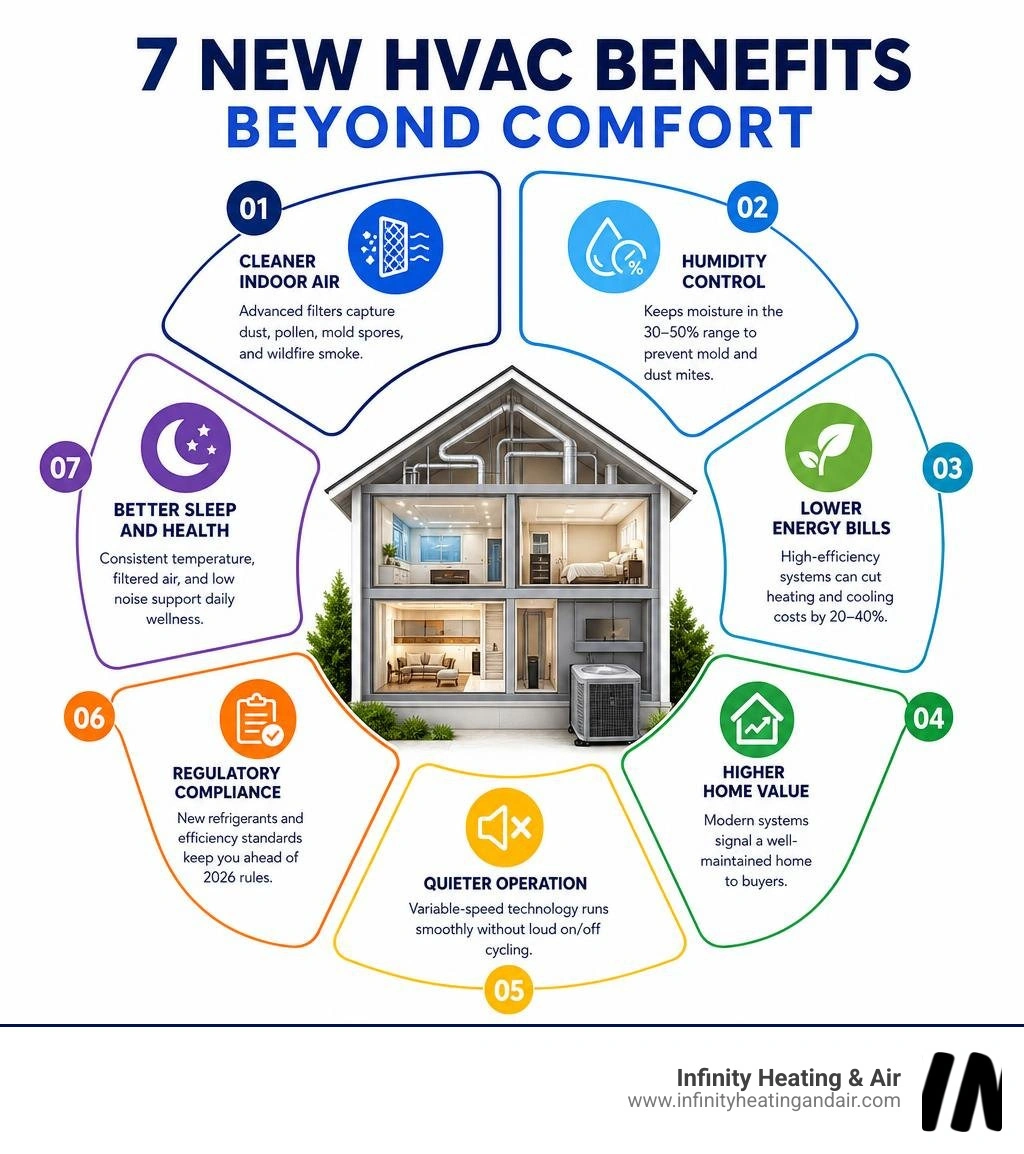
Here's a quick look at what a modern HVAC system actually delivers:
| Benefit | What It Means for You |
|---|---|
| Cleaner Indoor Air | Advanced filters capture dust, pollen, mold spores, and wildfire smoke |
| Humidity Control | Keeps moisture in the 30–50% range to prevent mold and dust mites |
| Lower Energy Bills | High-efficiency systems can cut heating and cooling costs by 20–40% |
| Higher Home Value | Modern systems signal a well-maintained home to buyers |
| Quieter Operation | Variable-speed technology runs smoothly without loud on/off cycling |
| Regulatory Compliance | New refrigerants and efficiency standards keep you ahead of 2026 rules |
| Better Sleep and Health | Consistent temperature, filtered air, and low noise support daily wellness |
Here's something worth knowing: the EPA has found that indoor air can be 2 to 5 times more polluted than outdoor air. In Northwest Washington — where wet winters, wildfire smoke season, and tightly sealed homes trap contaminants inside — that's not a small detail.
Heating and cooling already account for roughly 43% of the average home's energy use. An aging system isn't just uncomfortable. It's quietly draining your wallet, degrading your air, and putting your home's resale value at risk.
This guide walks you through every major benefit, from filtration to future-proofing, so you can make an informed decision about upgrading your system.
Why New HVAC Benefits Beyond Comfort Are Reshaping Home Wellness

When we talk about upgrading your home's heating and cooling system, the conversation usually starts with temperature. You want to escape the damp chill of a Puget Sound winter or the unexpected heatwaves of summer. However, viewing your HVAC system as a glorified thermometer misses its most transformative role: it is the primary health and wellness platform for your home.
Modern systems are designed to improve respiratory health, eliminate sleep-disrupting temperature swings, and dramatically reduce the allergens that keep you sneezing. In places like Puyallup, Tacoma, and Lacey, where seasonal dampness is a constant companion, these wellness advantages are a true game-changer.
To keep these systems functioning as health tools, regular care is essential. Understanding the benefits of regular HVAC maintenance in Pacific Northwest mild wet climates ensures your system continues to protect your family's health year-round.
Advanced Filtration and Whole-Home Contaminant Removal
Older HVAC systems often rely on basic one-inch fiberglass filters. These filters are designed to protect the equipment itself from large dust bunnies, but they do almost nothing to clean the air you breathe. They let roughly two-thirds of indoor air pollution slip right through.
Modern systems are engineered to handle high-efficiency MERV 13 or HEPA-grade filtration cabinets without restricting vital airflow. This advanced filtration acts as a whole-home air purifier, capturing up to 99.97% of airborne particles as small as 0.3 microns.
This is especially critical for capturing:
- Wildfire smoke particles (a growing concern for Northwest Washington residents)
- Pollen, grass, and agricultural allergens
- Pet dander and hair
- Microscopic mold spores
- Airborne pathogens, viruses, and bacteria
- Volatile Organic Compounds (VOCs) from household cleaners and building materials
By continuously circulating air through these advanced filters, a modern system prevents the buildup of these common indoor pollutants, giving your lungs a well-deserved break.
Precision Humidity Control and Mold Mitigation
If you’ve lived in Western Washington for any length of time, you know that moisture is our constant neighbor. High indoor humidity (above 60%) is an open invitation for dust mites to thrive and mold spores to colonize. Conversely, dry winter air can irritate your nasal passages and throat, making you more susceptible to respiratory infections.
A new, high-efficiency HVAC system provides precision humidity control. By utilizing variable-speed compressors, these systems run longer, gentler cycles that steadily pull excess moisture out of the air during the muggy summer months, keeping your indoor relative humidity within the optimal 30% to 50% range.
This tight moisture management is your home's first line of defense against biological growth. To learn more about how system care plays into this, check out our guide on how proper HVAC maintenance prevents mold growth.
Maximizing Energy Efficiency and Long-Term Utility Savings
Let’s talk about your pocketbook. Because heating and cooling make up nearly half of your home's total energy consumption, efficiency isn't just an environmental buzzword—it is a direct driver of your monthly household budget.
If you are replacing a system that is 10 to 15 years old, you are making a massive technological leap. In 2010, standard air conditioners and heat pumps operated at around 13 SEER (Seasonal Energy Efficiency Ratio). Today, in 2026, modern high-efficiency systems can reach ratings of 18 to 25 SEER2 for cooling and up to 10.0 HSPF2 (Heating Seasonal Performance Factor) for heating.
Upgrading to an energy efficient HVAC system can cut your heating and cooling costs by 20% to 40%. When you look at a standard efficiency vs high efficiency HVAC comparison, the long-term utility savings of the higher-tier system easily offset the initial investment over the lifetime of the equipment.
How Smart Thermostats Unlock New HVAC Benefits Beyond Comfort
One of our favorite pieces of advice is that a single thermostat in a drafty hallway shouldn't be the absolute ruler of every room in your home. Modern HVAC systems integrate seamlessly with smart thermostats and advanced zoning controls to eliminate this issue.
Smart thermostats can reduce your heating and cooling bills by an additional 10% to 15% by learning your family’s daily schedule, adapting to local weather patterns, and automatically implementing strategic temperature setbacks when you are asleep or away.
Furthermore, when paired with a zoning system, you can divide your home into distinct climate zones. Instead of wasting energy conditioning empty guest rooms or basement spaces, you can direct comfort precisely where it is needed, which can save between 21% and 42% on your overall energy use.
Eliminating Energy Waste Through Duct Integrity and Sizing
A high-efficiency heating or cooling unit is only as good as the distribution system attached to it. In the average American home, about 20% to 30% of the conditioned air moving through the ductwork is lost due to leaks, holes, and poor connections.
When we install a new system, we perform precise Manual J load calculations to ensure the equipment is perfectly sized for your home's square footage, insulation levels, and layout. An oversized system will short-cycle (turn on and off rapidly), wasting energy and wearing out components, while an undersized system will run constantly without ever reaching your desired temperature.
Addressing ductwork issues during installation ensures you aren't paying to heat your crawlspace or attic. To see how these factors connect, read about how leaky ducts waste energy and money and why pairing your ductwork with a high efficiency furnace is so effective.
How a Modern System Increases Property Value and Resale Appeal
If you are planning to sell your home in the next few years, upgrading your HVAC system is one of the smartest investments you can make. Today's home buyers are highly analytical. They aren't just looking at granite countertops and fresh paint; they are looking at the home's mechanical bones and long-term operating costs.
A new, professionally installed HVAC system provides "inspection confidence." When a potential buyer sees a modern outdoor unit and a clean, high-efficiency indoor system, it immediately removes a major financial question mark from their mind. They know they won't have to face an emergency replacement right after moving in.
In fact, documented mechanical upgrades can significantly boost your home’s marketability and appraisal value. For a deeper dive into this connection, explore our article on how a new HVAC system increases home value.
Signaling a Well-Maintained Home to Prospective Buyers
A new HVAC system acts as a billboard for the overall health of your home. It tells buyers that you cared about the property and didn't cut corners on essential maintenance.
Many modern systems also feature manufacturer warranties that can be transferred to the new owner, providing invaluable peace of mind. On the flip side, neglecting your mechanical systems can lead to costly surprises during the home inspection process. Understanding the true cost of neglecting HVAC maintenance can help you avoid these pitfalls and preserve your home's hard-earned equity.
Future-Proofing Your Home for 2026 Environmental and Regulatory Standards
The HVAC industry is currently undergoing some of its most significant regulatory changes in decades. Under the federal AIM (American Innovation and Manufacturing) Act, older HFC (hydrofluorocarbon) refrigerants like R-410A are being phased down in favor of environmentally friendly, low-GWP (Global Warming Potential) options like R-32.
If you are running a system that is over ten years old, servicing it will become increasingly expensive as older refrigerants become scarce. Upgrading your system in 2026 ensures your home is fully compliant with the latest environmental standards and utilizing modern, readily available refrigerants.
To help make sense of all the technical jargon and ratings, we’ve put together a guide on efficiency ratings explained for homeowners.
Sustainable Living Through New HVAC Benefits Beyond Comfort
For environmentally conscious homeowners in Auburn, Gig Harbor, and Olympia, upgrading to modern electric heat pump technology is a powerful way to reduce your household's carbon footprint. Heat pumps do not create heat through combustion; instead, they move heat from the outdoors inside (and vice versa), making them up to three to four times more efficient than traditional fossil-fuel systems.
To make these eco-friendly upgrades even more appealing, there are excellent financial incentives available. By taking advantage of the Washington energy rebates for HVAC upgrades, you can combine federal tax credits with local utility rebates to significantly lower your upfront investment while securing decades of sustainable, low-cost heating and cooling.
"Concerned about the air quality in my house. Can anyone recommend advanced air purification services in Bellingham?"
This is a question we hear frequently from homeowners across Northwest Washington. While our primary service areas focus on communities like Tacoma, Puyallup, Federal Way, and Lacey, the unique air quality challenges of our region remain identical whether you live in Bellingham or down in Olympia.
With our damp, mild climate and seasonal wildfire smoke, standard filtration often isn't enough to keep your indoor air truly clean. To address these concerns, we recommend looking at advanced whole-home air purification options.
Here is how standard filters compare to advanced, whole-home air purification systems:
| Feature | Standard 1-Inch Filter | Whole-Home MERV 13 Filter | Advanced Whole-Home Air Purifier / ERV |
|---|---|---|---|
| Primary Purpose | Protects HVAC equipment from large dust | Captures microscopic allergens and smoke | Sterilizes pathogens and exchanges stale indoor air |
| Particle Capture | Large dust, lint, pet hair | Pollen, mold spores, fine dust, smoke | Viruses, bacteria, VOCs, ultra-fine smoke particles |
| Fresh Air Exchange | None | None | Actively brings in fresh, pre-conditioned outdoor air |
| Moisture Management | None | None | Transfers moisture to keep indoor humidity in balance |
| Airflow Restriction | Low | Low to Moderate (if properly designed) | Optimized for high performance and low energy use |
Integrating an Energy Recovery Ventilator (ERV) or a dedicated whole-home air purifier into your new HVAC system is the ultimate way to future-proof your home's air quality. An ERV meets strict building ventilation codes by continuously exhausting stale, polluted indoor air and replacing it with fresh, filtered outdoor air—all while recovering up to 83% of the heating or cooling energy from the outgoing air stream so you don't waste money.
Frequently Asked Questions About Modern HVAC Upgrades
We know that upgrading your heating and cooling system is a major decision. Here are clear, straightforward answers to some of the most common questions we receive from local homeowners.
How do modern HVAC systems protect my family's health?
Modern systems protect your health through a multi-layered approach:
- Advanced Filtration: By utilizing MERV 13 or HEPA-grade filters, they capture microscopic irritants like pet dander, pollen, mold spores, and wildfire smoke before you breathe them in.
- Moisture Control: They maintain relative humidity between 30% and 50%, which is the ideal range to prevent the growth of mold, mildew, and dust mites.
- Active Air Purification: Many modern systems can be paired with UV-C germicidal lights or whole-home air scrubbers that actively neutralize airborne viruses and bacteria.
Can a new HVAC system really lower my monthly utility bills?
Absolutely. Replacing an outdated, inefficient system with a modern high-efficiency unit can reduce your monthly heating and cooling energy consumption by 20% to 40%. Because newer systems utilize variable-speed motors and inverter-driven compressors, they can run continuously at lower, highly efficient speeds (like cruise control for your home) rather than constantly cycling on and off at 100% capacity. This eliminates the costly energy spikes associated with older single-stage equipment.
How does a new HVAC system impact my home's resale value?
A new HVAC system is one of the most highly valued mechanical upgrades on the real estate market. It increases your home's resale value by:
- Boosting Buyer Appeal: Buyers prioritize homes with modern, reliable mechanical systems over those with aging equipment that may require immediate, expensive repairs.
- Providing Inspection Confidence: A brand-new system with a transferable warranty gives buyers peace of mind and prevents negotiations or price drops during the home inspection phase.
- Lowering Operating Costs: Showcasing low utility bills is a major selling point in today's cost-conscious housing market.
Conclusion
The new HVAC benefits beyond comfort are clear: upgrading your system is an investment in your family's health, your financial peace of mind, and the long-term value of your home. From capturing wildfire smoke with advanced MERV 13 filtration to cutting your monthly utility bills by up to 40%, a modern heating and cooling system completely redefines how your home functions.
At Infinity Heating & Air, we are proud to be Northwest Washington's trusted HVAC and home air quality experts. We design, install, and service high-performance systems for families throughout Auburn, Puyallup, Tacoma, Lacey, Federal Way, and the surrounding communities. Our mission is simple: crafting endless comfort with reliable, expert service.
If you are ready to experience a healthier, quieter, and more efficient home, we are here to guide you through every step of the process. Schedule your high-efficiency HVAC installation today and let us help you transform your indoor living space.
Written & reviewed by the Infinity Heating & Air team — licensed WA HVAC contractor (INFINHA841B8). Family-owned in Graham, answering 24/7 across the South Sound.
Choose Infinity & enjoy endless comfort.
Your perfect home environment awaits — call (253) 740-5135 or schedule service online and our team will take it from there.
Open 24/7 · 100% Satisfaction Guaranteed · Graham, WA