Step-by-Step Guide to Repair or Replace My HVAC System
Unsure should I repair or replace my HVAC system? Follow this Northwest Washington guide on age, $5K rule, efficiency & when to upgrade.
Should I Repair or Replace My HVAC System? Here's How to Decide
Figuring out should I repair or replace my HVAC system is one of the most stressful decisions a homeowner can face — and it almost always comes up at the worst possible moment, like during a July heat wave or a freezing Northwest Washington winter morning.
The good news? There are clear, proven rules that make this decision much easier.
Quick Answer: Repair or Replace?
| Situation | Recommendation |
|---|---|
| System is under 10 years old, minor repair needed | Repair |
| System is 10–15 years old, moderate repair needed | Evaluate using the $5,000 rule |
| System is 15+ years old, major repair needed | Replace |
| Repair cost exceeds 50% of new system cost | Replace |
| System uses R-22 refrigerant | Replace |
| Cracked heat exchanger or compressor failure | Replace immediately |
| 3+ repairs in the last 3 years | Replace |
Two simple rules guide most of these decisions:
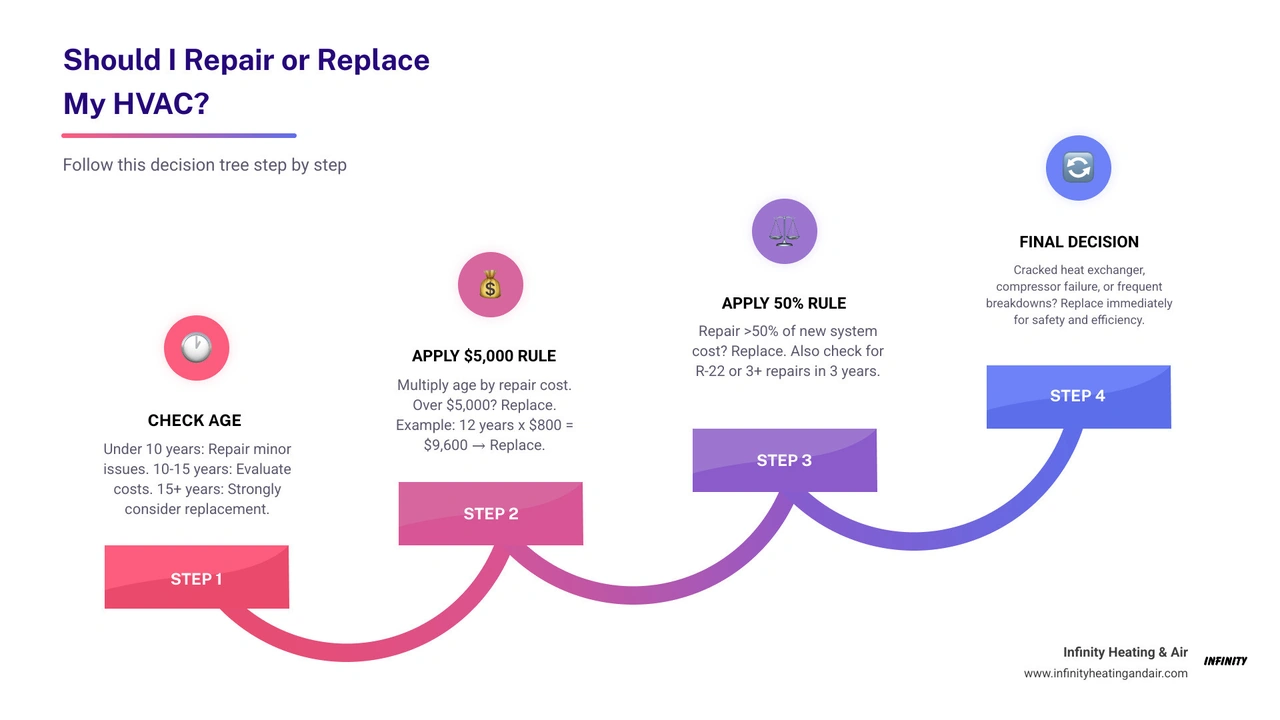
- The $5,000 Rule: Multiply your system's age by the repair cost. If the result is over $5,000, replace it.
- The 50% Rule: If the repair costs more than half of what a new system would cost, replacement is the smarter investment.
For example, a 12-year-old system facing an $800 repair scores 9,600 on the $5,000 rule — a clear sign to replace. A 4-year-old system with the same repair scores just 3,200 — repair it.
But age and cost aren't the only factors. Your repair history, refrigerant type, energy bills, and even Northwest Washington's damp climate all play a role.
This guide walks you through every factor — step by step — so you can make a confident, informed decision.
Understanding the Age and Lifespan of Your Equipment
Age is one of the strongest clues in the repair-versus-replace decision. In May 2026, the general benchmarks are still:
- Air conditioners: about 15 to 20 years
- Furnaces: about 15 to 20 years
- Heat pumps: about 15 years
That said, we usually start looking harder at replacement sooner than the maximum lifespan. A good rule of thumb is:
- Consider replacing an AC or heat pump once it passes 10 years
- Consider replacing a furnace once it passes 15 years
Why the earlier cutoff? Because systems do not age like fine wine. They age more like a favorite pair of work boots: still useful for a while, but less efficient, less comfortable, and more likely to fail at an inconvenient time.
If you want a deeper look at timing, see When to Replace Your HVAC System.
Determining the manufacture date
If you are not sure how old your system is, start here:
- Check the nameplate or sticker on the indoor and outdoor units
- Look for a manufacture date on the cabinet label
- Review installation paperwork or past invoices
- Ask us to identify the age from the model and serial number
Be sure to check both halves of the system. In many homes, the furnace and AC or heat pump were not installed at the same time. That matters, because a newer outdoor unit paired with an older indoor coil can create efficiency and performance problems.
Expected service life in May 2026
A system's "expected lifespan" is not just about whether it still turns on. It is about whether it still delivers reliable comfort, reasonable efficiency, and safe operation.
By 2026, older systems may also be behind on technology:
- Lower efficiency than modern SEER2 or AFUE equipment
- Poor humidity control compared to variable-speed systems
- Louder operation
- Harder-to-find parts
- Outdated refrigerant
Regular maintenance can absolutely help equipment last longer. If you want to keep yours healthy for as long as possible, read How Often Should You Service Your HVAC.
Applying the $5,000 and 50% Rules to Your Decision
Rules of thumb are not perfect, but they are extremely useful when you need a fast, logical answer instead of a stress-fueled guess.
The $5,000 mathematical formula
The $5,000 rule is simple:
- Multiply the age of the system by the repair cost
- If the result is over $5,000, replacement usually makes more sense
- If the result is under $5,000, repair is usually reasonable
Examples:
- 5-year-old system x $600 repair = $3,000 -> repair likely makes sense
- 12-year-old system x $600 repair = $7,200 -> replacement is likely smarter
- 16-year-old system x $400 repair = $6,400 -> replacement deserves serious consideration
This rule works because age changes the value of a repair. Spending money on a young system can buy years of reliable service. Spending similar money on an older system often just buys "one more season," and sometimes not even a full season if the HVAC gods are feeling dramatic.
The 50% rule for major components
The 50% rule is also straightforward:
- If the repair is more than 50% of the cost of a new system, replacement is usually the better investment
This rule is especially useful for large repairs involving major components. It helps prevent sinking serious money into old equipment that still has no new-system warranty, no efficiency upgrade, and no guarantee another part will not fail next month.
Here is a quick comparison:
| Situation | Better Choice |
|---|---|
| Newer unit, isolated small repair | Repair |
| Older unit, major repair, no warranty | Replace |
| Repair exceeds 50% of replacement value | Replace |
| Several repairs already made recently | Replace |
| Minor repair and otherwise reliable system | Repair |
If you are comparing long-term value, How Much Does HVAC Installation Cost? A Breakdown can help you understand what goes into a replacement decision.
Critical Indicators That You Should Replace My HVAC System
Sometimes the math says "maybe," but the system itself says "please let me retire."
Common signs your HVAC system needs attention or replacement include:
- Rising energy bills without a clear reason
- Uneven temperatures from room to room
- Weak airflow
- Frequent cycling on and off
- Strange noises like grinding, rattling, or squealing
- Musty or burning odors
- Excess dust in the home
- Humidity problems
- Repeated service calls
- Trouble reaching thermostat settings
These issues can sometimes be repaired, but if they keep returning, replacement often becomes the smarter path. Our HVAC Troubleshooting Guide can help you spot the difference between a simple problem and a bigger one.
Another major issue is refrigerant. If your cooling system uses R-22, that is a big red flag. R-22 was phased out in 2020, and reclaimed refrigerant has become very expensive and harder to source. Research shows R-22 can cost many times more per pound than newer refrigerants, which makes leak repairs and recharges much less attractive on older systems.
When is it better to repair instead of replace my HVAC system?
Repair is usually the better move when:
- The system is under 10 years old
- The issue is minor, such as a capacitor, contactor, thermostat, ignitor, or flame sensor
- The equipment has been maintained consistently
- The unit is still under manufacturer warranty
- This is the first repair in a long time
- Your comfort and energy bills have otherwise been normal
In other words, if the system is relatively young and the problem is isolated, repair is often the practical choice.
Routine maintenance also matters here. If you are not sure what a tune-up checks for, read What Does an HVAC Maintenance Visit Include.
Terminal repairs that signal retirement
Some repairs are not impossible, but they are strong signals the system is nearing the end.
The biggest replacement indicators include:
- Cracked heat exchanger
- Compressor failure
- Evaporator coil leaks on an older AC
- Major refrigerant leak in an R-22 system
- Repeated blower motor or control board failures on aging equipment
A cracked heat exchanger is the clearest example. That is a safety issue, not just a comfort issue, because it can allow combustion gases, including carbon monoxide, to enter the home. In that case, replacement is the responsible move.
Compressor failure is another major tipping point. Compressors are core components, and replacing one in an older unit often feels like putting a new engine into a very old car. Technically possible? Yes. Always wise? Usually no.
Efficiency Gains and Incentives for 2026 Upgrades
One reason replacement can make sense before total failure is energy performance.
Energy savings with modern SEER2 models
Older systems can use much more energy than newer ones. Research shows:
- Upgrading from SEER 9 to SEER 14 can reduce cooling energy use by more than 35%
- Moving from a 10 SEER system to a 16 SEER2 system can save roughly $400 to $1,200 per year on cooling, depending on usage
- New ENERGY STAR air conditioners and heat pumps can save up to 20% on heating and cooling costs
- ENERGY STAR furnaces are about 15% more efficient than conventional models
For heating, moving from an 80% AFUE furnace to a 96% AFUE model can also produce meaningful savings, especially during Northwest Washington winters.
Of course, savings depend on proper installation. Even the fanciest high-efficiency unit will not perform as promised if the sizing is wrong, airflow is poor, or ductwork leaks. That is one reason we look at the whole system, not just the box in the yard.
For more on how skipped maintenance affects performance, read The True Cost of Neglecting HVAC Maintenance.
Available tax credits and rebates in 2026
In 2026, homeowners may still have access to incentives for qualifying high-efficiency upgrades, including:
- Federal tax credits tied to eligible heat pumps and other qualifying equipment
- Inflation Reduction Act programs where available
- Utility rebates for efficient heating and cooling upgrades
- Incentives for smart thermostats or related efficiency improvements in some areas
Availability and rules can change, so the best move is to verify current programs before you choose equipment. We recommend checking for both federal opportunities and utility-based rebates that apply in your area of Northwest Washington.
Financing can also make replacement easier to manage. Since Infinity Heating & Air offers financing, homeowners do not always have to choose between comfort and cash flow.
How Local Climate and Maintenance History Impact the Choice
Northwest Washington is not the desert, and your HVAC system knows it.
The impact of Pacific Northwest dampness
Our local climate brings long damp seasons, chilly mornings, moisture exposure, and in some areas, added corrosion risk from marine air. Those conditions can influence both lifespan and performance.
Local climate can contribute to:
- Rust and corrosion on outdoor equipment
- Moisture-related wear
- Higher indoor humidity concerns
- Mold and mildew risks if airflow or drainage is poor
- Extra stress on heat pumps during long heating seasons
Duct issues also matter. Leaky ducts can pull dust and unconditioned air from crawl spaces or attics, which hurts comfort and indoor air quality. If your house feels dusty, clammy, or unevenly heated, the problem may be bigger than one failed part.
This is also why maintenance matters so much here. Annual HVAC Maintenance: Is It Worth It? is a helpful resource if you want to understand the payoff.
Tracking your system's service history
A repair log can tell you more than memory alone.
Track:
- Date of each service call
- What failed
- Whether the issue repeated
- Total repairs over the last 2 to 3 years
- Changes in comfort or utility bills
A strong rule from the research: if you have had 3 or more repairs in the last 3 years, replacement becomes much more likely to make sense. Even 2 repairs in 24 months on a 10-plus-year-old system can indicate a repair spiral.
This history helps answer a key question: is this a one-off repair, or is the system entering a pattern of decline?
If you do not have records, we can evaluate current condition, age, refrigerant type, maintenance history, airflow, and safety issues to give you a clearer picture.
Frequently Asked Questions about Should I Repair or Replace My HVAC System
Is it worth fixing a system that uses R-22 refrigerant?
Usually, no. R-22 has been phased out, and reclaimed supplies are limited and expensive. If an older AC or heat pump using R-22 develops a leak or needs a major cooling repair, replacement is usually the smarter long-term decision.
How many repairs are too many?
A good practical benchmark is 3 or more repairs in 3 years. That usually means reliability is declining. If your HVAC company is starting to feel like part of the family, your system may be asking for retirement.
Does a new HVAC system increase home resale value?
A newer HVAC system can improve buyer appeal because it suggests better efficiency, fewer near-term repair worries, and a smoother home inspection process. It may not always deliver dollar-for-dollar return, but it is often a strong selling point.
When should I call a professional for an HVAC evaluation?
Call right away if you notice:
- Burning smells
- Gas odors
- Yellow furnace flame instead of blue
- Loud metal-on-metal noises
- Short-cycling
- Water leaks around the unit
- Weak airflow
- Warm air from AC in cooling mode
- Rooms that never get comfortable
- A sudden spike in utility bills
You should also call if your system is over 10 years old for AC or heat pump service, or over 15 years old for furnace concerns, especially when a major repair has been recommended.
Conclusion
Deciding whether to repair or replace your HVAC system is really about looking at the whole picture: age, repair cost, safety, refrigerant type, efficiency, comfort, and your maintenance history.
In general:
- Repair younger systems with isolated, affordable issues
- Replace older systems with major repairs, frequent breakdowns, or obsolete refrigerant
- Replace immediately for serious safety issues like a cracked heat exchanger
If you are still unsure, that is exactly when a professional evaluation helps most. At Infinity Heating & Air, we help homeowners across Northwest Washington sort through the facts and find the path to reliable, efficient, long-term comfort.
When you are ready for expert guidance, Schedule your Northwest Washington HVAC installation or replacement today.
Written & reviewed by the Infinity Heating & Air team — licensed WA HVAC contractor (INFINHA841B8). Family-owned in Graham, answering 24/7 across the South Sound.
Choose Infinity & enjoy endless comfort.
Your perfect home environment awaits — call (253) 740-5135 or schedule service online and our team will take it from there.
Open 24/7 · 100% Satisfaction Guaranteed · Graham, WA