The Definitive Guide to Custom Comfort Systems vs Standard HVAC
Discover how a custom comfort system differs from a standard install with Manual J design, variable-speed performance, and zoning for year-round comfort.
Why How a Custom Comfort System Differs from a Standard Install Is the Question Every Homeowner Should Ask
Here's the short answer:
| Feature | Custom Comfort System | Standard Install |
|---|---|---|
| Sizing method | Manual J load calculation | Square footage rule-of-thumb |
| Equipment selection | Matched to your specific home | Generic, off-the-shelf |
| Ductwork | Engineered for your floor plan | Reused or minimally modified |
| Zoning | Room-by-room temperature control | Single thermostat for entire home |
| Energy efficiency | Optimized for your climate and home | Meets minimum code requirements |
| Indoor air quality | Advanced filtration, humidity control | Basic filtration |
| Lifespan | 15–20+ years with proper design | 10–15 years (often shorter if oversized) |
Sound familiar? You turn the thermostat down at night because the bedroom is too warm — and suddenly the living room feels like a freezer. Or one room never quite gets comfortable no matter what you do.
That's not bad luck. That's a design problem.
Most homeowners assume an HVAC installation is simple: pull out the old unit, drop in a new one, and call it done. But heating and cooling account for roughly 50% of a home's total energy use. Getting the system wrong — even by a little — means paying for that mistake every single month.
A standard install treats every home the same. A custom comfort system starts with your home's specific layout, insulation, sun exposure, and how you actually live in the space.
In Northwest Washington, where temperatures swing from damp, cold winters to warm, dry summers, that difference matters even more.
This guide walks you through exactly what sets these two approaches apart — and helps you decide which one is right for your home.
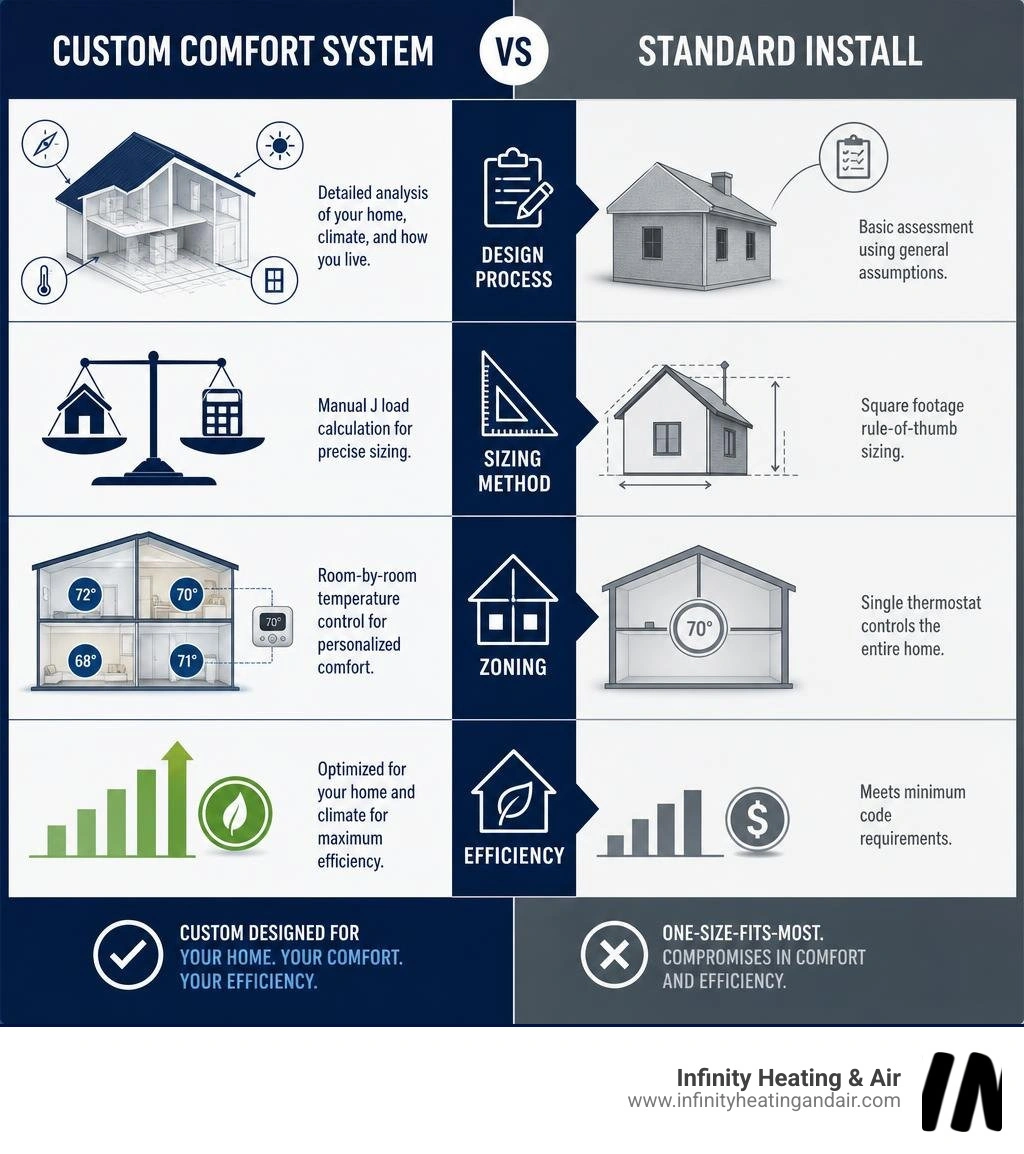
Quick look at how a custom comfort system differs from a standard install:
- how designing your home environment improves comfort
- how proper planning prevents costly hvac mistakes
What is a Custom Comfort System and Why Does It Matter?
A custom comfort system is not just a bigger furnace, a newer air conditioner, or a shiny thermostat with an app. It is a heating, cooling, airflow, and indoor air quality plan designed around your specific home.
That means we look at the whole house before choosing equipment:
- Square footage
- Ceiling height
- Window size and direction
- Insulation levels
- Air leakage
- Duct condition
- Home orientation and sun exposure
- Number of floors
- Room usage
- Family comfort preferences
- Indoor air quality needs
- Local climate conditions across Auburn, Tacoma, Puyallup, Olympia, Gig Harbor, Federal Way, Enumclaw, Yelm, and nearby Northwest Washington communities
A standard installation often starts with the equipment. A custom comfort system starts with the home.
That difference matters because two homes with the same square footage can have completely different heating and cooling needs. A well-insulated rambler in Lake Tapps will not behave the same as a draftier two-story home in Steilacoom or a sunny open-concept home in Bonney Lake. Same thermostat setting, totally different comfort story.
At Infinity Heating & Air, we think comfort should feel designed, not guessed. For a deeper look at that idea, read our guide on how designing your home environment improves comfort.
How a custom comfort system differs from a standard install in design
The biggest design difference is this:
A standard install often relies on rule-of-thumb sizing. A custom comfort system uses calculations, testing, and planning.
Rule-of-thumb sizing might sound like, "one ton of cooling for every certain amount of square footage." It is fast, but it misses the details that make a home comfortable. It does not fully account for things like afternoon sun, older windows, attic insulation, duct leakage, or a bonus room over the garage that has decided to become its own weather system.
A custom design typically includes:
Manual J load calculation
This determines how much heating and cooling your home actually needs. It considers insulation, windows, orientation, air leakage, occupants, and more.Ductwork evaluation
Even excellent equipment will struggle if the ducts are undersized, leaky, kinked, or poorly balanced.Static pressure testing
Static pressure is like blood pressure for your HVAC system. If it is too high, the blower works harder, airflow drops, noise increases, and equipment wears faster.Airflow testing and balancing
Each room needs the right amount of conditioned air. Not "some air if the system feels like it." The right amount.Equipment matching
The furnace, heat pump, air conditioner, air handler, thermostat, filtration, and ducts need to work together as a system.Commissioning after installation
This final step verifies refrigerant charge, airflow, controls, drainage, safety settings, and overall performance.
Skipping these steps can lead to short cycling, uneven temperatures, humidity problems, higher energy use, and unnecessary wear. Planning prevents those problems before they move in and start touching the thermostat.
For more on why design work matters before installation day, see How Proper Planning Prevents Costly HVAC Mistakes.
How a Custom Comfort System Differs from a Standard Install in Performance

Performance is where homeowners feel the difference every day.
A standard system often turns on, runs at full blast, shuts off, and repeats. That can create temperature swings, noise, drafts, and uneven humidity control.
A custom comfort system may use advanced equipment such as:
- Variable-speed heat pumps
- Variable-speed or multi-stage furnaces
- Inverter-driven compressors
- Smart thermostats
- Zoned controls
- Advanced filtration
- Whole-home humidity control
- Properly sized and sealed ductwork
Variable-speed and inverter systems can run longer at lower speeds instead of constantly starting and stopping. Think of it like driving smoothly on the highway instead of flooring it from stoplight to stoplight. The smooth approach is quieter, steadier, and usually easier on the system.
| Performance Factor | Custom Comfort System | Standard Install |
|---|---|---|
| Temperature control | Steady, room-aware comfort | More temperature swings |
| System operation | Often variable-speed or staged | Often single-stage on/off |
| Humidity control | Designed into the system | May be limited |
| Noise | Lower when airflow is engineered well | Can be louder if airflow is restricted |
| Duct performance | Tested, sealed, balanced, or redesigned as needed | Existing duct issues may remain |
| Comfort personalization | Built around how your household uses each space | Built around one general thermostat setting |
| Reliability | Supported by proper sizing and commissioning | More dependent on equipment replacement alone |
A custom system is not only about comfort. It is about helping every part of the system do its job without fighting the house.
Energy efficiency and long-term utility savings
Because heating and cooling account for roughly half of a typical home's energy use, small design mistakes can become long-term energy waste.
A custom comfort system improves efficiency by matching system capacity to the actual heating and cooling load. Oversized equipment can cycle too often. Undersized equipment can run constantly and still fail to keep up. Neither is ideal.
Efficiency improvements can come from:
- Proper equipment sizing
- High-efficiency heat pumps, furnaces, and air conditioners
- Variable-speed operation
- Better duct sealing and insulation
- Lower static pressure
- Smart thermostat scheduling
- Zoning that reduces conditioning in unused areas
- Improved air balancing
- Modern refrigerants such as R-454B in compatible newer systems
Efficiency ratings matter too. Furnaces are rated by AFUE, while air conditioners and heat pumps use ratings such as SEER2 and HSPF2. Modern high-efficiency furnaces can reach very high AFUE ratings, and top-tier cooling systems can achieve much higher seasonal efficiency than older systems. But equipment ratings only tell part of the story.
A high-efficiency system installed on poor ductwork can still underperform. That is like putting a race car engine in a shopping cart. Impressive? Maybe. Practical? Not exactly.
Custom design helps the equipment achieve the performance it was built to deliver. It also supports environmental responsibility by reducing wasted energy and helping homeowners choose systems that fit their home and local climate. Some high-efficiency upgrades may also qualify for rebates or incentives, depending on current programs and eligibility.
To learn more about performance-minded HVAC planning, visit Benefits of Choosing an Environment for Living HVAC Partner.
Note: Use this exact article link instead: Benefits of Choosing an Environment for Living HVAC Partner.
Indoor air quality and humidity control
Comfort is not only temperature. The air itself matters.
A standard install may include a basic filter designed mainly to protect the equipment. A custom comfort system can be designed to protect both the equipment and the people breathing the air.
Indoor air quality options may include:
- Higher-efficiency media filters
- HEPA-level filtration where appropriate
- UV air treatment
- Whole-home air purification
- Humidity control
- Dehumidification support
- Fresh air ventilation
- Duct sealing to reduce dust entry
- Better return air design
Advanced filtration systems can significantly reduce airborne particles, including allergens and other microscopic contaminants. For households with allergies, asthma, pets, wildfire smoke concerns, or frequent dust buildup, this can be a major quality-of-life improvement.
Humidity also matters in Northwest Washington. Damp conditions can make a home feel colder in winter and stuffier during shoulder seasons. Too much humidity can encourage mold and dust mites. Too little humidity can dry out skin, sinuses, wood floors, and furniture.
A custom system can help maintain a healthier indoor humidity range, often around 30% to 50% depending on the home and season. That range tends to feel more comfortable and supports better indoor air quality.
Zoning, Airflow, and Custom Ductwork Engineering
If the HVAC equipment is the heart of your comfort system, the ductwork is the circulation system. If circulation is poor, the whole house feels it.
Custom ductwork engineering focuses on moving the right amount of air to the right rooms at the right speed. That means designing for proper cubic feet per minute, duct size, return air pathways, static pressure, and register placement.
Custom ductwork may include:
- Galvanized sheet metal ducts
- Properly sized trunk lines and branches
- Smooth radius fittings instead of sharp turns
- Sealed joints with mastic
- Insulated ducts in unconditioned spaces
- Balancing dampers
- Additional return air pathways
- Redesigned transitions
- Improved supply register placement
Poor duct design can create common comfort complaints:
- One bedroom is always too hot
- The upstairs is stuffy
- The living room gets blasted with air
- The system sounds like a wind tunnel
- Doors slam when the system starts
- Dust keeps coming back after cleaning
- Energy bills rise even after replacing equipment
A custom comfort system looks beyond the box and asks, "Can the home actually deliver the air this system produces?"
That question is especially important for additions, finished garages, bonus rooms, and homes with limited duct access. In some cases, ductless systems may be a smarter solution than extending central ductwork. For more guidance, see Ductless vs Central HVAC for Home Additions.
How a custom comfort system differs from a standard install in zoning
Zoning is one of the clearest examples of how a custom comfort system differs from a standard install.
A standard system often uses one thermostat to control the entire house. That thermostat might be in a hallway, which is convenient for the wall but not always for the humans. If the hallway feels fine, the system stops, even if the primary bedroom, upstairs office, or nursery is uncomfortable.
A zoned custom comfort system divides the home into separate comfort areas.
Zoning can be created with:
- Multiple thermostats
- Electronic dampers in ductwork
- Variable-speed equipment
- Ductless mini-split zones
- Smart controls
- Separate systems for different areas when appropriate
This allows different parts of the home to receive different comfort treatment. Bedrooms can be cooler at night. A home office can stay comfortable during the day. A guest room can avoid being over-conditioned when nobody is using it.
Multi-zone ductless mini-splits are especially useful for:
- Home additions
- Finished basements
- Converted garages
- Older homes without ideal ductwork
- Rooms with unusual sun exposure
- Detached living spaces where applicable
Central zoning can be a strong fit for larger homes, multi-level homes, and households with different comfort preferences. Because yes, "too hot" and "too cold" can apparently exist in the same room at the same time if two family members are involved.
If you are comparing equipment styles, our guide to HVAC Unit Types and Which One Works for You can help.
Long-Term Value, Lifespan, and Home Resale Appeal
A custom comfort system is an investment in how your home feels, operates, and presents to future buyers.
When a system is properly sized, installed, and maintained, it usually experiences less unnecessary strain. It does not have to short-cycle as often. It does not fight restrictive ductwork as hard. It does not constantly overheat, overcool, or struggle to remove humidity.
That can support a longer service life. Properly designed and maintained HVAC systems can often last 15 to 20 years or more, while poorly matched systems may wear out sooner because of repeated stress.
Long-term value can show up in several ways:
- More consistent comfort
- Reduced energy waste
- Better indoor air quality
- Quieter operation
- Fewer comfort complaints
- Improved system reliability
- Better humidity management
- Stronger appeal when selling the home
Homebuyers increasingly care about efficiency, comfort, and air quality. A well-designed HVAC system can signal that the home has been thoughtfully maintained and modernized. It can also reduce uncertainty for buyers who do not want to inherit uneven heating, aging equipment, or mystery ductwork.
A standard installation can still be appropriate for some homes, especially when the existing system design is already sound and the home has simple comfort needs. But if your home has hot and cold spots, poor airflow, indoor air quality concerns, aging ducts, or unusual layout challenges, custom design can deliver value that a simple equipment swap cannot.
For more on resale impact, read How a New HVAC System Increases Home Value. You can also explore the Advantages of a Custom Designed Comfort System.
Frequently Asked Questions About Custom HVAC Systems
Can a custom comfort system be retrofitted into an older home?
Yes. A custom comfort system can often be retrofitted into an older home, and in many cases, older homes benefit the most from a custom approach.
Many homes in Tacoma, Puyallup, Steilacoom, Olympia, Sumner, Buckley, and surrounding communities were built before modern comfort expectations. Some have limited duct space. Some have additions that were never properly integrated. Some have charming character and one room that behaves like a walk-in freezer.
Retrofit options may include:
- Ductless mini-splits
- High-velocity systems
- Duct redesign
- Added return air
- Zoned controls
- Heat pump upgrades
- Air sealing and insulation recommendations
- Indoor air quality improvements
The goal is to improve comfort while respecting the structure of the home. In homes with limited duct access, ductless systems can provide targeted heating and cooling without major remodeling. In homes with existing ducts, selective duct upgrades can often improve airflow without replacing every component.
What is the difference between a standard load calculation and a Manual J?
A standard load estimate often relies heavily on square footage. It may use a shortcut such as matching the old equipment size or applying a general rule.
A Manual J load calculation is much more detailed. It evaluates the actual heating and cooling needs of the home based on factors such as:
- Square footage
- Ceiling height
- Insulation levels
- Window type and size
- Window direction
- Air leakage
- Duct location
- Home orientation
- Local weather conditions
- Number of occupants
- Internal heat sources
- Room-by-room loads
This matters because "bigger" is not better in HVAC. Oversized equipment can short-cycle, fail to dehumidify properly, create uneven temperatures, and wear out faster. Undersized equipment may run too long and still leave the home uncomfortable.
Manual J helps us choose equipment that fits the home instead of forcing the home to tolerate the equipment.
How does a custom system improve sleep quality and wellness?
Sleep is one of the most overlooked comfort benefits of a custom HVAC system.
Many people sleep better in a cooler, quieter room with stable humidity. A custom comfort system can support that by allowing better bedroom temperature control, quieter operation, and improved air quality.
Wellness benefits may include:
- More stable bedroom temperatures
- Reduced nighttime temperature swings
- Lower operating noise with variable-speed equipment
- Better humidity control
- Improved filtration for dust, pollen, and allergens
- Zoning that cools bedrooms without overcooling the rest of the home
- Smart thermostat schedules for nighttime comfort
A standard single-thermostat system may force the whole house to follow one setting. With zoning or ductless room control, bedrooms can be managed more precisely. That means fewer blanket negotiations at 2 a.m. and fewer thermostat battles before coffee.
Better indoor air quality can also support respiratory comfort, especially for households sensitive to dust, pollen, pet dander, or seasonal smoke.
Conclusion
Understanding how a custom comfort system differs from a standard install comes down to one simple idea:
A standard install replaces equipment. A custom comfort system designs comfort.
That design may include Manual J load calculations, airflow testing, ductwork evaluation, zoning, indoor air quality improvements, variable-speed equipment, smart controls, and careful commissioning. Each step helps your heating and cooling system work with your home instead of against it.
At Infinity Heating & Air, we serve homeowners throughout Northwest Washington with reliable heating, cooling, and home air quality solutions. From Auburn and Federal Way to Tacoma, Puyallup, Gig Harbor, Olympia, Yelm, and the surrounding communities, we help homeowners create comfort that lasts.
We also believe the relationship matters. A great HVAC system is not just installed and forgotten. It should be designed, explained, maintained, and supported by a team that knows your home. That is why our approach is built around reliable service, 24/7 emergency support, financing options, and long-term comfort planning.
To learn more about our service philosophy, read How Relationship-Driven Service Differs from Transactional HVAC.
Ready to make your home feel the way it should? Explore Infinity Heating and Air HVAC and let us help you craft endless comfort with a system designed around your home, your air, and your life.
Written & reviewed by the Infinity Heating & Air team — licensed WA HVAC contractor (INFINHA841B8). Family-owned in Graham, answering 24/7 across the South Sound.
Choose Infinity & enjoy endless comfort.
Your perfect home environment awaits — call (253) 740-5135 or schedule service online and our team will take it from there.
Open 24/7 · 100% Satisfaction Guaranteed · Graham, WA