How Heat Pumps Work: A Simple Guide
Learn how does a heat pump work year-round for efficient heating and cooling in your Pacific Northwest home.
How Does a Heat Pump Work — And Why Homeowners Are Switching
How does a heat pump work? Here's the short answer:
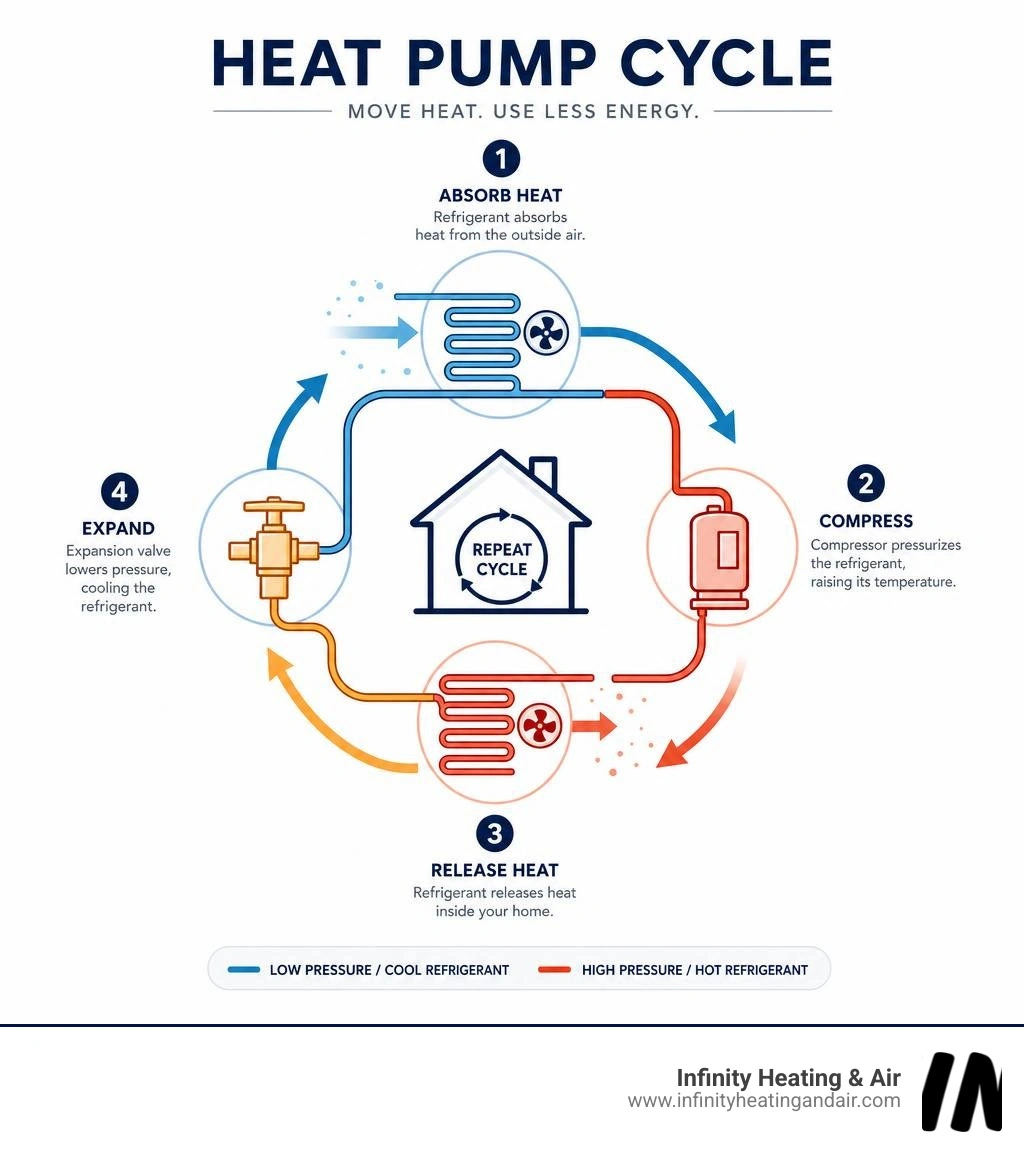
A heat pump moves heat from one place to another using electricity and refrigerant — it doesn't burn fuel to create heat. In summer, it pulls heat out of your home and sends it outside. In winter, it pulls heat from outdoor air and moves it inside.
Quick breakdown:
- Refrigerant absorbs heat from one location
- Compressor pressurizes the refrigerant, raising its temperature
- Condenser coil releases that heat where you want it
- Expansion valve drops the pressure, cooling the refrigerant down to start again
- Reversing valve flips the cycle between heating and cooling mode
That's it. No combustion. No burning gas or oil. Just heat being moved efficiently from one place to another.
For homeowners in Northwest Washington — where winters can be cold and damp, and summers can surprise you with real heat — this matters. A heat pump handles both seasons with a single system, and it does it using far less energy than traditional furnaces or air conditioners.
Modern heat pumps can deliver up to three to four times more heat energy than the electricity they consume. That's not a typo. It's the physics of moving heat rather than generating it.
The sections below walk you through exactly how the process works, what's inside the system, and which type of heat pump makes the most sense for your home.
What Is a Heat Pump and How Does a Heat Pump Work?
To understand how a heat pump works, it helps to forget about "creating" cold or warm air. Instead, think of a heat pump as a heat transporter.
Even on a chilly winter day in Tacoma or Olympia, the outdoor air contains a surprising amount of ambient heat energy. In fact, air at freezing temperatures still holds about 85% of the heat energy it would have at room temperature. A heat pump's job is to capture this existing heat and relocate it.
This relocation is made possible by the vapor-compression cycle, which relies on a specialized fluid called refrigerant. Refrigerant has an incredibly low boiling point, meaning it can change from a liquid to a gas even at very low temperatures. By circulating this refrigerant through a closed loop of copper lines, the system can absorb heat from a cool space (the source) and release it into a warmer space (the sink).
Traditional heating systems, like gas boilers or electric baseboard heaters, create heat through combustion or electrical resistance. This process is limited by a simple rule of physics: you can never get more energy out than you put in. Even a high-efficiency gas furnace tops out at around 95% to 98% efficiency.
A heat pump, however, breaks through this barrier. Because it only uses electricity to move heat rather than create it, a typical household heat pump operates with a Coefficient of Performance (COP) of around three to four. This means that for every 1 unit of electricity the system consumes, it delivers 3 to 4 units of heat energy into your home. This incredible efficiency is one of the main Heat Pump Benefits for Pacific Northwest Homeowners, helping local families keep utility bills manageable year-round.
The Core Components of a Heat Pump System
A heat pump relies on a highly synchronized team of components to move heat back and forth. Here are the five key players that make the magic happen:
- The Compressor: Often called the heart of the system, the compressor is located in the outdoor unit. It squeezes the refrigerant gas, raising both its pressure and its temperature.
- The Evaporator Coil: This is where the refrigerant absorbs heat. When low-pressure liquid refrigerant enters this coil, it evaporates into a gas, drinking in heat from the surrounding air.
- The Condenser Coil: This is where the heat is released. As high-pressure, high-temperature gas passes through this coil, it condenses back into a liquid, shedding its heat in the process.
- The Expansion Valve: This acts as a gateway. It regulates the flow of refrigerant, dropping its pressure and temperature rapidly so it can return to the evaporator coil to absorb more heat.
- The Reversing Valve: This is the brain of the operation. It physically reverses the flow of the refrigerant, allowing the heat pump to switch from heating your home in January to cooling it in July.

How Does a Heat Pump Work in the Summer (Cooling Mode)?
In the summer, a heat pump operates exactly like a standard air conditioner. It takes the unwanted heat from inside your home and dumps it outside. Here is how that cycle flows:
- Absorption: Warm air from your living room is pulled across the indoor coil (which acts as the evaporator in cooling mode). The cold liquid refrigerant inside the coil absorbs the heat from your indoor air, cooling the air down before it is blown back into your home.
- Compression: Having absorbed the indoor heat, the refrigerant evaporates into a low-temperature gas and travels to the outdoor compressor. The compressor squeezes the gas, raising its temperature and pressure.
- Rejection: The hot, pressurized gas flows into the outdoor coil (acting as the condenser). A fan blows outdoor air across this coil, carrying the heat away into the outdoor atmosphere.
- Expansion: As the refrigerant loses heat, it condenses back into a liquid. It then passes through the expansion valve, which drops its pressure and temperature, turning it back into a cold liquid ready to repeat the cycle.
Whether you are comparing Central Air vs Mini Split for the South Puget Sound Area Homes, the fundamental cooling physics remain the same. The heat pump simply acts as a one-way heat exporter during our increasingly warm Puget Sound summers.
How Does a Heat Pump Work in the Winter (Heating Mode)?
When winter arrives in Puyallup or Federal Way, the reversing valve slides into its heating position, reversing the entire process.
- Extraction: The outdoor coil now becomes the evaporator. The cold refrigerant inside the outdoor coil absorbs heat from the cold outdoor air. Even when it feels freezing outside, the refrigerant is cold enough to draw heat out of the atmosphere.
- Compression: The refrigerant gas travels to the compressor, where it is pressurized into a hot gas.
- Release: This hot gas is pumped indoors to the indoor coil (now acting as the condenser). Your home's blower fan pushes indoor air across this hot coil, warming the air and distributing it through your living spaces.
- Return: As the heat is released indoors, the refrigerant condenses back into a liquid and travels back outside through the expansion valve to start the process over.
Modern cold climate heat pumps are incredibly advanced. While older models struggled when temperatures dipped, today's inverter-driven systems can extract heat efficiently even in freezing temperatures down to -22°F. This makes them a highly reliable primary heat source, which is why many homeowners choose to go ductless. If you are exploring your options, you can read more about Why You Should Install a Ductless Heating System to see how these systems handle our damp winter months.
Types of Heat Pumps for Your Home
Not all homes in Northwest Washington are built the same way. A historic home in Steilacoom has different heating and cooling needs than a brand-new build in Tehaleh. Fortunately, there are several types of heat pumps designed to fit different home styles and layouts.
The two primary categories are air-source and ground-source (geothermal) heat pumps.
| Feature | Air-Source Heat Pumps | Ground-Source (Geothermal) Heat Pumps |
|---|---|---|
| Heat Source | Outdoor ambient air | Underground soil or groundwater |
| Average COP | 3.0 to 4.0 | 4.0 to 5.0+ |
| Installation Footprint | Small (outdoor unit + indoor unit) | Large (requires underground pipe loops) |
| Lifespan | ~15 years | 20–25 years (inside), 50+ years (ground loops) |
| Best Suited For | Most residential homes | Large properties with yard space |
While geothermal systems offer incredible efficiency because ground temperatures remain a constant 50°F to 55°F year-round, air-source heat pumps are by far the most common and practical choice for most homeowners in our local communities.
Ductless Mini-Split Systems
If your home doesn't have existing ductwork, you don't have to undergo a messy, expensive renovation to enjoy modern heating and cooling. Ductless mini-split systems are a highly popular, flexible solution.
A ductless system connects a single outdoor compressor to one or more indoor air handlers mounted on your walls or ceilings. Because there are no ducts to lose heat, these systems are incredibly efficient and allow you to create custom temperature zones throughout your home. You can learn more about how they operate by reading about How Ductless Mini Split Systems Work.
These systems are perfect for older homes, additions, or simply targeting rooms that are always too hot or too cold. To see if this setup matches your home, check out the Ductless Mini Split Benefits for Your Home guide. If you are currently using window units or portable heaters, you can also explore Adding Cooling Without Ductwork Options Compared to find the best fit for your space.
Ducted Central Heat Pumps
For homes that already have a central duct system from an old furnace, a ducted central heat pump is a seamless upgrade.
Instead of a gas or electric furnace, a central heat pump utilizes a central air handler connected to your existing ductwork. This allows you to heat and cool your entire home evenly through your existing floor or ceiling registers. When planning a home renovation or adding square footage, it is always wise to weigh your options. You can read our breakdown on Ductless vs Central HVAC for Home Additions to determine which delivery method will keep your home most comfortable.
Frequently Asked Questions About Heat Pumps
Do heat pumps use a lot of electricity?
Because heat pumps run on electricity, homeowners often worry their electric bills will skyrocket. However, heat pumps are actually designed to reduce your overall energy consumption.
Because they transfer heat rather than generating it, they are up to 3 to 5 times more energy efficient than gas boilers or electric resistance baseboards. By upgrading to a high-efficiency heat pump, you can drastically reduce the amount of electricity required to heat your home compared to traditional electric heating systems.
How long do heat pumps last and what maintenance do they need?
With proper care, a high-quality heat pump typically lasts about 15 years.
Because heat pumps work hard all year long—providing heat in the winter and cooling in the summer—regular maintenance is critical. We recommend scheduling a professional tune-up twice a year: once in the spring before the cooling season, and once in the autumn before the cold weather sets in. Between professional visits, homeowners should clean or replace their indoor air filters every 1 to 3 months to keep airflow strong and efficient.
Do heat pumps work in freezing temperatures?
Yes! While older heat pumps from decades ago struggled when temperatures dropped below freezing, modern technology has completely solved this issue.
Today's cold climate heat pumps utilize variable-speed inverter compressors that can ramp up to extract heat even when outdoor temperatures drop as low as -22°F. For added peace of mind during rare, extreme cold snaps, many ducted systems are installed with auxiliary electric heat strips. These heat strips act as an emergency backup, turning on automatically only when the outdoor temperatures drop to extreme lows, ensuring your home stays perfectly warm no matter what the Washington winter throws at us.
Conclusion
Understanding how does a heat pump work is the first step toward creating a more comfortable, energy-efficient home. By moving heat rather than burning fuel, these smart systems provide reliable, year-round comfort while keeping your carbon footprint and energy bills low.
At Infinity Heating & Air, we are proud to be the trusted HVAC experts for families across Northwest Washington. Whether you live in Auburn, Puyallup, Gig Harbor, or Olympia, our team is here to help you design, install, and maintain the perfect comfort system for your home. We stand by our promise of crafting endless comfort with reliable, expert service.
Ready to upgrade your home comfort? Contact us today to explore our Infinity Heating and Air Heat Pump Services and find the perfect system for your household.
Written & reviewed by the Infinity Heating & Air team — licensed WA HVAC contractor (INFINHA841B8). Family-owned in Graham, answering 24/7 across the South Sound.
Choose Infinity & enjoy endless comfort.
Your perfect home environment awaits — call (253) 740-5135 or schedule service online and our team will take it from there.
Open 24/7 · 100% Satisfaction Guaranteed · Graham, WA